
 Main Number
 Find us on
 Reach us @
A batching plant decision can shape the delivery, consistency and continuity of a major infrastructure project. With schedules under pressure and supplier claims difficult to compare, selecting a Concrete Batch Plant Supplier requires more than reviewing capacity or equipment specifications. You need to assess how the supplier will support the plant from engineering through commissioning and ongoing operation.
For Australian projects, confidence also depends on understanding how plant design aligns with Australian Standards, how key parts can be accessed locally, and how responsibilities are managed across the delivery process. This article provides a practical framework for evaluating supplier capability, including engineering, manufacturing, testing, transport, erection, commissioning and after-sales support.
GPE Group brings quality German engineering and project-specific plant design to this assessment, backed by hundreds of installations around the world. GPE Group batching plants have been used to manufacture concrete for the Burj Khalifa project, and its after-sales service and spare-parts support extend around the world. The guidance below shows how to assess these capabilities against your project’s requirements and make a considered decision about plant fit, delivery coordination and operational support.
Key Takeaways
- Assess a Concrete Batch Plant Supplier by its ability to coordinate the complete project scope, not by equipment specifications alone.
- Translate output needs, available raw materials, budget and Australian requirements into clear design criteria before comparing plant proposals.
- Compare engineering, installation, commissioning, after-sales support and spare-parts provision using the same criteria for every proposal.
- Map responsibilities across each delivery stage to identify scope gaps and clarify coordination needs.
- Consider how project-specific engineering and ongoing support affect a plant’s fit throughout its operational life.
What a Concrete Batch Plant Supplier Delivers Beyond Equipment
A concrete batching plant is a production asset within a wider project system, not simply a machine selected from a catalogue. Its design and delivery need to reflect how the project will use it, the materials available, required output, site conditions and applicable standards. When evaluating a Concrete Batch Plant Supplier, consider both the equipment and the work needed to bring it into operation.
Definition: A concrete batch plant supplier provides batching equipment and may also coordinate project delivery, from plant design and manufacture through testing, transport, erection and commissioning. Integrated responsibility connects these stages; equipment-only supply does not necessarily include them.
A concrete plant combines equipment and processes to produce concrete, with plant types and applications varying by project. The distinction matters commercially: GPE supplies concrete batching plants, not ready-mix concrete. The plant is the production asset; concrete supply is a separate activity.
Supplier, Manufacturer, and Turnkey Partner: Distinct Responsibilities
An equipment supplier may provide specified components or a plant assembled to an existing design. A manufacturer engineers and produces the plant, while a project-delivery partner can coordinate defined stages around the equipment. These roles can overlap, but they are not interchangeable. Project-specific design starts with the installation requirements instead of treating catalogue selection as the complete engineering task.
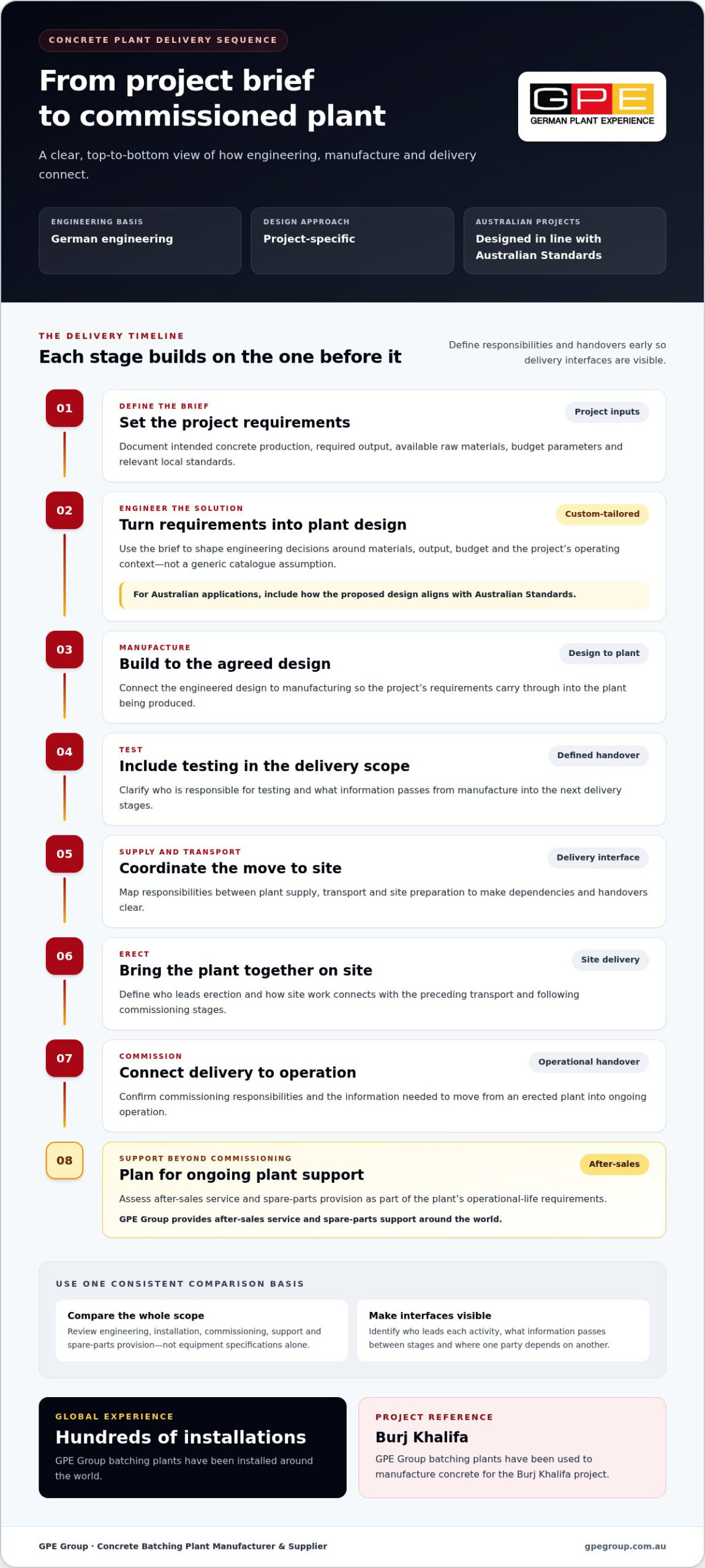
GPE combines German-engineered plant design with turnkey delivery covering design, manufacturing, testing, supply, transport, erection and commissioning. For the project team, defining each activity makes responsibilities, handovers and interfaces easier to map before delivery begins. It also helps prevent gaps between plant manufacture, transport, site erection and commissioning from becoming unmanaged project issues.
Allocate responsibility by identifying who leads each activity, what information needs to pass between stages, and where one party’s work depends on another. A scope matrix makes these interfaces visible and gives the team a consistent basis for comparing proposals. It also distinguishes equipment supply from an integrated delivery commitment, without assuming that every proposal covers the same activities.
Which Projects Need a Batching Plant Supplier?
Concrete producers, construction firms, road builders, dam builders and mining operations may require batching capability when project demands call for controlled concrete production at a dedicated facility. Their operating contexts differ, so assess the plant against the work to be delivered rather than selecting it solely by industry label. A road project and a mining operation, for example, can have different site conditions, material logistics and production requirements.
Start by documenting the intended output, the raw materials available to the project, budget parameters and relevant local standards. These inputs guide project-specific design and help the team identify which delivery stages need coordination. They also provide a sound basis for discussing configuration without relying on generic assumptions or unsupported capacity claims.
For Australian projects, include how the proposed design aligns with Australian Standards in the assessment. GPE designs its batching plants in line with Australian Standards and tailors plant solutions to project requirements, connecting engineering decisions with the intended application and delivery scope.
How Supplier Engineering Connects Plant Design to Project Delivery
Plant engineering is most effective when it starts with the project’s operating requirements and stays connected to delivery through commissioning. A clear sequence is to define requirements, engineer the plant, manufacture and test it, then coordinate supply, transport, erection and commissioning. Each stage should build on agreed information from the one before it, so design decisions carry through to the installed plant.
For a major project, this sequence makes supplier capability easier to assess. It shows whether the proposed role extends from technical design into physical delivery, and whether handovers are defined rather than left between separate scopes. German engineering informs GPE’s project-specific design approach, while the delivery stages provide a practical structure for coordinating the work.
From Project Requirements to Custom-Tailored Design
Design starts with a project brief, not a generic assumption about what every plant should include. Establish the intended concrete production context and document required output, available raw materials, budget parameters and relevant local standards. These inputs shape engineering decisions and help distinguish essential project requirements from preferences that may not affect the plant’s role.
Raw-material availability matters because the design needs to respond to the materials the project expects to use. Output requirements and budget also inform how the proposed plant is tailored, while local standards help establish the design basis for an Australian application. GPE develops custom-tailored plant designs around project requirements, bringing these considerations into the engineering process.
Manufacturing, Testing, Erection, and Commissioning
Once the design is established, delivery moves through manufacturing and testing, followed by supply and transport, erection, and commissioning. The stages connect: manufacturing follows the engineered design, transport moves the supplied plant to the project, erection establishes it at the site, and commissioning completes the delivery scope. GPE’s turnkey project lifecycle covers these activities.
Defined handovers help teams coordinate the information, materials and responsibilities required at each transition. Transport and erection planning, for example, need to connect the supplied plant with the site work, while commissioning follows erection rather than being treated as an unrelated final task. A responsibility schedule can record who leads each activity and what needs to be in place before the next begins.
As a Concrete Batch Plant Supplier, GPE integrates German-engineered design with manufacturing, testing, supply, transport, erection and commissioning. Project teams developing a delivery scope can use GPE’s project-specific plant engineering as a reference for how these stages connect.
Assessing Supplier Claims: Experience, Standards, and Support
A supplier’s product range is only one part of the assessment. Project teams also need to understand the basis for claims about engineering capability, installation, commissioning and ongoing support. Separate what a proposal explicitly includes from what it implies, then record the documents or project information that support each point. This creates a more reliable basis for comparison than broad descriptions alone.
For each claim, note its relevance to the project, the evidence provided and any unresolved interface. A general capability statement, for example, does not define who coordinates site erection or which commissioning responsibilities sit within the proposed scope. Making this distinction helps prevent assumptions from being mistaken for agreed commitments.
Evidence of Project Experience and Engineering
Assess experience by its relevance to the work ahead. Consider whether the evidence relates to comparable plant applications, delivery stages or project environments, and whether it clarifies the supplier’s role. German engineering can be considered as part of the design approach, but assess it through the engineering scope and project-specific design process rather than treating it as a standalone performance guarantee.
When reviewing examples, distinguish plant use from supplier responsibility. A project reference may show that equipment was used in a particular context, but it does not by itself establish which delivery activities the supplier performed or what results another project should expect. Keep the project context separate from the specific claim being assessed.
Australian Standards, Parts, and After-Sales Support
Standards positioning is most useful when connected to the project’s design basis and documented responsibilities. Record how the proposal addresses the standards relevant to the project, what design information supports that position, and where other project parties hold related responsibilities. This makes standards alignment a practical part of the design review rather than a broad statement detached from the project scope.
Evaluate parts and support with the same discipline. Consider how spare-parts provision and after-sales support relate to the plant, and how that information can inform operational planning. GPE provides after-sales service and spare-parts support around the world, and states that most parts are from internationally known brands and are easily available in Australia.
Use this table to compare each Concrete Batch Plant Supplier against the same evidence categories. Record substantiated information rather than assigning unsupported scores.
| Assessment area | Evidence to record | Project relevance |
|---|---|---|
| Engineering scope | Design responsibilities and project-specific engineering information. | Shows how the proposed design relates to the project brief. |
| Installation | Stated installation role and defined interfaces. | Clarifies coordination responsibilities at the site. |
| Commissioning | Included activities, completion criteria and responsible parties. | Identifies how the handover into operation is addressed. |
| Support | Documented after-sales arrangements and their stated scope. | Informs planning beyond initial delivery. |
| Spare parts | Information about parts provision and sourcing approach. | Helps frame operational support requirements. |
A Practical Framework for Comparing Concrete Batch Plant Suppliers
A repeatable comparison process helps project teams assess proposals against consistent requirements instead of relying on broad claims or supplier rankings. Begin with a project brief, then record each proposal’s stated scope, supporting evidence and assumptions. This makes differences easier to identify and keeps the comparison focused on the plant’s fit with project needs.
Questions to Resolve Before Supplier Evaluation
Define the production context first. Identify the concrete applications the plant is intended to serve, the output required and the constraints that could influence design or delivery. Document raw-material considerations, budget parameters and the local standards relevant to the project. These inputs establish a common basis for evaluating proposed designs without assuming that one configuration suits every application.
Next, determine which delivery stages need to be integrated. Clarify whether the project requires the supplier’s scope to cover design, manufacturing, testing, supply, transport, erection and commissioning, or selected stages. This helps the team compare proposals on equivalent terms and identify responsibilities that remain with the project or other parties.
For a deeper discussion of engineering considerations, refer to Precise German Concrete Batching Plants. Use that perspective alongside your project brief, while grounding the evaluation in the requirements and responsibilities specific to the proposed installation.
A Supplier Comparison Matrix for Project Teams
Apply the same headings to every Concrete Batch Plant Supplier proposal. Record the stated scope and evidence without assigning invented scores or benchmarks. The objective is to make distinctions clear, not to reduce complex project considerations to an unsupported ranking.
- Engineering fit: Record how the proposed design addresses intended applications, required output, raw materials and project constraints.
- Project scope: Note which delivery stages are included and how they connect with work by other parties.
- Standards positioning: Document how the proposal addresses the standards applicable to the project and what information supports that position.
- Installation and commissioning: Identify the stated responsibilities for erection, commissioning and the handovers between them.
- Manufacturing and testing: Record whether these activities are included and how they relate to the proposed plant design.
- Ongoing support: Capture the information provided about after-sales service and spare-parts provision.
Label each entry as documented, not stated or assumed. A missing detail signals that the proposal does not establish that responsibility; it is not evidence that a supplier cannot perform the work. This distinction helps the project team maintain an accurate comparison and avoid treating an assumption as an agreed scope item.
To align your project brief with a tailored plant solution, discuss your concrete batching plant requirements with GPE.
GPE as a Concrete Batch Plant Supplier for Australian Projects
For Australian infrastructure teams, GPE’s role as a concrete batching plant manufacturer and supplier connects plant design with project procurement. A project-specific approach lets the equipment scope be considered against the production brief, site context and delivery interfaces established by the project team. This gives decision-makers a basis for assessing how a proposed plant solution fits within the wider construction programme.
Rather than treating procurement as equipment selection in isolation, use the project brief to frame discussions about design priorities, scope boundaries and coordination needs. This supports clearer planning as engineering decisions become a plant proposal for the intended application.
German Engineering and Worldwide Project Experience
GPE’s engineering approach is grounded in Germany and applied to custom-tailored concrete batching plant solutions. Assess how the proposed design responds to the defined application and integrates with the wider delivery plan. This keeps the evaluation focused on engineering fit and project requirements, rather than broad claims that do not explain how a solution relates to the work.
GPE operates across Germany, Italy, Dubai and Australia, and installs all over the world. Its international operations support projects across different contexts, while the Australian project brief remains the basis for plant planning and supplier coordination.
Project Delivery and Ongoing Support
GPE’s turnkey offer brings design, manufacturing, testing, supply, transport, erection and commissioning into a defined project lifecycle. For procurement teams, considering these stages together helps set scope, sequence interfaces and establish where supplier responsibilities meet the wider project plan.
GPE also provides after-sales service and spare-parts support around the world. Include these services in supplier evaluation to consider the plant solution not only in terms of initial delivery, but also the support relevant to continued operation.
Set the Project Up for a Confident Decision
Turn your project priorities into a clear decision brief. Bring engineering, procurement and site teams together to agree what the plant must support, which delivery responsibilities matter most and what evidence will inform selection. A shared brief keeps discussions focused on project fit and helps prevent proposals from being judged against different assumptions.
Use that brief to frame a conversation with a Concrete Batch Plant Supplier around your intended application and the outcomes your team needs to plan for. GPE’s experience includes plant use on the Burj Khalifa project, and its after-sales service and spare-parts support extend around the world. These details provide useful context, while your project requirements remain the basis for assessing fit.
Discuss your concrete batching plant project with GPE and take the next step towards a plant solution aligned with your project’s requirements. A disciplined decision now gives the delivery process a clearer foundation.
Frequently Asked Questions
What Does a Concrete Batch Plant Supplier Provide?
A concrete batch plant supplier may provide equipment only or take responsibility for a broader delivery scope. GPE provides a turnkey solution that includes engineering and manufacturing, testing, supply, transport, erection and commissioning. For your project, map these activities against the procurement and site-work packages already in place. This clarifies interfaces, helps identify duplicated responsibilities and shows whether the proposed scope covers the stages your team needs coordinated.
Are GPE Concrete Batching Plants Designed in Line with Australian Standards?
Yes. GPE states that its concrete batching plants are designed in line with Australian Standards. Consider this alongside the design basis, project requirements and responsibility allocation. For example, record how standards alignment is addressed in the plant design scope and how that scope connects with other project work. This keeps the review focused on the project without assuming a specific standard, clause or certification beyond GPE’s stated position.
How Does Hourly Plant Capacity Relate to Mixer Size?
Hourly capacity and mixer size are related, but the relationship depends on the plant configuration and is not a universal formula. GPE’s stated example pairs a 120 m³ per hour plant with a 3 m³ twin-shaft mixer. Use this as an example, not as a prediction for another configuration. During planning, consider required output and the complete plant design together rather than selecting equipment from mixer size alone.
Can a Concrete Batching Plant Produce Different Concrete Slumps?
A plant can batch ingredients for different specified concrete mixes, but slump depends on the mix design and constituent materials rather than on a single guaranteed plant outcome. The concrete producer defines the intended properties for the application, including the target slump. For project planning, align the proposed batching system with the producer’s mix requirements and material inputs. Do not assume that a plant alone guarantees a particular slump or slump range.
Can GPE Advise on Concrete Recipes and Raw-Material Availability in Australia?
GPE tailors plant design to project requirements, including raw-material availability, while concrete recipes depend on the producer’s mix design and intended application. For an Australian project, document the materials expected to be used and the concrete requirements before making design decisions. This gives the plant design process relevant inputs without assuming a standard recipe or making claims about supply in particular locations. The producer remains responsible for defining the concrete mix.
What Does German Engineering Mean for a Concrete Batching Plant Project?
GPE’s concrete batching plants are engineered in Germany, connecting the design approach to project requirements and the plant’s delivery scope. Assess how the proposed engineering responds to your production context and connects with manufacturing, testing and commissioning. German engineering describes the plant’s engineering origin; it should not be treated as an independent performance guarantee, award or certification. GPE has also documented plant use on major projects.
Are Spare Parts for GPE Batching Plants Available in Australia?
GPE provides after-sales service and spare-parts support around the world. The company also states that most parts are from internationally known brands and are easily available in Australia. Include parts access in the operational support review and identify the components relevant to the plant’s maintenance planning.
