
 Main Number
 Find us on
 Reach us @
Mobility alone does not make a remote concrete operation reliable. A mobile batching plant for remote sites must suit the access route, installation area, material supply, utilities and project demand. Overlook one of these factors and production may be constrained before the first batch is made.
Deciding whether on-site batching suits your project means considering logistics and production requirements together. This guide explains what site information to gather, how to plan capacity around actual demand, and how to coordinate mobilisation, commissioning, operations and demobilisation.
GPE Group’s German-engineered Concrete Batching Plants are backed by hundreds of installations around the world, including plants used to manufacture concrete for landmarks such as Burj Khalifa, where the highest quality of concrete was used. GPE provides turnkey project delivery, after-sales service and spare parts around the world. The practical steps below can help you plan a remote deployment in Australia.
Key Takeaways
- Assess transport access, installation space, utilities, materials and delivery constraints before defining the plant configuration.
- Plan production around peak demand and pour sequence, not average volume alone.
- Consider on-site production when project duration, concrete demand and distance from external supply support it.
- Bring site conditions and production requirements together in one project brief for mobilisation, commissioning and demobilisation planning.
- GPE’s German-engineered plants are supported by hundreds of installations worldwide. GPE has offices in Germany, Italy, Dubai and Australia, and its plants have been used to manufacture concrete for landmarks including Burj Khalifa. After-sales service and spare parts are provided around the world.
When a Mobile Batching Plant Suits a Remote Site
A mobile batching plant is relocatable equipment configured to produce concrete near project demand. Mobility describes how the plant can be moved between locations. It does not establish whether a site is ready to receive, install, supply and operate it. A Concrete plant brings together batching, mixing and material handling equipment, with the configuration shaped by project requirements and operating conditions.
The case for on-site production depends on the project schedule, expected concrete demand and practical distance from external supply. A mobile batching plant for remote sites may suit infrastructure, construction or mining work when the planned pours and anticipated volumes justify producing concrete near the work. Assess demand across the project programme rather than basing the decision on one large pour or assuming every remote location needs a mobile plant.
Assess the Case for On-Site Concrete Production
Start with the project duration and sequence of concrete works. Map expected volumes against pour dates, noting periods of concentrated demand and intervals when little or no concrete is required. This makes it easier to see whether on-site production fits a sustained programme or whether demand is too intermittent for the proposed operating plan.
Next, assess how external supply affects coordination. Distance, delivery timing and access to the work front can all influence how well concrete supply fits the pour schedule. Producing near demand may help a remote project, but the case also depends on material availability and a workable production plan. Infrastructure, construction and mining are possible applications, not automatic indicators that on-site batching is the right choice.
Understand What Plant Mobility Does and Does Not Solve
Relocatable equipment can support a project when its needs or work locations change, but relocation is only one part of the operating plan. The receiving site still needs suitable access, an installation area, materials and the utilities required for the selected configuration. Account for transport, site preparation and coordination alongside the plant itself.
Mobility does not determine production output or continuity. Output depends on the plant configuration and project requirements. Continuity also relies on material supply, delivery sequencing and a workable pour plan. Connect the equipment decision to the full production environment, so the plant is not treated as ready for a remote site before practical conditions have been assessed.
Assess Remote-Site Readiness Before Specifying a Batching Plant
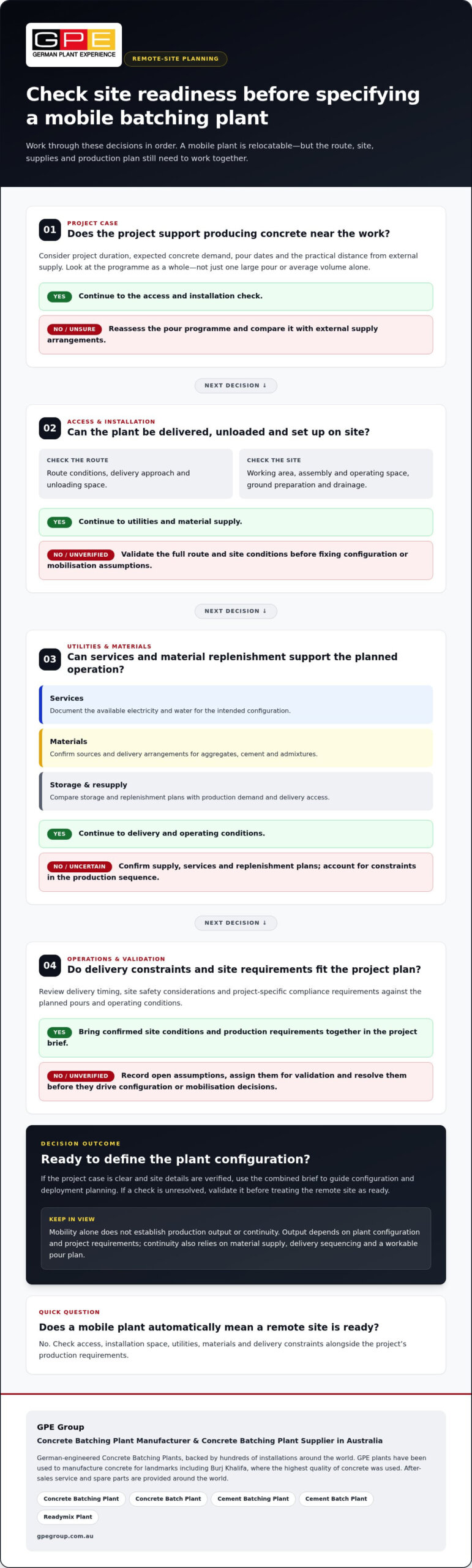
A practical site assessment turns broad project assumptions into information that can guide plant configuration and deployment. For a mobile batching plant for remote sites, readiness depends on more than the proposed installation area. Access, material supply, utilities and delivery constraints must work together with the production plan.
Verify transport access, installation space, available utilities, material supply and delivery arrangements against the project schedule before fixing the plant configuration.
Separate confirmed information from items that still need validation by the project team. A route marked on a plan, for example, does not by itself establish that transport and unloading can proceed as intended. Record assumptions, assign them for review and resolve them before they drive layout or mobilisation decisions.
- Access: route conditions, delivery approach and unloading space.
- Installation: available working area, ground preparation and drainage considerations.
- Services: electricity and water requirements for the intended operation.
- Materials: sources and replenishment arrangements for aggregates, cement and admixtures.
- Operations: delivery constraints, site safety considerations and project-specific compliance requirements.
Review Transport Access and the Installation Area
Assess the full delivery route, not just the final approach to the work site. Consider the space required for unloading, assembly and ongoing operations. Establish whether the plant may need to move again as the project progresses. Ground preparation, drainage and delivery access can all affect the layout and mobilisation sequence.
Transport and installation requirements depend on the site and selected configuration. Gather route and site details early, then validate them with the project team before they become fixed design assumptions.
Map Utilities, Materials, and Operating Conditions
Document available electricity and water, as well as planned sources and delivery arrangements for aggregates, cement and admixtures. Compare storage and replenishment plans with expected production demand and delivery access. If deliveries are constrained or supplies are variable, account for that when planning storage and the production sequence.
Record the operating conditions and project-specific safety and compliance requirements that apply. Keep verified details separate from estimates, and assign someone to validate each open item. This gives the team a firmer basis for configuration, mobilisation and coordination.
With the site brief established, GPE’s German-engineered mobile concrete batching plants can be configured around project requirements. Explore GPE mobile batching plant solutions as part of your planning.
Match Batching Plant Configuration to Remote-Site Production
Once site conditions are understood, translate the concrete programme into plant requirements. Consider expected volume, peak demand, operating schedule, mix requirements, material handling, storage, available layout and any planned relocation. These factors need to be reviewed together. Average production may look adequate on paper but fail to reflect concentrated pours or constrained material replenishment.
For a mobile batching plant for remote sites, compare project needs with configuration questions before settling on a design basis. This helps distinguish the required output from the broader system needed to support planned work.
| Project Requirement | Configuration Question |
|---|---|
| Expected volume and peak demand | What total production is anticipated, and when do the largest pours occur? |
| Pour sequence and operating schedule | How do work periods, pour timing and interruptions shape production planning? |
| Mix requirements | Which concrete mixes must the plant produce for the project programme? |
| Materials and storage | How will aggregates, cement and admixtures be handled, stored and replenished? |
| Site layout and dispatch | Can material flow, mixing and concrete dispatch be coordinated within the available area? |
| Relocation requirements | Will the plant remain in one position or need to move as the project develops? |
Translate Concrete Demand Into Production Requirements
Build the production brief around anticipated volume, peak demand, operating hours, mix requirements and pour patterns. Average demand provides useful context, but peak periods and pour sequence determine whether production can support the programme when concrete is needed. Include possible supply interruptions or changes in site access in the plan, rather than treating them as separate logistics issues.
GPE’s customised capacity range is 30 m³/h to 400 m³/h across its plant offering. This is a general range, not a specification for a particular mobile plant. Define the required output and configuration against the project’s actual production brief.
Coordinate Plant Layout and Material Handling
Layout connects aggregate handling, cement feed, mixing and concrete dispatch into a workable production flow. Storage and replenishment arrangements must support planned demand while fitting the available area and delivery access. For example, on a constrained site, coordinate where materials arrive and are stored with how they move through the plant.
No single remote-site layout suits every project. GPE’s German engineering supports the development of a plant configuration around defined requirements, including production planning, material flow and relocation needs. Base the configuration on the project brief rather than assuming a standard arrangement.
Plan Mobile Batching Plant Deployment Step by Step
A controlled deployment connects the project brief to plant configuration, site preparation, mobilisation and commissioning. For a mobile batching plant for remote sites, define dependencies and responsibilities early so transport, services, materials and production planning progress in sequence. Include relocation or demobilisation requirements from the outset, even if they will arise later in the project.
Prepare the Project and Site Brief
Before developing the configuration, assemble the information that determines how the plant must serve the work. Record project duration, anticipated demand, peak pour periods, concrete mix requirements, operating schedule and pour sequence. Add site access and installation details, available utilities, material sources, delivery constraints and any planned changes to the work area. Clearly label estimates and assumptions, then assign project team members to validate them.
Coordinate Mobilisation Through Commissioning
Use the brief to sequence technical and logistical activities, with project requirements informing each stage. GPE’s turnkey project delivery can include design, manufacturing, testing, supply, transport, erection and commissioning. Align these stages with site readiness and the operating plan. The sequence and scope depend on the selected configuration and site conditions.
- Define the project brief. Consolidate the production programme, concrete requirements, site information and operating assumptions in one working document.
- Validate site readiness. Resolve open questions about access, installation area, utilities, material supply, delivery arrangements and project-specific safety and compliance requirements.
- Develop the plant configuration. Translate confirmed production and site information into a project-specific design basis, including material handling, storage, layout and any relocation needs.
- Coordinate project delivery. Align design, manufacturing and testing with supply and transport planning, so the plant and prepared site are ready for the planned mobilisation sequence.
- Prepare for erection and commissioning. Coordinate site access, installation activities, utilities, materials and team responsibilities before commissioning begins.
- Plan sustained operation and exit. Establish responsibilities for production oversight, replenishment and maintenance access. Include future relocation or demobilisation, with timing and site dependencies built into project coordination.
This sequence makes deployment a managed project process rather than simply a transport event. GPE’s German engineering connects plant configuration with project requirements, while turnkey delivery can bring the stages from design through commissioning into one project scope.
Use the completed brief to develop a GPE mobile batching plant plan for remote-site deployment.
Apply the Remote-Site Plan to a GPE Mobile Batching Plant
A completed site brief gives engineering and project delivery teams a practical basis for defining a mobile plant configuration. For a mobile batching plant for remote sites, connect required output and concrete demand with raw-material availability, site layout, transport constraints and project budget. Local standards and project-specific requirements also inform planning. One configuration should not be assumed to suit every site.
Connect Project Requirements With Engineering and Delivery
GPE Group is a German-engineered Concrete Batching Plant Manufacturer and Concrete Batching Plant Supplier serving projects in Australia. Related Australian industry terms include Concrete Batch Plant, Readymix Plant, Cement Batching Plant and Cement Batch Plant. GPE’s customised plant capacity range is 30 m³/h to 400 m³/h across its offering. This is a general range, not a specification for every mobile configuration.
GPE’s turnkey project scope can include design, manufacturing, testing, supply, transport, erection and commissioning. A well-prepared brief helps align these stages with production needs, material availability, site conditions and project-specific local requirements.
Consider GPE Experience and Ongoing Support
Hundreds of GPE Concrete Batching Plants have been installed around the world. GPE plants have also been used to manufacture concrete for world landmarks, including Burj Khalifa, where the highest quality of concrete was used. These projects demonstrate GPE’s installation experience, not a guarantee of identical results at another site.
GPE provides after-sales service and spare parts around the world. Document your project requirements to help define a suitable plant configuration and delivery scope with GPE Group.
Build a Deployment Plan Around Verified Project Needs
A dependable remote-site batching plan begins with verified conditions, not assumptions. Assess access, installation space, utilities, materials and delivery constraints before defining the plant configuration. Then align production requirements with expected demand, peak pours, operating schedules and material replenishment so the plan reflects how the project will run.
Planning a mobile batching plant for remote sites as a complete project sequence helps coordinate configuration, mobilisation, commissioning, operations and eventual demobilisation. GPE Group’s Concrete Batching Plants are engineered in Germany and supported by experience from hundreds of installations around the world. After-sales service and spare parts are provided worldwide.
To discuss your remote-site batching plant requirements and develop a project-specific configuration and delivery scope, contact GPE Group.
Frequently Asked Questions
Can a mobile batching plant operate at a remote project site?
Yes, when the project requirements and site conditions support the selected configuration. Assess concrete demand, access routes, installation space, utilities, material supply and delivery constraints before finalising plant requirements. Mobility makes equipment relocatable, but does not by itself establish production readiness or continuity. A structured assessment helps identify constraints that may affect configuration, mobilisation and the operating plan.
What site information is needed to plan a mobile batching plant?
Gather the project duration, expected concrete demand, peak pour periods, mix requirements and operating schedule, together with site access, installation area, available utilities, material sources and delivery constraints. Record which details are confirmed and which remain assumptions. Resolving uncertainties early gives the team a better basis for defining layout, storage, mobilisation sequence and operating responsibilities.
How do you determine batching plant capacity for a remote project?
Capacity planning should account for average and peak demand, pour sequence, operating schedule, mix requirements, project duration and supply reliability. GPE’s customised capacity range of 30 m³/h to 400 m³/h applies across its plant offering, not as a specification for every mobile model. For example, the GPE 120-6-3-1 has a production capacity of 120 cbm/hr and a twin-shaft mixer with 3 cbm output. Use project requirements to guide configuration rather than assuming a model will suit the site.
Does a mobile batching plant still need site preparation?
Yes. Relocatable equipment still needs suitable transport and unloading access, an installation area, required utilities and coordinated material supply. Depending on the project and configuration, site preparation may also involve working-area, ground-condition and drainage planning. Assess these requirements before mobilisation so the installation sequence reflects actual site conditions. Mobility supports relocation, but does not remove the need to coordinate access, preparation and logistics.
What materials and utilities should be planned for remote-site batching?
Include aggregates, cement, water, admixtures and electricity in the site assessment, then document how each will be supplied and replenished. Storage arrangements should reflect production demand, delivery access and supply constraints. Quantities and utility requirements depend on the project and plant configuration, so base them on project data rather than generic assumptions. This helps align plant layout, storage and production planning.
Are GPE concrete batching plants designed in line with Australian Standards?
GPE states that its concrete batching plants are designed in line with Australian Standards. Consider the relevant requirements alongside the site, plant configuration and intended operation. The statement is not a blanket certification or confirmation that one approach covers every project. GPE’s German engineering informs plant design, while project-specific requirements remain part of configuration and deployment planning.
Can a batching plant produce concrete to a project’s specified mix and slump?
Document mix requirements and slump targets in the project brief, then incorporate them into configuration and production planning. Recipes and target slumps are project-specific, so avoid relying on generic figures or assuming a particular result without the relevant technical information. Clear specifications help align the intended concrete with the batching process and operating plan. GPE’s customised plant design approach provides a basis for considering those requirements as part of the wider project configuration.
