
 Main Number
 Find us on
 Reach us @
The plant with the highest headline capacity may not be the right choice for your project. To understand how to choose batching plant capacity, start with peak pour demand and the productive hours available, then account for the operating conditions that affect how much concrete can be batched and dispatched in practice.
Total project volume alone can hide the pressure of a busy pour day. A useful capacity range comes from dividing peak demand by realistic productive hours, then considering constraints such as raw material supply, truck dispatch, work schedules and planned downtime. This helps you identify a production scale that fits the project, rather than relying on a rating that may not reflect site conditions.
This guide explains how to estimate hourly output, assess factors that influence effective capacity and prepare a project-specific engineering brief. GPE Group’s German-engineered Concrete Batching Plants have capacities from 30 m³/h to 400 m³/h, with stationary and mobile configurations to assess against project demand. Hundreds of installations worldwide include plants used to manufacture concrete for landmarks such as Burj Khalifa. After-sales service and spare parts are provided around the world.
Key Takeaways
- Learn how to choose batching plant capacity by assessing peak demand against productive hours, rather than relying on total project volume alone.
- Estimate required hourly output by dividing planned concrete volume by productive operating hours, using project-specific assumptions.
- Identify how material supply, mixing, dispatch, maintenance and site conditions can affect effective production.
- Compare candidate capacities against typical, peak and lower-demand scenarios to understand schedule and output risks.
- Prepare an engineering brief that records project duration, target output, peak scenarios, materials and site conditions.
How to Choose Batching Plant Capacity From Project Demand
Batching plant capacity describes a production rate, commonly expressed as cubic metres of concrete per hour (m³/h). It is different from total project volume: total volume shows how much concrete is required, while capacity selection depends on how much must be produced within the available production window. A large volume spread across an extended programme may need a different output rate from a smaller volume scheduled for a concentrated pour period.
Australian project documents may also use terms such as Concrete Batch Plant, Cement Batching Plant, Cement Batch Plant and Readymix Plant. For a foundational overview of concrete plant types and components, see Wikipedia. This guide focuses on the demand-led capacity decision. To determine how to choose batching plant capacity, assess the production rate your programme requires and the conditions in which the plant will operate.
Rated Capacity, Required Output and Sustained Production
A stated hourly rating describes nominal production capacity. Required output is the rate your project needs during a defined period. The two figures answer different questions: a plant rating indicates its stated capacity, while the project calculation shows how much concrete the programme requires. Actual production depends on operating conditions at the site.
Assess the rating against the project’s production window, not as a promise of uninterrupted output. German engineering supports a considered approach to plant design, but capacity selection still depends on the assumptions behind the target. Whether the equipment is called a Concrete Batch Plant or Readymix Plant, do not treat its rating as guaranteed continuous site production.
Project Inputs That Shape the Capacity Decision
Start with the planned concrete volume and the schedule for placing it. Separate regular demand from short-term peaks. Typical output describes normal operations; peak requirements reveal whether concentrated pours or overlapping work periods will put extra pressure on production and dispatch.
Record the working pattern that defines the production window, including shifts, operating hours and planned interruptions. The same volume can require different hourly output depending on productive hours and placement timing. A project-wide average can hide a demanding pour period, while planning only for the highest short-term peak may overstate ongoing needs.
- Set out total planned volume and the project duration.
- Identify typical demand and the busiest expected production periods.
- Document shifts, available operating hours and planned interruptions.
These inputs create a project-specific demand profile for comparing capacity options. They also give you a clear basis for converting planned volume and productive hours into required hourly output.
Calculate a Batching Plant Capacity Range From Volume and Schedule
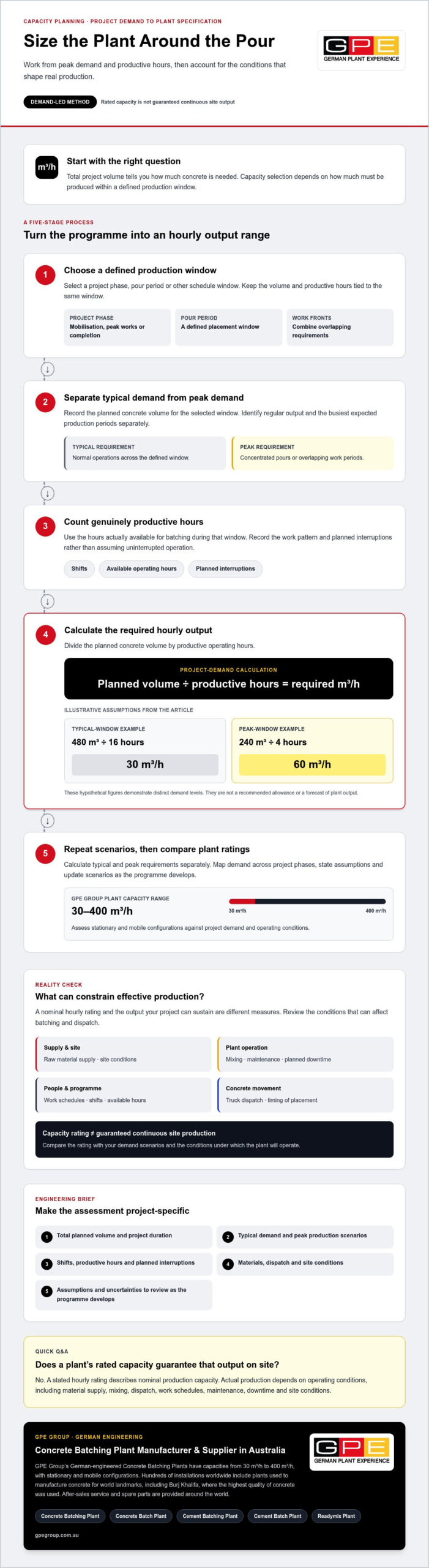
Translate the project programme into hourly production requirements before comparing plant ratings. The calculation is straightforward, but the result is useful only when the volume and productive hours refer to the same defined phase or production window.
A Practical Project-Demand Calculation
Use this method to establish a demand-based starting point:
- Choose a defined window. Select a project phase, pour period or other production window that reflects the schedule.
- Estimate the concrete volume. Record the volume required in that window, distinguishing normal demand from peak demand.
- Count productive operating hours. Use the hours genuinely available for batching during that period, allowing for scheduled shifts and planned interruptions.
- Divide volume by hours. Required hourly output equals planned volume divided by productive hours.
- Repeat for different scenarios. Calculate typical and peak requirements separately instead of relying on one project-wide average.
Illustrative example, assumptions only: Assume a project phase requires 480 m³ over 16 productive hours. The calculation is 480 ÷ 16 = 30 m³/h. For a separate peak window, assume 240 m³ must be produced over 4 productive hours. That calculation is 240 ÷ 4 = 60 m³/h. These hypothetical figures are not a recommended allowance or a forecast of plant output. They show how one project can have distinct typical and peak demand levels.
Account for Project Phases and Demand Variability
Map expected production across mobilisation, peak works and project completion. Early activities may need a different output rate from a period when several work fronts are active; later demand may ease as major pours conclude. When work fronts overlap, combine their concrete requirements within the relevant production window rather than assessing each in isolation.
Build the estimate from the project schedule, planned pours, shift pattern and known interruptions. Avoid adding a generic buffer or assuming a standard peak factor without a project-specific basis. If timing or volume remains uncertain, calculate separate scenarios and state their assumptions. This makes the capacity range easier to review and update as the programme develops.
These calculations define required output, not guaranteed sustained production. Compare each demand scenario with plant ratings while accounting for site operating conditions. GPE Group’s German-engineered Concrete Batching Plants have stated capacities from 30 m³/h to 400 m³/h, providing a range for project-specific evaluation. View the German-engineered batching plant range against your calculated demand.
Assess Operating Constraints That Affect Effective Batching Plant Capacity
A plant’s stated capacity does not, by itself, establish the sustained output a project will achieve. Production depends on a connected system: materials must arrive consistently, batching and mixing must keep pace, and concrete must be loaded and dispatched in line with placement requirements. A constraint at any stage can reduce production below the plant’s nominal rating.
For a sound assessment of how to choose batching plant capacity, distinguish site conditions from configuration decisions. Supply continuity, shift patterns and truck availability are operating conditions. Plant design and configuration can be engineered around defined requirements, but no plant rating can remove a bottleneck elsewhere in the production chain.
Material Supply and Batching-Process Constraints
Assess the continuity of aggregate, cement, water and admixture supply against the production schedule. A delay or shortage in any required input can interrupt batching, even when the plant has capacity available. Material handling, batching and mixing must also function as connected stages, with each stage supporting the next without creating a queue or production gap.
Document material sources, delivery arrangements and known restrictions. Then identify where supply or handling interruptions could limit usable output. These project-specific findings give you a stronger basis for assessing production than a headline rating considered on its own.
Dispatch, Operating Hours and Plant Availability
Finished concrete must be loaded, dispatched and placed in coordination with the production schedule. If trucks are unavailable when batches are ready, or placement cannot accept the planned flow, dispatch may constrain output. Operating hours and planned maintenance also affect the productive time available across the project, so include them in the operating assumptions instead of treating every scheduled hour as productive.
| Operating constraint | Potential effect on production | Assessment focus |
|---|---|---|
| Aggregate or cement supply interruptions | May pause batching or restrict the rate of production | Supply continuity and delivery arrangements |
| Water or admixture availability | May interrupt the production sequence | Availability during planned operating windows |
| Material handling, batching or mixing limitations | A slower stage may constrain the connected process | Coordination between production stages |
| Truck availability and loading coordination | May delay dispatch and restrict the flow from the plant | Fleet timing and placement schedule |
| Shift schedules and planned maintenance | Reduce the hours available for production | Operating calendar and planned interruptions |
Use the table to separate constraints that need operational planning from those that should inform plant engineering. GPE Group’s German-engineered stationary and mobile plant configurations can be assessed against defined demand and site conditions. Sustained output still depends on the complete materials, production and dispatch system.
Compare Batching Plant Capacity Options Against Project Risk
Once demand and operating assumptions are clear, compare candidate plant capacities against more than the busiest pour. Assess each option against typical production, peak requirements and lower-demand periods. This shows whether it can support the programme when output pressure is highest and whether its capacity remains practical across the wider project schedule.
Undercapacity, Overcapacity and Project Exposure
Use the same project assumptions for each candidate, then consider the likely trade-offs:
- Lower-demand periods: Compare expected output with typical demand. If a plant’s capacity substantially exceeds the sustained requirement, it may be underutilised for significant parts of the programme.
- Typical production: Assess whether the option aligns with routine pours and available productive hours, rather than selecting solely for the most demanding scenario.
- Peak periods: Test whether the candidate can support planned high-volume pours and overlapping work fronts. Insufficient output may constrain production, extend pour sequences or put pressure on project scheduling.
These are project risks, not automatic outcomes. Their significance depends on the delivery sequence, productive hours, material continuity and dispatch arrangements in the project assumptions. A larger rating is not inherently safer if demand rarely approaches it. Likewise, a plant selected only around average demand may leave too little capacity for critical peak periods. When deciding how to choose batching plant capacity, compare the consequences of each candidate across all three demand scenarios and record the assumptions behind the decision.
Consider Plant Configuration After Establishing Capacity
Set the required capacity range first, then consider whether a stationary or mobile configuration better suits the project. Project duration, relocation requirements and site constraints can influence this decision, but they should not replace the demand calculation. A long-term fixed operation and a project that requires movement between sites may call for different configurations, even when their assessed output needs are similar.
GPE Group designs customised stationary and mobile Concrete Batching Plants engineered in Germany, with stated capacities from 30 m³/h to 400 m³/h. This range supports project-specific evaluation; it is not a universal recommendation. Consider project duration, relocation needs and site conditions alongside the calculated output range.
Carry typical, peak and lower-demand scenarios into the plant specification, together with the operating assumptions. GPE’s hundreds of Concrete Batching Plant installations worldwide reflect experience across varied project requirements. Review your project’s capacity requirements with GPE to move from demand scenarios to a project-specific plant assessment.
Turn the Capacity Assessment Into a Batching Plant Specification
A capacity assessment becomes useful for engineering when its calculations, assumptions and constraints are recorded in a clear project brief. This gives the plant specification a traceable basis: intended output can be compared with the programme, while unresolved assumptions remain visible for further assessment.
Capacity-Selection Inputs for an Engineering Brief
Record the total concrete volume alongside the production windows in which it is required. Include typical and peak output targets, the duration of each demand phase, operating hours, shift arrangements and planned interruptions. Distinguish scheduled or measured requirements from estimates so the basis for the capacity range stays clear.
The brief should also describe conditions that may affect production and dispatch. Capture material supply arrangements, expected coordination with trucks and placement activities, and relevant site limitations. This input list can help keep the assessment complete:
- Project demand: total volume, project duration, production phases, typical output and peak scenarios.
- Operating plan: productive hours, shifts and planned interruptions.
- Site and supply conditions: available materials, delivery arrangements, dispatch coordination and site constraints.
- Assumptions: identify estimates or unresolved conditions separately from established project requirements.
Separating these inputs helps engineers evaluate the capacity requirement without treating provisional information as a fixed specification. As scheduling and site details develop, update the brief while keeping the reasoning behind the selected range. This is a practical basis for choosing batching plant capacity using project-specific evidence rather than a single headline figure.
From Capacity Range to a Tailored Plant Solution
Once demand is defined, capacity informs the wider plant configuration. GPE Group designs customised stationary and mobile Concrete Batching Plants engineered in Germany, with stated capacities from 30 m³/h to 400 m³/h. This range supports matching project requirements to a plant solution, not making a universal recommendation. Project duration, relocation needs and site conditions guide the configuration decision alongside the calculated output range.
GPE’s quality German engineering is supported by hundreds of Concrete Batching Plant installations worldwide. Its plants have been used to manufacture concrete for landmarks including Burj Khalifa, where the highest quality of concrete was used. After-sales service and spare parts are provided around the world.
For projects across Australia, GPE Group is a German-engineered Concrete Batching Plant Manufacturer and Concrete Batching Plant Supplier. Discuss your project’s capacity requirements and engineering brief with GPE Group. Bring your demand scenarios, operating assumptions, material and dispatch arrangements, and site conditions to start a project-specific assessment.
Turn Your Capacity Assessment Into a Confident Project Decision
A sound plant specification begins with project demand, not a headline rating. Calculate required hourly output for defined production windows, separate typical requirements from peak pours, and assess how material supply, operating schedules and dispatch may affect sustained production. Recording these inputs in an engineering brief gives your capacity decision a clear, project-specific basis.
Understanding how to choose batching plant capacity also means matching the assessed range to broader project requirements. GPE Group designs customised stationary and mobile Concrete Batching Plants engineered in Germany, with stated capacities from 30 m³/h to 400 m³/h. Hundreds of installations worldwide include plants used to manufacture concrete for landmarks such as Burj Khalifa, where the highest quality of concrete was used. After-sales service and spare parts are provided around the world.
Bring your demand scenarios, operating assumptions and site requirements into the next stage of planning. Discuss your batching plant capacity requirements with GPE Group and move towards a solution aligned with your project. A well-founded assessment is a strong starting point for dependable project delivery.
Frequently Asked Questions
How do you calculate the capacity of a concrete batching plant?
Divide the concrete volume required in a defined production window by the productive operating hours in that same window. For example, if a project phase requires 480 m³ over 16 productive hours, the calculated requirement is 30 m³/h. This is a demand estimate, not a guaranteed plant output. Assess typical and peak periods separately, then account for operating constraints when comparing plant ratings.
What factors determine the right batching plant capacity?
The right capacity depends on the project’s total concrete volume, placement schedule and available production hours, particularly during peak pours. Consider shifts, planned interruptions, material supply continuity, batching and mixing stages, truck availability, dispatch arrangements and coordination with concrete placement. These factors form a connected operating system. Documenting them alongside typical and peak demand helps establish a project-specific capacity range instead of relying on a single average.
What is the difference between rated and actual batching plant capacity?
Rated capacity is the plant’s stated production rate, commonly expressed in cubic metres per hour. Actual output is the volume produced under the project’s operating conditions, which may be affected by material supply, production sequencing, dispatch, operating hours and planned maintenance. A rated figure should not be treated as guaranteed continuous site production. Compare the rating with sustained demand and the constraints recorded in the project assessment.
What mixer size corresponds to a 120 m³/h batching plant?
A documented GPE configuration pairs a production capacity of 120 m³/h with a 3 m³ twin-shaft mixer. This is a specific plant example, not a universal rule that every 120 m³/h plant uses the same mixer size. Capacity selection should consider the complete plant configuration and the project’s demand, operating schedule and conditions. Compare candidate ratings with typical and peak output requirements before specifying a plant.
Can a batching plant produce different concrete recipes and slumps?
Concrete batching plants can be configured for project-specific production requirements, including different mix recipes. The concrete mix design and material characteristics determine the intended slump, while plant configuration and batching controls support the required proportioning. Results depend on the specified recipe and operating conditions, so do not assume a particular slump from plant capacity alone. Include required mixes and slump targets in the project engineering brief.
Are GPE concrete batching plants designed in line with Australian Standards?
Yes. GPE’s concrete batching plants are designed in line with Australian Standards. Project requirements and site conditions inform the tailored plant design, with relevant Australian Standards providing the applicable design context. Include the standards and requirements relevant to your project in the engineering brief so they can be incorporated into the assessment. This helps align the plant specification with the intended application and project obligations.
Does GPE provide German engineering, after-sales service and spare parts internationally?
Yes. GPE’s concrete batching plants are engineered in Germany, and the company provides after-sales service and spare parts around the world. GPE states that hundreds of batching plant installations are located worldwide, and its plants have been used to manufacture concrete for landmarks including Burj Khalifa, where the highest quality of concrete was used. This international project experience supports GPE’s role as a concrete batching plant engineering and supply partner.
