 Main Number
 Find us on
 Reach us @
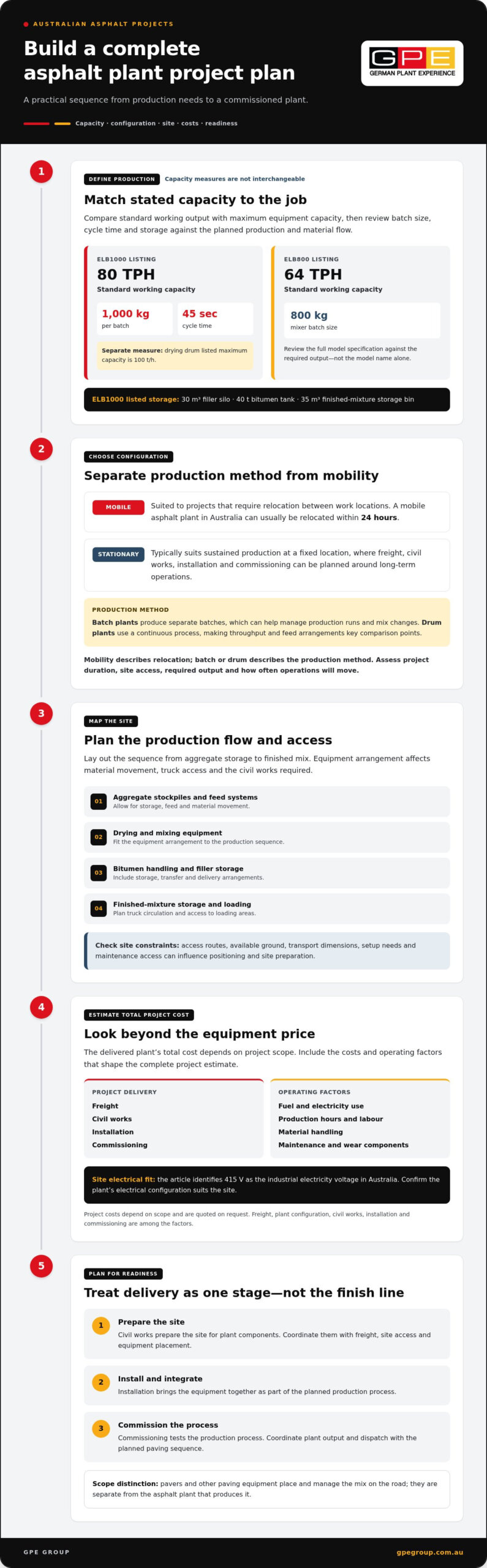
The mobile option is not automatically the lower-cost choice. A mobile plant generally suits projects that require relocation between sites, and a mobile asphalt plant in Australia can usually be relocated within 24 hours. A stationary plant is typically better suited to sustained production at a fixed location, where freight, civil works, installation and commissioning can be planned around long-term operations. Choosing an asphalt plant supplier in Australia means weighing these requirements together, rather than comparing equipment alone.
Both formats can meet demanding production needs, but the right configuration depends on project duration, site access, required output and how often operations will move. Freight and site preparation also affect total project cost, so a plant that seems easier to transport may not be the most economical choice once the full scope is considered.
This comparison explains how to assess mobile and stationary plants for Australian projects, what to include when estimating costs beyond the equipment, and how installation and commissioning affect readiness. It also outlines the information needed to match a plant configuration to your production plan, site constraints and expected operating life.
Key Takeaways
- Match plant capacity and production method to the project’s output needs, operating pattern and site constraints.
- Assess total project cost beyond the equipment, including freight, civil works, installation and commissioning.
- Compare mobile and stationary configurations by how often the plant must move and how long production will remain at each site.
- Understand how new, used and batch plant options differ before narrowing the equipment requirements.
- Compare suppliers on engineering fit, plant configuration and the support needed to bring the project into operation.
Which Asphalt Plant Fits Your Australian Project Best?
Choose a plant by matching its production method and stated capacity to the project’s output needs and site plan. Compare standard working output with maximum equipment capacity: they are different measures and should not be treated as equivalent.
Capacity and Specification Choices
Batch-mix specifications show the size of each mix and the time required for a production cycle. An ELB1000 listing gives 80 TPH standard working capacity, a 1,000 kg-per-batch mixer and a 45-second cycle. Its drying drum measures 1,600 × 6,800 mm, with a listed maximum capacity of 100 t/h. These measures describe separate parts of the operating specification.
The ELB1000 example also lists a 30 m³ filler silo, a 40 t bitumen tank and a 35 m³ finished-mixture storage bin. An ELB800 listing gives 64 TPH standard working capacity and an 800 kg-per-batch mixer. Review the complete batch-mix plant specification, including cycle time and storage, against required output and material flow.
Portable and Batch Plant Options
Mobile asphalt plants suit projects where production equipment must move between work locations. Batch plants produce separate batches, which can help manage production runs and mix changes. Drum plants use a continuous production process, so throughput and feed arrangements are key comparison points. Mobility describes relocation; batch or drum describes the production method.
Before selecting a mobile asphalt plant, map project locations, site access and expected production patterns. Assess transport dimensions, setup needs, material handling and maintenance access. Government road works may have project-specific production requirements, so include the applicable project specifications in your equipment assessment rather than choosing by plant type alone.
New and Used Plant Availability
Assess new and used equipment against the same project requirements, while accounting for their different procurement considerations. For new equipment, compare the proposed configuration with planned output, material handling and site layout. For used equipment, review its condition, configuration and maintenance history alongside stated capacity and included components.
Use model specifications as a practical starting point. For example, distinguish the ELB1000’s 80 TPH standard working capacity from its drum’s listed maximum capacity of 100 t/h. An asphalt plant supplier in Australia can be assessed by how clearly the proposed model and configuration align with the project’s needs. Confirm that batch size, cycle, storage and production method suit the planned operation, rather than relying on a model name alone.
How Much Will Your Asphalt Plant Cost Beyond the Equipment?
Operating costs in Australia depend on fuel and electricity use, production hours, labour, material handling and maintenance. The plant’s electrical configuration must suit the site, where industrial electricity voltage is 415 V. Maintenance planning should account for wear components, cleaning and servicing across the production line.
Equipment is only one part of an asphalt project budget. Freight, civil works, installation and commissioning all contribute to the delivered plant’s total cost, while production and handling equipment shape the site layout. Project costs depend on the scope and are quoted on request. Factors include freight, plant configuration, civil works, installation and commissioning.
Start your estimate by mapping the production sequence, from aggregate storage to finished mix. Aggregate feed systems, drying and mixing equipment, bitumen handling, filler storage and finished-mixture storage each need space and integration. Their arrangement affects material flow and truck access to loading areas. At a constrained Australian site, access routes and available ground may influence equipment positioning and civil works.
Include downstream paving and pavement operations in the project scope, but distinguish them from the asphalt plant’s production equipment. Pavers and other intelligent paving equipment place and manage the mix on the road; they are separate from the plant that produces it. For infrastructure projects, coordinate plant output, dispatch arrangements and paving work so production supports the planned placement sequence.
- Equipment locations: Plan for aggregate stockpiles, plant components, finished-mixture loading and truck circulation. The location of each area influences material movement and site access.
- Bitumen equipment: Include storage and transfer arrangements in the layout. Their position should support delivery, handling and the plant’s production sequence.
- Cold mix equipment: Cold mix is supplied ready to use and is typically used for temporary patches or where hot mix placement is impractical. Assess it separately from hot-mix production when defining project requirements.
Installation and commissioning affect both budget and schedule. Civil works prepare the site for plant components, installation integrates the equipment, and commissioning tests the production process. Plan these activities alongside freight, access and equipment placement rather than treating delivery as the final project stage.
For a mobile or stationary configuration, compare how the equipment’s location affects transport, site preparation and ongoing material handling. A mobile layout may involve repeated relocation planning; a stationary layout requires careful attention to the fixed site arrangement. Both approaches need planned maintenance access, energy supply and a coordinated production flow. A project-specific asphalt plant configuration can be assessed against these requirements before finalising the total project scope.
Mobile and stationary asphalt plant types
Plant mobility determines how equipment is arranged, transported and used across Australian road projects. A stationary plant is established at one site, while a mobile configuration is designed to move as project locations change. The right option depends on the work programme, site access and expected production duration at each location.
Fixed and Mobile Plant Configurations
A stationary asphalt plant can suit sustained production from a central site serving several pavement projects. Its fixed layout allows a planned arrangement for aggregate storage, production equipment and truck loading. This approach is most useful when production stays concentrated around one location and the site can accommodate the required infrastructure.
A mobile asphalt plant is designed for projects where production needs to follow changing work locations. Depending on project geography and logistics, relocating production may reduce the need to transport finished asphalt over long distances. Each move still requires transport planning, access assessment and a workable setup at the new site.
Mobile Versus Stationary Plant Demand
Demand reflects project mix as well as equipment preference. Mobile asphalt mixing plants are projected to account for more than 40% of new Australian plant installations from 2026 onward. That outlook indicates a growing role for mobile configurations, but it does not make them the automatic choice for every operator or contract.
For a contractor serving dispersed regional projects, mobility may suit changing work fronts. For a government or infrastructure programme centred on a consistent production location, a stationary plant may provide a stable operating arrangement. Compare where asphalt will be produced, how far it must travel and how often the production site is expected to change.
Environmental and Sustainability Considerations
Environmental planning matters for both formats. A fixed plant concentrates production and material storage at one location, so the site layout should account for aggregate movement, truck circulation and nearby land uses. A mobile plant changes location with the project, making each site’s access, surroundings and operating conditions part of the assessment.
Sustainability also depends on transport and production planning. Consider the distance between the plant and paving works, the movement of incoming materials, and whether the production schedule can limit unnecessary haulage. A mobile setup near a temporary road project may reduce some transport movements, while a stationary facility may serve recurring works from one established location.
Use a practical comparison before selecting a plant type:
- Map the work: Identify project locations and how production needs may shift.
- Assess the site: Compare access, material storage and truck movements at each location.
- Match the operating model: Choose mobility for changing work fronts or a fixed arrangement for sustained central production.
- Review environmental fit: Consider material transport and the conditions of each proposed site.
Are new, used, mobile, and batch asphalt plants available in Australia?
Australian asphalt plant procurement can involve new or used equipment, mobile configurations and batch-mix systems. These describe different decision criteria: new or used refers to equipment condition, mobile to relocation design, and batch to production method. A plant may therefore be both mobile and batch-mix. Define each requirement before comparing listings or preparing a project specification.
New and Used Plant Considerations
New equipment can be specified around a planned production process, site layout and operating requirements. Used equipment needs a condition and configuration review before its rated output can be assessed against project needs. Examine the equipment inventory, maintenance records, control systems, wear components and technical documentation. Then compare the installed configuration with the production task rather than relying on a model name alone.
Existing Australian installations provide useful reference points, but do not establish current stock. Proven models like the ELB1000 asphalt mixing plant demonstrate reliable operation nationwide. Such examples help identify a model operating successfully across the country; they do not determine whether a particular new or used unit is available for purchase. Procurement decisions still depend on the specific equipment offered and its condition.
Mobile and Batch Configurations
Mobile and batch plants describe separate characteristics. Mobility concerns how plant components are transported and set up between work locations; batch production concerns how material is manufactured in discrete cycles. Record both requirements in the specification, alongside output needs, material handling, storage and site access constraints.
For a project with changing work locations, assess mobile plant transport and relocation requirements alongside the batch equipment configuration. At a fixed production site, examine how the selected plant integrates with aggregate storage, bitumen handling and finished-mix dispatch. This helps determine whether a mobile batch plant, stationary batch plant or another configuration best fits the operating plan.
Australian listings for named models from a trusted asphalt plant supplier in Australia, such as the ELB800 and ELB1000, can provide comparison points for capacity and configuration. Treat a listing as a starting point, not a complete procurement specification. Record the model, production method, included equipment and condition, then compare those details with the project’s required mix and operating arrangement.
Before proceeding, use this review sequence:
- Define the requirement: State whether the priority is new or used equipment, mobility, batch production, or a combination.
- Review the plant: Match its configuration and condition to the intended production process.
- Assess the site: Consider transport access, setup, storage and dispatch arrangements.
- Compare documentation: Use equipment records and specifications to assess suitability for the Australian project.
What are the leading asphalt plant brands available in Australia, and how do they compare
A reliable brand comparison begins with equipment evidence, not reputation alone. The Australian market examples available here identify ELB800 and ELB1000 models, but model names alone do not establish a ranking of manufacturers. Compare each proposed plant’s specifications, production method, configuration and project fit before drawing conclusions about brand suitability.
For example, the ELB800 listing specifies a drying drum measuring 1,500 × 6,300 mm and a maximum capacity of 80 TPH. Compare that maximum with the plant’s standard working capacity, which is a separate measure. A sound comparison records each figure under its correct label, then evaluates whether the equipment supports the project’s required production and material flow.
When comparing brands, distinguish batch-mix equipment from drum-mix equipment. A batch plant produces separate mixes, while a drum plant runs continuously. These methods affect production planning and the flexibility needed for mix changes. A brand may offer one or both configurations, so compare the specific model rather than assuming every plant from a manufacturer works the same way.
Use the same criteria to assess every shortlisted model. Review stated output, included equipment, layout requirements, control system and maintenance access. Then consider practical needs at the Australian site, including transport routes, installation planning and suitable technical support. These details show whether a configuration fits the work programme.
- Confirm the model: Record the manufacturer and exact model designation, such as ELB800, separately.
- Compare like with like: Match batch plants against batch plants, and drum plants against drum plants.
- Separate capacity measures: Distinguish maximum capacity from standard working output in every specification.
- Assess project fit: Relate equipment configuration to the required production process and site arrangement.
- Review lifecycle factors: Consider maintenance access, documentation and technical support alongside plant specifications.
For Australian procurement, the right model is the one that meets the defined production requirement and fits the project plan. A prominent brand name cannot replace a specification review. Use a comparison sheet for each candidate, applying the same measures for output, equipment scope, layout, maintenance and commissioning requirements.
Where a project requires a plant configuration matched to its production objectives, review asphalt plant configurations as part of the technical comparison. This keeps the assessment centred on equipment suitability and the operational demands of the Australian project.
The cited examples are the ELB800 and ELB1000; suitability is best compared by model specifications and project fit rather than by name alone. Compare like plant types and assess output, equipment scope, layout, maintenance access and technical support.
GPE Group: Concrete Batching Plants
GPE Group is a Concrete Batching Plant Manufacturer and Concrete Batching Plant Supplier serving projects in Australia. Its quality German engineering supports stationary and mobile concrete batching plants, with custom production capacities from 30 m³/h to 400 m³/h.
With hundreds of installations worldwide, GPE Group’s batching plants have contributed to concrete production for landmarks including the Burj Khalifa. After-sales service and spare parts are provided around the world. For projects requiring bulk cement storage, GPE Group also offers cement silos and mobile horizontal cement silos.
Contact GPE Group to discuss your concrete batching plant or cement silo requirements.
Turn Your Plant Comparison Into a Project Brief
Before committing to a configuration, turn your production requirements into a concise project brief. Define the operating plan, site conditions, material flow and installation scope, then assess proposed equipment against those criteria. When evaluating an asphalt plant supplier in Australia, a clear brief keeps technical discussions focused on your project’s actual needs.
For related work involving concrete production or cement storage, GPE Group offers Concrete Batching Plants, a Mobile Concrete Batching Plant and Cement Silos. These can form part of a broader infrastructure project alongside asphalt production, with each requirement assessed according to its role and site needs.
For a considered discussion about plant requirements, contact GPE Group about your plant. A well-defined next step can bring greater clarity to your project planning.
Frequently Asked Questions
Which companies supply asphalt plants in Australia?
GPE Group supplies Asphalt Plants and Mobile Asphalt Plants in Australia. In any procurement, distinguish the equipment supplier from the parties responsible for freight, installation and commissioning, as these activities may involve separate project interfaces. Compare suppliers by plant type, configuration, technical documentation and delivery scope. Clarifying responsibilities helps establish who coordinates each stage, from equipment specification through installation and operational handover.
What types and capacities of asphalt plants are available from Australian suppliers?
Australian market examples include batch-mix and drum asphalt plants, in mobile and stationary configurations. ELB800 and ELB1000 are model examples associated with Australian listings. Compare each plant’s standard working capacity with its stated maximum capacity, since these figures describe different measures. Also assess batch size, cycle time, aggregate and bitumen handling, storage, and whether the plant layout suits the production process and project site.
How much does an asphalt plant cost in Australia, including installation?
Project costs depend on the scope and are quoted on request. Major factors include plant configuration, freight, civil works, installation and commissioning. The equipment purchase is only one part of the project. Site access, ground preparation, equipment positioning and integration also affect the work required before commissioning. For a useful budget, define the plant configuration and site scope together, then assess the complete delivered and installed project.
Which Australian suppliers offer local manufacturing, parts, servicing, and technical support?
Supplier capabilities differ, so assess local manufacturing, parts supply, servicing and technical support as distinct requirements. GPE Group supplies Asphalt Plants and Mobile Asphalt Plants. For any proposed plant, document where equipment is manufactured, how parts are sourced, and who is responsible for service and technical assistance. This separates the supplier’s Australian presence from the specific support arrangements included for the asphalt plant and project.
What should buyers check when selecting an asphalt plant supplier in Australia?
Check that the proposed plant configuration matches the required production method, site layout and operating plan. Review technical specifications, included equipment, delivery scope, and responsibility for installation and commissioning. For used equipment, examine condition records and maintenance documentation. Assess parts sourcing and technical support arrangements, too. A written scope that defines responsibilities and equipment boundaries makes supplier proposals easier to compare for operational suitability.
How long does delivery, installation, and commissioning of an asphalt plant take in Australia?
Delivery, installation and commissioning depend on the plant configuration, freight route, site readiness and installation scope. Sea transport from China to Australia is stated as less than 20 days, but that is only a transport segment, not the full project duration. Civil works, equipment arrival, assembly and commissioning each contribute to the schedule. Planning these activities together helps identify dependencies and prevent site preparation from delaying installation.