 Main Number
 Find us on
 Reach us @
A directory summary lists 167 fitting asphalt mixing plant manufacturers in Australia, while a narrower matched company set includes 15 businesses with 1-10 employees, 13 with 11-50 employees and 8 with 51-200 employees as of 30 September 2026. The count therefore depends on how a directory defines a manufacturer and which businesses its search includes. For anyone assessing an asphalt plant manufacturer in Australia, the useful question is not only how many companies appear, but which capabilities matter to a project.
That distinction matters when a plant represents a substantial, long-term operational decision. A company listed in a directory may not have the engineering capabilities, mix flexibility or operational approach a project requires. Treat directory entries as a market snapshot, not a complete measure of suitability.
This guide explains how to assess the Australian asphalt plant market and how plant design, mix quality, recycled asphalt use and reliable operation shape equipment selection and potential return on investment. It also covers practical checks to make before moving a plant project forward.
Key Takeaways
- Interpret Australian directory counts carefully: the number of listed businesses depends on how manufacturers, construction companies and service providers are classified.
- Compare batch and drum plant configurations against your production workflow, project locations and operational requirements.
- Assess how a custom design can accommodate site constraints, material handling and the mix requirements of your projects.
- Consider recycled asphalt compatibility and mix consistency when evaluating plant performance and long-term operating value.
- Compare maintenance arrangements, spare-parts support and warranty terms as part of a practical assessment of operational stability.
How many asphalt plant construction companies are there based in Australia?
Australian directory counts vary with the way listings define manufacturers, construction companies and service providers. One results summary lists 167 fitting asphalt mixing plant manufacturers and 297 suitable service providers. A separate matched company set, dated 30 September 2026, includes 15 businesses with 1-10 employees, 13 with 11-50, and 8 with 51-200. These figures describe different categories, so they should not be added together as a single count of Australian plant builders.
The matched set also includes one company in the 201-500 employee band, while its median employee-size band is 11-50. For a project team, those figures provide context, not a measure of engineering fit. A useful next step is to distinguish an established asphalt plant manufacturer in Australia from a contractor, equipment supplier or service provider, then compare the specific plant configurations each can deliver.
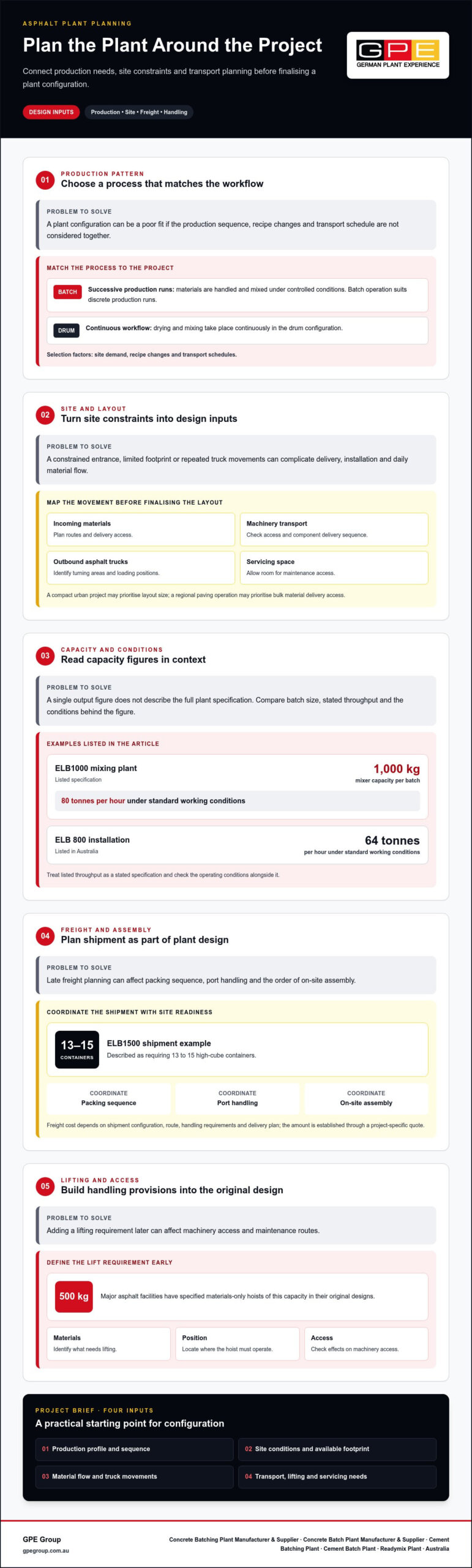
Asphalt production typically uses batch-mix or drum-mix processes. A batch plant produces asphalt in successive batches, with materials handled and mixed under controlled conditions. A drum plant combines drying and mixing continuously. Batch operation suits discrete production runs, while a drum configuration supports a continuous workflow. Site demand, recipe changes and transport schedules all influence which process fits the project.
Batch-plant specifications should be assessed as a connected system, rather than by a single capacity figure. For example, an ELB1000 mixing plant is listed with a 1,000 kg mixer capacity per batch and output of 80 tonnes per hour under standard working conditions. An ELB 800 installation in Australia is listed at 64 tonnes per hour under standard working conditions. These examples show why buyers should compare batch size, stated throughput and operating conditions closely.
Site access affects delivery and installation planning. Map routes for incoming materials, machinery transport and outbound asphalt trucks, then identify turning areas, unloading positions and other site constraints. A plant serving separate work areas, for example, may need a layout that supports production and repeated truck movements. Plan for the sequence of component delivery and assembly, too.
What Australian environmental, emissions and planning rules apply to asphalt plants? Requirements depend on the proposed site, plant design and operating impacts, including emissions, noise and land use. The relevant Australian jurisdiction determines the applicable assessment process.
What permits and approvals are needed to install and operate an asphalt plant in Australia? Approvals depend on the location, facility scale and proposed operations. Planning and environmental assessment requirements must be considered for the specific site and project before installation and operation.
Customising plant design for client requirements
Customisation starts with the project’s production profile, site conditions and transport requirements. An urban infrastructure project may need a compact layout, while a regional paving operation may prioritise access for bulk material deliveries. Define the intended mix range, production sequence and available footprint before finalising the equipment configuration. These inputs determine how mixing, storage, loading and maintenance access work together. A documented site plan also helps the design team identify constraints before fabrication and shipment.
Translate operating needs into plant specifications before comparing proposals. Document the required production pattern, material flow, truck movements and space for servicing. Then assess how each proposed layout addresses these needs, including the position of feed systems, mixing equipment and finished asphalt discharge. A site with a constrained entrance, for example, may need a different layout and delivery sequence from an open site. This review connects equipment selection with the actual paving workflow.
Freight planning is part of design, not a final administrative step. An ELB1500 asphalt plant shipment managed by an experienced asphalt plant manufacturer in Australia is described as requiring 13 to 15 high-cube containers. Container requirements affect component breakdown, packing sequence, port handling and the order of on-site assembly. Freight costs depend on the shipment configuration, route, handling requirements and delivery plan; the amount is established through a project-specific quote. Aligning the transport plan with the site’s access and lifting arrangements helps prevent avoidable handling changes after arrival.
Consider lifting provisions early. Major asphalt facilities across the country have successfully specified allowances for 500 kg materials-only hoists in their original designs. That example demonstrates how a defined handling requirement can be incorporated into plant planning rather than addressed after installation. Project teams should identify which materials require lifting, where the hoist must operate and how its position affects access to machinery. The resulting design can then integrate the lift provision with the plant structure and maintenance routes.
How long does it take to manufacture, deliver and install an asphalt plant in Australia? The schedule depends on design finalisation, fabrication, shipping, site readiness, assembly and commissioning. Coordinating these workstreams early helps establish a realistic project programme and identify the site preparations needed before equipment arrives.
Before approving a configuration, compare the layout against the production workflow, transport route, container plan and lifting requirements. An asphalt plant design assessment from GPE Group can help frame these decisions around the intended project and site arrangement.
Australian asphalt plant construction company directory
A directory can help identify businesses involved in asphalt construction, but it does not provide a ready-made shortlist of plant manufacturers. Classify each entry by its stated role: plant designer, equipment manufacturer, supplier, service provider or road contractor. Road construction capability alone does not demonstrate experience designing or building asphalt production machinery.
Apply the same screening process to every entry. Record the company name and its documented business activity, then look for evidence of direct involvement in plant design, construction or supply. Compare that role with your procurement needs. A project seeking a complete production facility, for example, requires different capabilities from one seeking pavement works or maintenance support.
- Classify the business: distinguish plant manufacturing from road construction and related services.
- Match the scope: identify whether the listed work concerns plant design, supply, installation or operation.
- Record evidence: retain the specific service or project information supporting each classification.
Directory contact data can help teams understand how much professional information accompanies a listing. The matched Australian company set averages 6.7 tracked contacts per company as of 30 September 2026. Roads 2000 has 26 tracked professional contacts in the directory data. These figures describe contact records, not manufacturing capacity, workforce size or plant-building credentials. Treat them as directory context rather than proof of technical capability.
For an initial comparison, create a register with separate fields for business role, documented plant activity, equipment scope and project responsibilities. Keep a company record that identifies only road construction distinct from one that explicitly describes asphalt plant engineering. This prevents directory labels from being mistaken for evidence of plant manufacture.
Compare each relevant entry with the project’s procurement scope. A fixed production facility may require documented plant construction and integration responsibilities, while a project with changing work locations may prioritise experience with transportable configurations. Record which requirements each listing supports, separating documented evidence from assumptions based on a company name or general industry description.
Use the directory to organise further market assessment, not to declare a preferred supplier. Review each business activity, the equipment or project work described, and its fit with the required production arrangement. This structured approach makes company records more useful while keeping construction contractors, service providers and plant manufacturers in their proper categories.
Mix quality, recycled asphalt use and operational stability
Australian asphalt plant projects may need to accommodate recycled asphalt and varied mix recipes. This affects material handling, mixing control and finished pavement consistency. A project using several recipes, for example, needs a production sequence that manages each material stream without disrupting operations. Start plant selection with the required mix range, recycled material plan and expected workflow, not capacity alone.
Recycled asphalt use affects how the plant receives and handles reclaimed material. During design review, map where it enters, how it moves through the process and how it interacts with other ingredients. Then assess how operators will keep recipes distinct and repeatable. A road project using conventional and recycled mixes, for example, needs a clear sequence for switching between them. The configuration must suit the materials and procedures planned for the project.
Use a practical review before comparing equipment:
- List recipes: record the mix types required for current and planned projects.
- Trace materials: map how each input reaches the mixing process.
- Define changeovers: identify the sequence for moving between different asphalt mixes.
- Review results: establish how production teams assess consistency for each pavement application.
These steps connect plant design with finished-mix quality requirements and can reveal mismatches early. If a proposed layout makes recycled material difficult to handle, operators may face avoidable production complexity. Reviewing material flow alongside recipe requirements gives the project team a clearer basis for assessing whether an installation fits its operations.
Operational stability depends on how plant configuration, planned production and maintenance practices work together. A plant serving several projects may need to accommodate recipe changes or shifting production priorities as paving schedules change. Documenting routine procedures helps teams manage these transitions consistently. Plan for access to service points and material movement around machinery, too, so maintenance can fit into normal operations.
Include environmental considerations in the selection process. Assess how the planned material mix, site layout and production workflow relate to project requirements. The suitable arrangement depends on the actual materials and operating plan, not a generic claim about recycled content. Mobile operations also involve relocation and changing site conditions. Assessing these factors together helps align mix quality, production continuity and project needs.
For a structured comparison, prepare a recipe and material-flow schedule for each project and review it against the proposed plant arrangement. This gives decision-makers a practical way to assess recycled asphalt capability, production flexibility and operational demands before committing to an installation.
How do Australian asphalt plant manufacturers compare on features, warranties and after-sales support?
Compare plant features against operating requirements, then assess warranty terms and support arrangements separately. A specification sheet describes machinery; it does not establish how defects, replacement parts or technical assistance are handled. For example, the ELB1000 asphalt mixing plant has a listed 45-second cycle time. That figure helps describe one operating feature, but it cannot establish suitability for every production schedule or mix plan.
For each proposal, review the stated cycle, batch capacity, production conditions and included equipment. Check how those specifications relate to the materials and recipes required. A shorter cycle time alone does not establish annual output: actual production also depends on operating conditions and the production sequence. Compare like with like, using consistent assumptions and recording any conditions attached to published performance figures.
Compare warranty terms by recording the coverage period, start point, covered components, exclusions, remedies and responsibilities for labour or freight. Identify how to report a claim and what documentation it requires. These details define the practical scope of protection. A broad warranty description without clear component coverage is difficult to compare with terms that specify covered machinery and claim steps.
Assess after-sales support as a defined operating process. Consider how technical issues are diagnosed, replacement parts are identified and maintenance information reaches the operating team. Clarify whether the support arrangement covers commissioning questions, routine servicing and urgent component needs. The answers should match the plant configuration and operating location, rather than rely on a general service statement.
Parts logistics can affect operational continuity. The available market information states that urgently needed asphalt plant wearing parts can be delivered by air in about 2 to 3 days. Treat this as a stated delivery example, not a universal response time for every component or destination. Compare parts identification, dispatch arrangements and transport mode, then consider how each factor affects the site’s maintenance plan.
- Features: compare stated cycle time, capacity and operating conditions.
- Warranty: document coverage, exclusions and the claims process.
- Support: assess technical assistance, maintenance guidance and parts logistics.
Use the same comparison sheet for each manufacturer, and separate documented specifications from commercial terms. This makes differences visible without treating a single feature as proof of overall value. To discuss asphalt plant requirements and support considerations for an Australian project, request an asphalt plant discussion.
GPE Group: Concrete Batching Plants
GPE Group is a German-engineered Concrete Batching Plant Manufacturer and Concrete Batching Plant Supplier serving projects in Australia. Hundreds of its Concrete Batching Plants have been installed worldwide, supporting customers with stationary and mobile plant solutions tailored to project production requirements.
GPE Group also designs and manufactures concrete batching plants and cement silos. Its broader plant engineering experience can help project teams consider asphalt production alongside other site and material-handling requirements.
To discuss your concrete plant requirements, contact GPE Group or visit gpegroup.com.au.
Turn Plant Selection Into a Project Decision
The next step is to build a project-specific investment model. Set out expected production, utilisation, operating costs, transport requirements and maintenance assumptions, then test how schedule changes affect projected returns. This gives decision-makers a clearer basis for comparing plant configurations with the work they expect to deliver.
Use documented project assumptions rather than relying on a headline capacity or general payback estimate. An asphalt plant’s value depends on how its design fits actual demand, site conditions and operating plans. An experienced asphalt plant manufacturer in Australia can help frame requirements around the intended project scope, while your investment case remains grounded in your own operational and financial assumptions.
GPE Group also supports businesses assessing concrete production requirements as part of broader infrastructure planning. Discussing project objectives and site needs can help establish a clear direction for further evaluation.
Discuss your plant needs with GPE Group and take the next step with a considered project plan.
Frequently Asked Questions
Need an Easy-to-Move & Containerized Asphalt Plant?
A mobile configuration can support projects that require plant relocation, while containerization is a separate transport consideration. The MABP-120 configuration used towable components to support movement between Australian project sites without heavy civil preparation. Before selecting equipment, map site access, transport routes, component handling and the sequence for reassembly. This assessment distinguishes a towable plant arrangement from a containerised shipping plan and helps align both with project logistics.
Which companies manufacture asphalt plants in Australia?
Australian directory summaries list 167 fitting asphalt mixing plant manufacturers and 297 suitable service providers, but these are separate directory categories, not a single verified count of local plant builders. Treat each listing as a research lead. Establish whether the business designs or manufactures plants, supplies equipment, provides services, or constructs roads. Then assess the specific plant configuration and project responsibilities relevant to your procurement.
Where are Australian asphalt plant manufacturers and facilities located?
Directory records provide company-location information, but a listed business address does not necessarily identify a manufacturing facility or installed plant site. Distinguish the company’s registered or operating location from fabrication, storage and installation locations, then map transport routes between the relevant facility and project site. This gives a more useful logistics picture than relying on a directory address alone.
What types and capacities of asphalt plants are available from Australian manufacturers?
Asphalt plants use batch-mix or drum-mix processes and can be stationary or mobile. Capacity depends on the selected configuration and stated operating conditions, so compare the project’s production needs with the proposed plant’s documented figures. A project with varied recipes, for example, should assess batch operation and production sequence, while continuous demand calls for a suitable continuous process. Match the configuration to the actual operating plan.
How much does an asphalt plant cost in Australia, including installation and freight?
Plant cost depends on the project and is provided after a quote request. Factors include configuration, production requirements, freight route, component shipment plan, site preparation, installation scope and commissioning requirements. Assess these together rather than comparing equipment prices alone. A project-specific cost model should also account for the planned operating schedule and maintenance approach, which influence the investment case over the plant’s working life.
Do Australian manufacturers offer mobile, batch and continuous asphalt plants?
Mobile or stationary describes plant deployment; batch or continuous describes the production process. These are separate configuration choices. A mobile plant addresses relocation needs, while a batch plant produces discrete batches and a drum process supports continuous production. Define both requirements independently, then compare the proposed arrangement with site access, production workflow and recipe needs. This avoids treating mobility and production method as interchangeable features.
What should buyers check when evaluating an asphalt plant manufacturer in Australia?
Compare documented plant specifications, production conditions, warranty coverage, parts arrangements and technical support processes. Then assess the proposed configuration against your operating schedule, site layout and expected utilisation. Stated capacity alone does not establish financial fit: the investment model also depends on productive operating hours, maintenance downtime and project demand. Record assumptions consistently so proposals can be evaluated on equivalent operational terms.