 Main Number
 Find us on
 Reach us @
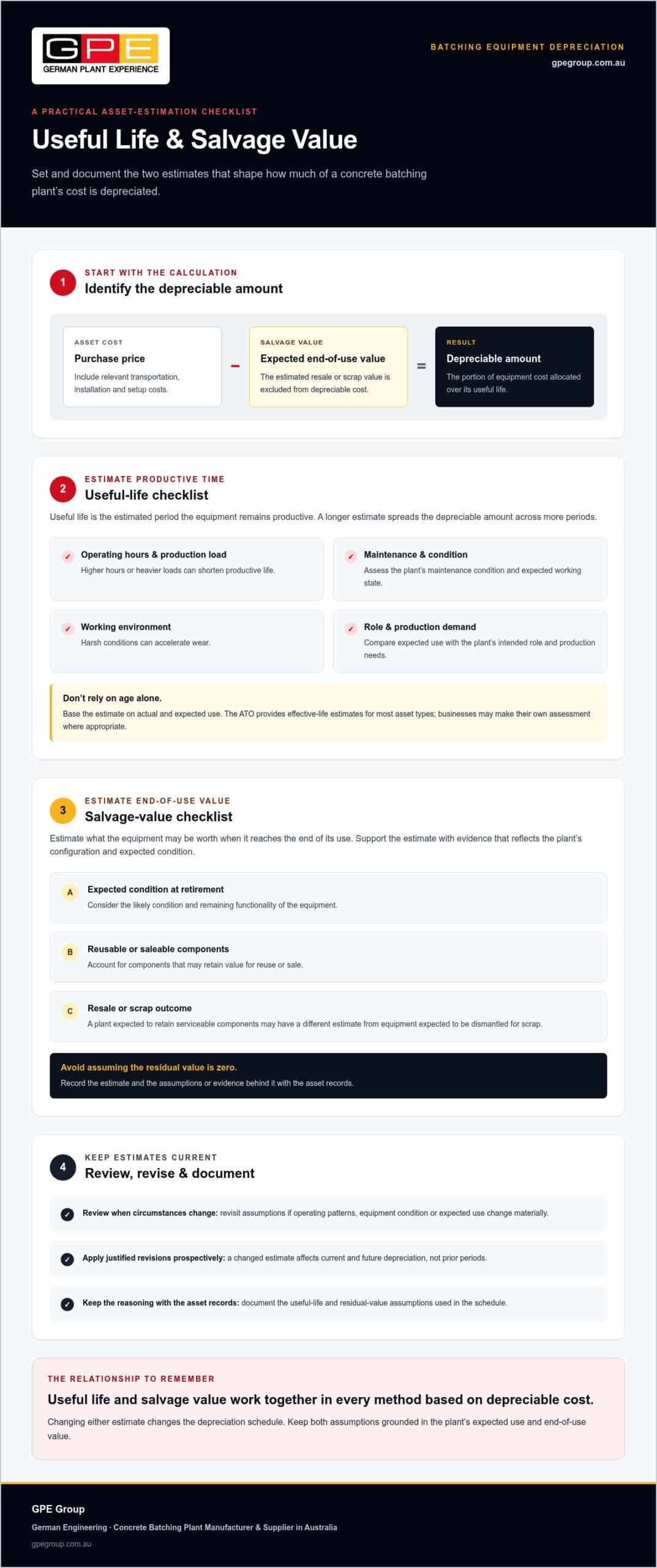
A batching plant’s purchase price is only the starting point for depreciation. Under the straight-line method, subtract the expected salvage value from the asset’s cost, then divide the result by its useful life. Calculating depreciation on concrete batching equipment therefore begins with establishing those inputs. Include relevant transportation, installation and setup costs in the asset’s cost.
The method matters because concrete production machinery may be used intensively, and its wear may relate more closely to operating hours or output than to time elapsed. Straight-line depreciation allocates the depreciable amount evenly. Declining-balance and units-of-production methods recognise expense differently as book value or production changes.
For Australian tax calculations, the Australian Taxation Office (ATO) provides effective-life estimates for most asset types. Businesses may make their own assessment where appropriate. This guide explains how useful life and salvage value shape the calculation, how common methods apply to manufacturing machinery, and why accounting and tax depreciation may need separate consideration.
Key Takeaways
- Depreciation spreads equipment cost across its useful life, with the depreciable amount based on cost less expected salvage value.
- Declining-balance, straight-line and units-of-production methods allocate depreciation differently; the best fit depends on how the equipment is used and how its value changes.
- Useful-life estimates should reflect operating conditions, workload and the equipment’s expected productive period.
- Australian businesses can use the ATO’s effective-life estimates for most asset types, while maintaining distinct tax and accounting records where needed.
- Understanding production needs and equipment lifecycle costs can support more informed planning for a concrete batching plant investment.
Declining balance depreciation
Declining-balance depreciation applies a fixed rate to an asset’s opening book value. As that value falls after each charge, depreciation expense generally decreases over time.
Double-declining method
Double-declining depreciation applies twice the straight-line rate to the opening book value. It recognises more depreciation earlier, which may suit equipment expected to lose value more quickly during its initial productive years.
For a concrete batching plant, the method changes the timing of expense recognition, not the asset’s purchase cost. The calculation uses the book value after accumulated depreciation, multiplied by the selected rate.
Rates, used equipment, and component changes
The rate depends on the method and, for Australian tax depreciation, the asset’s effective life. A 10% annual diminishing-balance rate appears in an equipment example, but it is not a universal rate for batching equipment. According to the Australian Taxation Office, diminishing value corresponds broadly to declining balance in financial reporting.
For second-hand equipment, use its cost to the current owner and assess its remaining useful life and expected residual value. Consider the asset’s age, condition, operating history and production demands. Repairs, upgrades and major components can also affect its recorded value and remaining life. Document each change and its accounting treatment.
How does depreciation differ for owned, leased, and financed concrete batching equipment? For owned or financed equipment, treatment depends on which entity recognises the asset; consider financing charges separately. Lease treatment depends on the lease arrangement and applicable accounting and tax rules.
What are the tax and accounting differences between ATO depreciation and book depreciation? The ATO’s diminishing value and prime cost methods correspond broadly to the declining-balance and straight-line methods used in financial reporting. Businesses may need separate tax and accounting depreciation records.
Can concrete batching equipment qualify for instant asset write-off or temporary full expensing in Australia? Eligible assets may qualify for the small business instant asset write-off, allowing a deduction in the purchase year instead of depreciation over time. Eligibility rules determine whether this treatment applies. Temporary full expensing is a separate tax treatment.
What records must Australian businesses keep to claim depreciation? Keep purchase and installation documents, the selected method, useful-life and residual-value assumptions, accumulated depreciation, and records of upgrades or disposal. These records support consistent calculations and tax and accounting schedules.
How is depreciation calculated for concrete batching equipment in Australia? Under the diminishing-value method, multiply the opening book value by the depreciation rate.
How are repairs, upgrades, and major components treated? Record the work and distinguish maintenance from changes that extend the equipment’s capability or useful life. A substantial upgrade or separately tracked component may affect the asset’s depreciable amount and schedule.
Estimating useful life and salvage value
Useful life and salvage value determine how much of the equipment’s cost is depreciated. For batching machinery, estimate both inputs based on expected operating conditions and end-of-use value.
Service life estimates
Useful life is the estimated period during which equipment remains productive. A longer estimate spreads the depreciable amount across more periods. The ATO provides effective-life estimates for most asset types, and businesses may make their own assessment.
For a batching plant, assess expected operating hours, production load, maintenance condition and working environment. Higher hours or heavier loads can shorten productive life, while harsh conditions can accelerate wear. Compare these factors with the equipment’s intended role and expected production demand. Record your reasoning so the estimate reflects actual use, not simply the asset’s age.
Residual value assessment
Salvage value, also called residual value, is the expected resale or scrap value when equipment reaches the end of its use. This amount is excluded from depreciable cost. Assess the likely condition at retirement, remaining functionality, and whether components may retain value for reuse or sale.
Base the estimate on evidence relevant to the plant’s configuration and expected condition, rather than assuming it will have no residual value. For example, a plant expected to retain serviceable components may have a different residual estimate from equipment expected to be dismantled for scrap. Document the estimate and supporting assumptions with the asset records.
Useful life and residual value work together in every method based on depreciable cost. A change to either estimate changes the depreciation schedule. Apply a justified revision prospectively and document it: the revised estimate affects current and future depreciation, not prior periods. Review assumptions when operating patterns, condition or expected use change materially.
An asset with a useful life of one year has a very different allocation pattern from equipment expected to remain productive longer. This is not a default estimate for a batching plant. Actual life depends on production capacity, operating hours, load, maintenance and obsolescence. Newer equipment models can also make existing machinery obsolete sooner, even if it remains mechanically functional.
Consider salvage estimates alongside the equipment’s expected condition at retirement. Changes in production needs may extend or shorten the period of use, while upgrades can affect what remains serviceable at disposal. Keep the useful-life assessment and residual-value reasoning together so each depreciation review uses consistent assumptions. This also makes it easier to compare the original estimate with later revisions.
Where production plans are changing, the expected duty cycle should inform the assessment. A mobile concrete batching plant configuration may serve a different operating profile from a fixed installation, affecting expected use and eventual condition. The depreciation estimate still rests on the business’s documented assumptions, not on the equipment category alone.
Straight-line depreciation formula
Straight-line depreciation allocates an asset’s depreciable amount evenly across its useful life. In Australia, the ATO’s prime cost method broadly corresponds to straight-line depreciation in financial reporting.
Annual depreciation = (asset cost − salvage value) ÷ useful life. Include relevant transportation, installation and setup costs in the asset cost.
Under this method, the same annual expense is recorded throughout the useful life, assuming the estimates remain unchanged.
For businesses calculating depreciation on concrete batching equipment, this even allocation can make period-to-period expenses easier to forecast. It does not mean the equipment’s market value falls evenly or that wear is identical each year. Production demand, condition and useful-life assumptions still determine whether the method appropriately represents the asset’s consumption.
Prime cost depreciation uses the asset’s cost, residual value and effective life. The ATO provides effective-life estimates for most asset types, while businesses may make their own assessment. Keep the selected useful-life basis consistent with the asset’s expected productive period and document the reasoning.
Annual allocation is the formula’s basic pattern, but businesses may need to calculate expense for shorter periods. One example uses an asset acquired for A$365 with a one-year useful life, allocating A$31 to January when calculating by calendar days. For calculating depreciation on concrete batching equipment by calendar days, a method other than straight-line may be more suitable.
For a monthly schedule, divide annual depreciation by 12 periods. For a daily schedule, the calculation must reflect the chosen method and period basis; retain the underlying dates and calculations with the fixed-asset records.
Apply the method consistently and document any justified change in estimates prospectively. If useful life or salvage value changes, recalculate the remaining depreciable amount over the remaining life rather than revising prior periods. A clear schedule should show original cost, relevant setup costs, residual value, useful life, annual charge and accumulated depreciation.
Units of production depreciation
The units-of-production method links depreciation expense to equipment output. For a concrete batching plant, production records can measure use more directly than elapsed time. The calculation allocates depreciable cost according to output during each accounting period. This method is most relevant when wear or consumption follows production volume.
Depreciation for the period = depreciable cost × (period output ÷ total estimated output). Depreciable cost is the asset’s cost less its expected salvage value. Period output is the production recorded during the period. Total estimated output is the equipment’s expected production over its useful life. Together, these inputs turn recorded production into an expense allocation.
For example, a batching operation can use the volume of concrete produced as its output measure. The business estimates the plant’s total productive capacity, then compares each period’s actual volume with that estimate. A period accounting for a larger share of expected lifetime production will have a larger depreciation charge. Lower production results in a smaller charge under this method.
Reliable measurement is essential. Select an output measure that reflects the equipment’s productive role, then apply it consistently. Production logs, batch records and plant operating data can support the period’s output figure. Estimate total output based on expected productive capacity, rather than relying on calendar-based service life alone.
A practical calculation follows a defined sequence:
- Establish the asset’s depreciable cost after considering salvage value.
- Set the production measure, such as concrete volume recorded by the operation.
- Estimate total output expected during the asset’s productive life.
- Record the period’s actual output using the same measure.
- Apply the formula and retain the supporting calculation with asset records.
Unlike straight-line depreciation, units of production is driven by output, not equal time intervals. It also differs from declining balance, which applies a rate to book value. The methods can produce different expense patterns for the same asset. Units of production is most informative when output reasonably measures equipment consumption.
Production from batching equipment may vary between reporting periods as project demand changes. A low-output period does not automatically mean the plant’s productive capacity has fallen or its useful life has lengthened. It reflects the output recorded for that period. Reassess total expected production when operating expectations change, and document the basis for any revised estimate.
Consistency matters throughout the schedule. Use the same output unit for period production and estimated lifetime production, and keep records that reconcile the quantities. Incomplete output data can make the allocation a less accurate reflection of actual use. Australian businesses may also need separate accounting and tax schedules because depreciation treatment can differ between records.
Depreciation for manufacturing machinery
Manufacturing machinery supports production over multiple reporting periods, so depreciation allocates its cost across its productive life. Concrete batching equipment may operate under demanding loads, making the relationship between use, wear and expense important. The selected method shapes when depreciation appears in financial records. It does not directly reduce cash, but it affects reported profit and helps track asset consumption.
The sum-of-the-years’-digits method accelerates depreciation by applying a decreasing fraction to depreciable cost. Calculate the denominator using n(n + 1) ÷ 2, where n is useful life in years. For a five-year life, the denominator is 15. The Year 1 fraction is 5/15, then the remaining-life fraction decreases annually.
Across that five-year schedule, the fractions are 5/15, 4/15, 3/15, 2/15 and 1/15. Multiply each fraction by depreciable cost to calculate that year’s expense. This recognises more depreciation earlier, then progressively less. It can suit machinery whose productive contribution or value is expected to decline faster during earlier years.
Operating conditions also inform the assessment. Higher operating hours or loads can reduce machinery’s lifespan, while harsh conditions can accelerate wear. Newer models may make existing equipment obsolete sooner, even if it remains operational. These factors inform useful-life estimates and method selection; they do not replace asset records or justify unsupported rate assumptions.
Keep tax depreciation distinct from accounting depreciation where the calculations differ. The ATO’s diminishing value and prime cost methods broadly correspond to declining-balance and straight-line methods in financial reporting. Australian businesses may need separate tax and accounting records to meet ATO and Australian Accounting Standards Board requirements. Each schedule should identify its method, assumptions and accumulated depreciation.
Review machinery assumptions regularly. If an unexpected event sharply reduces an asset’s value, recognise impairment promptly rather than treating it as routine depreciation. Depreciation allocates an asset’s cost over time, while impairment reflects an unexpected decline in its value. Keeping these entries distinct clarifies both planned asset consumption and unexpected damage or obsolescence.
For a five-year asset, the declining fractions make the timing difference visible: Year 1 receives 5/15 of depreciable cost, while Year 5 receives 1/15. Apply the chosen method consistently, document justified changes, and retain the calculations behind each schedule. To align capital equipment planning with production requirements, discuss your plant requirements.
GPE Group: Concrete Batching Plants
GPE Group is a Concrete Batching Plant Manufacturer and Concrete Batching Plant Supplier serving Australia, with stationary and mobile plants engineered in Germany. Its solutions support concrete production planning, while after-sales service and spare parts are provided around the world.
Hundreds of GPE Group plant installations operate worldwide, including plants used to manufacture concrete for landmarks such as the Burj Khalifa. For Australian businesses assessing production equipment, this engineering background offers a relevant basis for discussing project requirements and plant configuration.
Contact GPE Group to discuss your requirements or visit gpegroup.com.au.
Align Asset Planning With Future Production
Depreciation is more useful when it informs decisions beyond period-end reporting. As project requirements evolve, businesses can connect asset assumptions with production plans, expected operating demands and replacement priorities. This provides a practical basis for coordinating finance, operations and engineering teams, while keeping the rationale for capital decisions clear and documented.
For future investments, calculating depreciation on concrete batching equipment can sit alongside a broader assessment of how a plant must perform across its intended service. Consider how the proposed configuration supports the work ahead, and how its operating profile fits the business’s long-term plans. GPE Group works with businesses considering concrete production equipment as part of that evaluation. Contact GPE Group to discuss your requirements and take the next step with a clearer view of your project needs.
Frequently Asked Questions
What Is Equipment Depreciation and How to Calculate It?
Equipment depreciation allocates an asset’s depreciable amount across the periods in which it helps generate business income. The calculation depends on asset cost, expected salvage value, useful life and the selected method. Production-based calculations use recorded output, while time-based methods use the asset’s useful life. Australian businesses should distinguish tax depreciation schedules from accounting records when their purposes or applicable methods differ.
What Is Fixed Asset Depreciation?
Fixed-asset depreciation is the accounting allocation of a long-term asset’s depreciable amount over its useful life. Plant, machinery and other production equipment may be fixed assets when used in business operations. Depreciation reduces an asset’s carrying amount over time, but a fully depreciated asset can remain on the balance sheet until disposal or write-off. A clear asset register helps track its status and accumulated depreciation.
What is the ATO effective life of concrete batching plant and equipment?
The ATO provides effective-life estimates for most asset types, but do not assume a single effective life applies to every concrete batching plant configuration. Businesses can use the relevant estimate or make their own assessment based on expected productive use. Operating hours, production load, working conditions and obsolescence can inform the assessment. Record the basis used, since effective life affects the timing of tax depreciation deductions.
How does the ATO determine the cost base of concrete batching equipment for depreciation?
To calculate depreciation, establish the equipment’s cost using its purchase amount and relevant costs of getting it ready for use. Include transportation, installation and setup costs in the equipment cost calculation. Keep invoices and supporting records that identify these amounts separately so the calculation can be traced to source documents. The depreciable amount also depends on residual value and the method used.