 Main Number
 Find us on
 Reach us @
The equipment budget is only one part of a batching plant funding case. To understand how to get project funding for a new batching plant, first define the project scope and assess demand and site requirements. Then prepare a credible budget, feasibility study and financial projections for potential funders. Grant applications may also require evidence of compliance, and eligibility depends on the program and the project’s circumstances.
Scrutinise capital costs, funding conditions and expected returns before committing. This guide covers the main funding routes, the information typically needed to support an application, and how to assess eligibility by project type and location. It also explains how to model operating costs and returns and what to look for in funding milestones and reporting requirements, helping you build a disciplined investment case.
Key Takeaways
- Build a project budget around the full scope, including equipment, site needs, operations and ongoing maintenance.
- Strengthen a funding application with a feasibility case, realistic cash-flow projections and evidence that supports the project’s demand.
- Assess funding eligibility against the project’s location, sector, stage of development and the program’s application requirements.
- Model returns using production volumes, input costs, operating expenses and realistic assumptions about sales and utilisation.
- Review funding conditions carefully, then plan how to document milestones, report progress and manage approved changes.
Financial projections and return-on-investment analysis
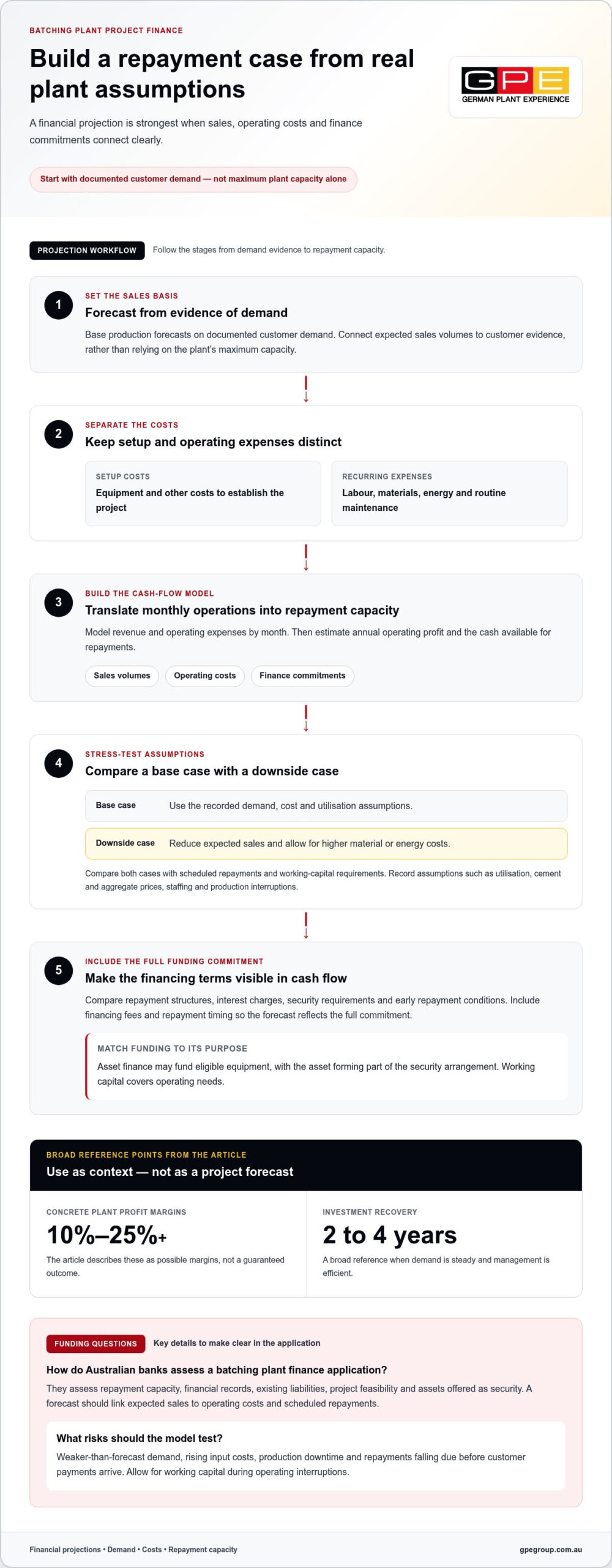
Financial projections are central to securing project funding for a new batching plant because they show how proposed production could generate cash for repayments. Build the model around sales volumes, operating costs and finance commitments, not maximum plant capacity alone. Separate setup costs from recurring expenses, and base production forecasts on documented customer demand. This makes the funding case easier to assess and highlights assumptions that could affect returns.
Concrete plants can achieve profit margins of 10%-25% or more, with investment recovery in 2 to 4 years when demand is steady and management is efficient. Use these figures as broad reference points, not as project-specific forecasts. Model revenue and operating expenses by month, then estimate annual operating profit and cash available for repayments. Include labour, materials, energy and routine maintenance.
Run a base case and a downside case. In the downside case, reduce expected sales and allow for higher material or energy costs. Compare both projections with repayments and working-capital requirements. Record every assumption, including utilisation, cement and aggregate prices, staffing, and production interruptions. For businesses planning how to get project funding for a new batching plant, this sensitivity analysis shows funders which factors most influence repayment capacity.
How much equity or deposit is typically needed to finance a batching plant in Australia? There is no single deposit amount for every project. The required contribution depends on the lender’s assessment of asset security, the business’s financial position, project cash flow and the overall funding structure.
How do Australian banks assess finance applications for a concrete batching plant? Banks assess repayment capacity, financial records, existing liabilities, project feasibility and assets offered as security. A forecast linking expected sales to operating costs and scheduled repayments helps explain how the business expects to service the debt.
Asset finance can fund eligible equipment, with the asset forming part of the security arrangement. Long-term financing may align repayments with the years in which the plant generates revenue, while working capital covers operating needs. Compare repayment structures, interest charges, security requirements and early repayment conditions. Include financing fees and repayment timing in the cash-flow model so the forecast reflects the full funding commitment.
Agricultural businesses should assess grants and financial assistance alongside commercial lending. In Queensland, the Queensland Rural and Industry Development Authority provides grants and loans to help establish and improve primary production enterprises. Eligibility depends on the program and business purpose. A funding plan can combine eligible support with asset finance or long-term debt, assigning each source to specific project costs.
What are the risks of financing and operating a new concrete batching plant in Australia? Key risks include weaker-than-forecast demand, rising input costs, production downtime and repayments falling due before customer payments arrive. Test these conditions in the financial model, budget for working capital during operating interruptions, and consider industrial IoT monitoring systems from providers such as CAPTEMP to safeguard critical equipment.
Batching plant investment and fundraising
A credible funding plan starts with a defined project scope, not a headline funding request. Securing funding for a new batching plant means setting out the intended capacity, site requirements, construction work, utilities, commissioning and working capital. Separate equipment and infrastructure costs from recurring operating expenses. This shows funders what the capital will support and how each component contributes to production. It also lets the business stage spending against procurement, construction and commissioning milestones.
Prepare a project brief that connects demand evidence to the proposed investment. Include customer segments, expected sales volumes, delivery constraints and the proposed concrete batching plant’s market position. Support assumptions with customer discussions, letters of intent or existing contracts where available. Then map the supply chain, including cement, aggregates, water and transport. Documenting supply arrangements for key inputs helps show how the facility can operate consistently.
Funding can combine sources with different obligations. Owner equity demonstrates commitment, while commercial lending and asset finance can fund eligible capital requirements. Private investors may provide capital in return for an agreed ownership interest or other terms. Grants and regional development programs may support projects that meet specific objectives, but eligibility, timing and permitted expenditure vary. Compare repayment schedules, security, ownership dilution and reporting duties before combining sources.
Its infrastructure focus means an application must explain how the project scope relates to that purpose. Do not treat the facility’s total lending capacity as funding allocated to an individual project. Build the application around location, infrastructure contribution, commercial rationale and financing structure.
A commercial feasibility assessment can test whether the scope, site conditions, budget and staging support the funding case. Assemble a data room with a project summary, feasibility study, financial projections, demand evidence, site information, supplier quotations and a risk register. Keep assumptions consistent across documents. For example, production forecasts in the feasibility study should match sales volumes in the cash-flow model. Record the funding sought, its intended use and the timing of each expenditure category.
- Distinguish equity, loans, asset finance, grants and investor capital by repayment or ownership conditions.
- Match each funding source to an eligible project cost and its expenditure timing.
- Use staged funding to connect capital drawdowns with procurement, infrastructure and commissioning.
A practical answer to how to get project funding for a new batching plant is to reconcile the complete project budget with the financing plan and forecast cash flow. A clear record of assumptions makes the proposal easier to assess and helps identify funding gaps early. Align the financing brief with the project’s production and site requirements before presenting it to prospective funders.
Assessing eligibility by project type and location
Funding eligibility depends on the relationship between the project, the applicant and the program’s objectives. Start by classifying the proposal as a new concrete production facility, an expansion, a relocation or a replacement investment. Each type presents a different funding case. A new facility may need to demonstrate local demand and infrastructure benefits, while an expansion can show how existing operations support the proposed increase in output.
Location can narrow the funding options. Commercial project funding support may involve reviewing opportunities by project type, location, sector, eligibility and timing. Prepare a location profile covering the proposed site, nearby customers, material supply routes, transport access and relevant local infrastructure. For a regional project, explain how the facility would serve construction activity or address a supply constraint. For an urban proposal, describe demand, access and the proposed site’s role.
Match the project’s stated purpose to the funding stream before drafting an application. A program focused on regional development may assess a project differently from one supporting industry growth or agricultural productivity. For example, an applicant proposing concrete production for farming-related infrastructure should explain its connection to primary production. A general commercial plant proposal should instead clarify its customer base, expected sales and wider economic contribution.
Eligibility also depends on the applicant’s structure and financial position. Assemble business registration details, ownership information, financial statements and evidence of operating capability. If a new entity will own the facility, document its relationship with any established operating business. Funders need a clear view of who will receive the funds, own project assets, manage construction and generate revenue. Keep these responsibilities consistent across the application and supporting documents.
Site readiness is separate from business eligibility. Identify land access, the intended facility layout, utility needs, materials handling and transport movements. Explain how site constraints affect the project schedule and budget. Where approvals or environmental assessments apply, record their status and show how they relate to the proposed scope. Do not present a project as construction-ready if essential site decisions remain unresolved.
- Map each funding program against the project’s location, sector, applicant type and eligible expenditure.
- Separate costs directly tied to the facility from working capital and general business expenses.
- Prepare evidence linking projected demand to customers, contracts or documented market analysis.
- Set out the project’s current stage, key dependencies and the timing of funding needs.
A practical eligibility matrix can reveal gaps before submission. List each program’s purpose, applicant criteria, location requirements, eligible costs, assessment timing and required evidence. Mark each item as supported, in progress or unresolved. This makes the next action clear: strengthen demand evidence, clarify ownership, resolve site planning or choose a funding route better suited to the project.
Keep the funding request proportionate to the project’s scope. A proposal for a single regional facility should explain its local demand and site rationale rather than rely on broad claims about national infrastructure. A well-matched application presents the location, project type and applicant as one coherent case, supported by consistent records and a clearly defined use of funds.
Commercialisation and growth funding
Growth funding is most relevant when a batching plant project forms part of a broader commercialisation plan. Define what the business will bring to market, how the operation will grow and what evidence supports demand. A proposal seeking funds for increased production capacity should distinguish the plant investment from any research, product development or market expansion activities. This clarity helps match the project to each funding program’s purpose.
These categories are not interchangeable. Describe the project stage, intended outcomes, commercial pathway and proposed use of funds. Separate capital equipment, site works and operating costs in the budget, then map each item to the relevant program’s eligible expenditure rules.
For the Industry Growth Program Advisory Service, a business must have had combined annual turnover of less than A$20 million in each of the three financial years before applying, according to the Australian Government Department of Industry, Science and Resources. The turnover threshold is only one part of eligibility. Prepare financial statements and supporting records that clearly show the applicant entity’s turnover and business structure.
The Industry Growth Program is paused to new applications. Treat this status as a practical constraint when planning funding timing, rather than assuming a new application can be lodged immediately. Businesses can still build a commercialisation case for future opportunities or assess other relevant programs. For example, a regional project may examine development funding, while an agricultural operation may assess assistance designed for farming-related businesses.
Prepare a concise commercialisation plan before approaching a grant program. Explain the current business operation, the proposed change, the intended customers and how increased capacity supports growth. Include a staged budget, sales assumptions, key risks and measurable project outputs. For example, a concrete production expansion plan should connect the investment to forecast demand and explain how additional output will be sold.
- Identify whether the project supports early commercialisation, market expansion or production growth.
- Confirm the applicant entity, turnover evidence, location and eligible expenditure against each program.
- Align the project schedule with application timing, assessment stages and any funding milestones.
Grant funding is only one part of a capital structure. Compare it with asset finance, lending and business equity, then identify which source will cover each project cost. Keep a separate cash-flow forecast for the grant-funded work and the wider plant operation. This prevents projected commercialisation activity from obscuring repayment needs or the funds required to bring the facility into sustained production.
Funding conditions, milestones and reporting
Once funding is approved, the funding agreement governs how the money can be used. Review its conditions alongside the project budget before committing expenditure. Record eligible costs, payment arrangements, reporting dates and any approval requirements for project changes. For example, a grant may restrict spending to specified activities, while asset finance has its own repayment and security terms. These obligations shape procurement, construction and cash-flow planning.
Translate the agreement into a milestone schedule that follows the actual project sequence. A batching plant project may progress through design, site preparation, equipment procurement, installation and commissioning. For each milestone, identify the responsible person, expected evidence and related funding drawdown. Invoices, supplier contracts, progress records and commissioning documents can support milestone claims when they meet the agreement’s requirements.
Establish a reporting process before the initial funding drawdown. Assign responsibility for collecting financial and project records, then reconcile actual spending against the approved budget. Keep invoices, payment records and a clear explanation for each material variance. Regular reviews can identify issues early, including delayed procurement or changes to site work, before they affect the next milestone or funding request.
- Maintain a register of approved costs, actual expenditure and supporting documents.
- Compare project progress with agreed milestones and record any schedule changes.
- Separate funded project transactions from unrelated business expenditure in management records.
- Escalate proposed changes through the funder’s stated variation process before acting.
Handle variations carefully. If the project scope, supplier, timing or budget changes, compare the proposed adjustment with the agreement. Document the reason, financial effect and impact on delivery milestones. Submit the required variation information before making a commitment that could conflict with funding conditions. If an extension is needed, explain the cause, revised schedule and remaining work using current project records.
For a financed asset, distinguish lender obligations from grant reporting. A lender may require scheduled repayments and compliance with agreed security terms, while a grant may require evidence of eligible expenditure and project outcomes. Maintain separate calendars for repayment dates, reporting deadlines and milestone submissions. This helps avoid missing a financial obligation while the project team focuses on construction or commissioning.
At close-out, reconcile total project expenditure against the approved funding amount and retain the evidence required by the agreement. Summarise completed milestones, explain material variances and record outstanding actions. This final account gives funders a clear view of how funds were applied and whether the approved scope was delivered. Documented close-out also supports internal reviews of future capital projects.
Before finalising milestones, align the funding schedule with the batching plant project scope and its procurement sequence. A clearly defined equipment scope helps connect expenditure records with delivery evidence, while a coherent schedule supports timely reporting and reduces avoidable variation requests.
GPE Group: Concrete Batching Plants
GPE Group is a Concrete Batching Plant Manufacturer and Concrete Batching Plant Supplier in Australia, with German-engineered stationary and mobile solutions tailored to project requirements. Its plants offer custom production capacities from 30 m³/h to 400 m³/h, enabling businesses to align equipment scope with planned demand and site conditions.
For projects that require mobility or relocation, a Mobile Concrete Batching Plant may suit the operating plan. Cement Silos and Mobile Horizontal Cement Silos can also be incorporated into the material storage scope, helping define a coordinated equipment brief for project planning.
GPE Group plants have been used to produce concrete for landmarks including the Burj Khalifa. If you are defining equipment requirements alongside your funding plan, contact GPE Group to discuss your project scope.
Move From Funding Case to Project Scope
A funding model becomes more actionable when its assumptions translate into a defined equipment scope and delivery plan. Securing funding for a new batching plant also means showing how the proposed investment fits the business’s operating strategy, rather than treating finance as a separate decision.
GPE Group offers Concrete Batching Plants, a Mobile Concrete Batching Plant and Cement Silos for projects that require these solutions. Aligning the equipment brief with expected production, site constraints and funding milestones gives the project team a clearer basis for its next planning decisions.
Bring together your proposed capacity, site information and funding objectives before discussing the project. This creates a focused starting point for considering an appropriate plant configuration and how it supports the broader investment plan.
Contact GPE Group about your batching plant project to discuss the equipment scope. A disciplined next step can move your project planning forward with greater clarity.
Frequently Asked Questions
How Much Will It Cost?
There is no single fixed cost for a batching plant project. The price depends on the project and is provided after a quote request. Scope, production capacity, plant configuration, site requirements, storage needs and project delivery arrangements shape the equipment specification. Include site preparation, infrastructure and commissioning in the wider project budget, rather than treating the equipment quote as the total capital requirement.
What funding options are available for a new batching plant in Australia?
Common funding routes include business equity, commercial lending, asset finance, private investment and eligible grants. Compare them by repayment obligations, security, ownership implications and permitted use of funds. For example, a business might use equity for early project costs, then align asset finance with machinery procurement. List each source beside the cost it will fund to make the overall structure clear and avoid relying on one source for every project need.
What grants or government incentives can help fund a batching plant in Australia?
Potential support depends on the project’s sector, location and purpose. Agricultural businesses can assess relevant grants, loans and partnerships, including Queensland Rural and Industry Development Authority programs for primary production enterprises. Regional development and industry growth programs may also be relevant when project objectives align. The Industry Growth Program is paused to new applications, so distinguish current opportunities from programs that are not accepting applications.
What financial projections and documents do lenders require for batching plant funding?
Lenders need a coherent view of the applicant’s financial position and the project’s repayment capacity. Prepare historical financial statements, current liabilities, a project budget, cash-flow forecasts and a documented sales case. Reconcile forecast output with customer demand and planned operating hours. Also show how the business will meet repayments during commissioning, before production reaches its planned operating level.
Can equipment finance or leasing cover batching plant machinery and vehicles?
Equipment finance can be structured around eligible batching machinery, while vehicle funding can be assessed as a separate asset requirement. Present each asset clearly, with its intended business use, supplier documentation and place in the project schedule. Distinguish ownership, repayment and end-of-term conditions between finance and leasing arrangements. This helps the business understand which assets secure each facility and how the obligations affect cash flow.
How can a new batching plant demonstrate demand and profitability to investors or lenders?
Show demand through a customer-by-customer sales forecast, expected order patterns and evidence of repeat purchasing. Explain the operating assumptions behind the forecast, including utilisation, material costs, staffing and delivery constraints. Test the model against lower sales volumes and changes in input costs. Investors can then see which assumptions most affect break-even performance and whether the proposal remains viable under less favourable trading conditions.