 Main Number
 Find us on
 Reach us @
A useful on-site concrete production vs ready-mix cost comparison in Australia weighs the full project costs, including delivery, waiting time and small-load charges, rather than comparing material prices alone.
For a small pour, delivery and site access can affect the budget as much as the concrete itself. For sustained or larger-volume work, production control and the ability to batch on site may carry more weight in the cost assessment.
This article compares the two approaches for Australian projects, explains the factors that can change the cost, and shows how batch size, location and operating requirements shape the decision. It also considers ready-mix production in Australia, helping you assess which supply model suits your project’s demands and site conditions.
Key Takeaways
- Compare delivered concrete costs on a consistent basis, accounting for strength grade, location, load size and any applicable delivery or waiting charges.
- Ready-mix can reduce on-site mixing labour, equipment needs and raw-material storage, while site production requires those resources to be planned and costed.
- Because fresh concrete is perishable, local supply and the distance to site affect ready-mix logistics and the overall cost assessment.
- Site-mixing can provide flexibility for small batches or remote locations, but the outcome depends on controlled proportions, suitable materials and competent operation.
- There is no single project-volume threshold that determines the cheaper option; compare expected batch demand, production duration and site requirements before choosing.
How much does concrete cost per m³ in Australia in 2026?
Indicative Australian ready-mix prices in 2026 vary by concrete strength, order size and location. Compare the delivered cost with on-site production costs, including labour, materials, equipment and waste.
Ready-Mix Supply and Local Markets
Ready-mix concrete is batched before delivery and transported to the site while it is still workable. Because fresh concrete is perishable, suppliers serve local markets, and transport distance affects delivery logistics and cost.
The 20 MPa range includes GST; the 25 MPa figure has no stated GST basis. For 25 MPa, compare the same strength, load size and inclusions across quotes.
State and Regional Price Variation
Location affects both the material price and the cost of transporting concrete.
Regional prices are typically 10 to 30% above metro prices; remote and island locations can cost more because of freight. Ask each supplier to separate concrete, cartage, load-size surcharges and GST in its quote.
To compare quotes, match the strength grade and volume, then check whether the figures include GST, delivery and small-load fees. Record waiting-time allowances and other charges separately: a lower per-m³ price may not mean a lower delivered total.
On-Site Batching Requirements
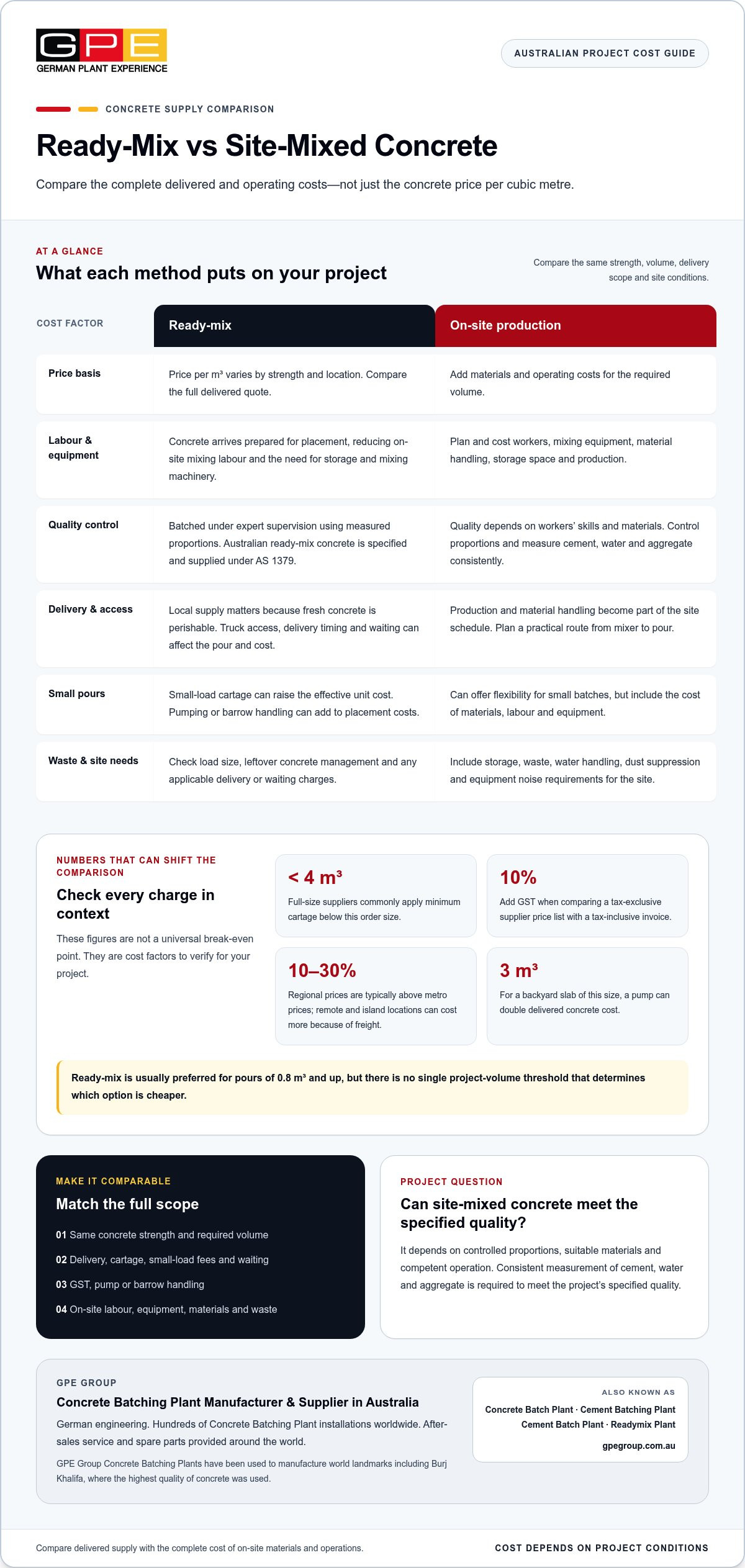
Australian ready-mix concrete is specified and supplied under AS 1379. On-site production still requires controlled proportions and consistent measurement of cement, water and aggregate to meet the project’s specified quality.
Environmental, water-use, dust, noise and waste requirements depend on the site and applicable local controls. Assess water handling, dust suppression, equipment noise and leftover concrete management separately, rather than treating them as part of the material price.
On-site batching puts material storage, mixing and production under the project’s control. Include the resources needed to maintain mix consistency and manage the site’s environmental impacts in the cost comparison.
| Option | Price basis | Key cost considerations |
|---|---|---|
| Ready-mix | Price per m³ by strength and location | Cartage, load size, GST and waiting |
| On-site production | Materials plus operating costs | Labour, equipment, storage and waste |
Compare the full delivered ready-mix quote with the complete cost of on-site materials and operations for the required volume.
Ready-Mix Vs Site-Mixed Concrete: What’s Better For Your Project?
Ready-mix reduces on-site mixing tasks, while site-mixing puts production labour and equipment on the project. Compare concrete quality, delivery and small-load costs alongside the resources each method requires.
Ready-mix is produced under expert supervision using measured proportions, supporting uniformity. Site-mix quality depends on workers’ skills and materials. Both methods require appropriate control of the specified strength and mix.
On-site production makes mixing, material handling and equipment operation part of the site schedule. Ready-mix reduces those tasks, but delivery timing and truck access affect placement. Delays can add waiting costs and disrupt the pour sequence.
Labour and Equipment Costs
Site-mixing requires workers to handle cement, water and aggregate, measure proportions and operate mixing equipment. The project also needs space for materials and a practical route from the mixer to the pour. Ready-mix arrives prepared for placement, reducing on-site mixing labour and the need for storage and mixing machinery.
Access still matters. If the crew uses barrows, concrete must be moved from the discharge point to the pour, adding handling work. A pump can reduce manual transfer but adds a separate charge.
GST and Delivered Costs
Australian supplier price lists are commonly exclusive of GST, so add 10% when comparing them with a tax-inclusive invoice. Compare the same strength, volume and delivery inclusions.
For a 3 m³ backyard slab, the pump can double delivered concrete cost. Include pump access and barrow handling in the placement plan.
Small Loads and Cartage
Full-size suppliers commonly apply minimum cartage when an order falls below 4 m³. These charges can raise the effective unit cost of a small pour, even when the quoted concrete rate appears competitive.
Calculate the required volume before ordering, then compare the delivered total with the cost of site-mixing materials and labour. A prepared crew and clear truck access can help limit delays.
Project Size and Cost Advantage
There is no single volume at which site production becomes cheaper. Ready-mix is usually preferred for pours of 0.8 m³ and up, while small-load cartage can alter the comparison. For sustained demand, assess production labour, equipment, material storage and waste against delivered concrete and placement costs.
Compare the full scope, not just the per-m³ rate. Include concrete strength, labour, equipment, cartage, GST, pump or barrow handling, and scheduling constraints. This project-specific calculation shows which method suits the required batch size and site conditions.
Ready-mixed concrete manufacturing in Australia
Australia’s ready-mixed concrete manufacturing industry supplies projects with concrete batched before delivery. In 2026, the industry had a market size of A$7.6 billion and included 172 businesses. Its output includes ready-mixed concrete and mortar, dry-mix concrete, and concrete slurry, serving construction work with differing material and placement requirements.
Concrete production combines Portland cement, water and aggregates in controlled proportions. The concrete is delivered unhardened, ready for placement. This connects production, transport and the construction programme: delivery must align with site readiness, access and the crew’s ability to place the load.
For a driveway, the practical difference is between producing concrete at a manufacturing facility and arranging placement at the property. Ready-mix arrives prepared for use, so the site does not need to organise separate mixing of cement, water and aggregate. The driveway crew still needs a clear placement plan, suitable access and coordination with delivery timing.
The industry’s structure has also shifted. Between 2021 and 2026, its business count declined at a compound annual growth rate of 3.7%, while industry growth over that period was 0.4%. These figures describe different measures: the number of businesses fell, while the industry’s overall activity recorded modest growth.
Manufacturers supply concrete to local construction markets because fresh concrete is perishable. Transport and scheduling are therefore integral to production. Project managers should define the required mix, coordinate the delivery window, prepare the site for discharge and sequence placement so the concrete can be used while workable.
Australia’s ready-mixed concrete manufacturing industry is expected to grow over the next five years, while its reported industry data includes 10 years of historical figures and five years of forecasts. For buyers, industry scale does not determine the best method by itself. Project volume, delivery distance, site access and production continuity still shape whether factory supply or on-site batching suits the work.
Boral Limited, Hanson Australia, Holcim Australia and Adbri Limited account for more than two-thirds of ready-mixed concrete industry sales in Australia. Ready-mix can help projects progress faster because it arrives ready to use and does not require on-site mixing.
Site-mix flexibility and small batches
Site-mixing gives project teams control over production timing and batch sequence. This may suit a residential repair, staged work or a remote Australian site without a nearby ready-mix plant. The benefit is operational flexibility, not an automatic reduction in total cost.
Concrete combines Portland cement, water and aggregates, so each batch requires measured proportions. Site-mixed proportions can be adjusted to suit project requirements or environmental conditions, while the specified mix must still be maintained. Because the result depends on workers’ skills and materials, consistent measuring and mixing are central to quality.
Small quantities can make manual handling intensive. A cubic metre requires roughly 110 bags of 20 kg pre-mix, illustrating the storage and handling involved when bagged material is used. A machine can assist mixing, but the team still needs to organise material supply, batch preparation and movement to the pour.
For a residential path or repair, site production can let work proceed in smaller batches instead of relying on one large delivery. This may help where access limits delivery or work is staged. It also requires a practical sequence: prepare the area, measure ingredients, mix, place and finish each batch without disrupting the next task.
- Confirm the mix requirements: establish the required strength and proportions before batching.
- Plan materials: organise cement, water and aggregate close to the mixing area.
- Sequence the work: align batch size with placement and finishing capacity.
- Estimate volume: calculate the slab volume and allow a 5 to 10% wastage buffer.
A wastage allowance accounts for differences between the calculated slab volume and the concrete actually needed. It does not replace accurate measurement or controlled batching. For irregular residential areas, careful volume calculations are especially useful because edges, changes in depth and ground conditions affect the quantity required.
Remote projects may favour site-mixing when nearby batching plants cannot meet the required location or timing. But distance alone does not determine the economics: labour, material transport, storage, equipment and waste all affect the total. Compare those operating needs with the ready-mix delivery arrangement available to the site.
Site-mixing is most useful when flexibility and control over batch timing outweigh the extra work of producing concrete on site. For larger, continuous pours, production consistency and the crew’s ability to keep pace are key considerations. Match the method to the required mix, site access and realistic placement sequence.
At what project size does on-site concrete production become cheaper than ready-mix in Australia?
There is no single cubic-metre threshold at which on-site production becomes cheaper across Australian projects. The break-even point depends on delivered ready-mix costs and the full cost of producing concrete on site. A project-specific on-site concrete production vs ready-mix cost comparison in Australia should account for volume, schedule, location and operating requirements, not rely on a single national cutoff.
Ready-mix is usually preferred for pours of 0.8 m³ and up, according to the market guidance. That is a general selection benchmark, not a guaranteed cost crossover. Small pours may still suit ready-mix when delivery aligns with site access, while repeated demand can change the calculation for on-site production.
Compare the same concrete strength and usable volume. For ready-mix, include the quoted material rate, delivery, load-related charges, GST and placement costs. For site production, include cement, water and aggregate, plus labour, mixing equipment, material storage and waste. Divide each complete project cost by the usable cubic metres produced to compare the methods consistently.
Production continuity can change the calculation. If a project needs concrete across multiple stages, on-site production may avoid arranging separate deliveries for each batch. However, equipment and labour need to be used productively. Idle time, uneven batch demand and excess material handling can reduce the apparent advantage, even when the total project volume seems substantial.
Location also affects the comparison. A remote Australian site may have longer ready-mix supply routes, while on-site production requires ingredients to be transported and stored. Assess the transport burden for both options, along with how each method supports the required mix and construction schedule. Comparing alternative delivery patterns or production schedules can refine the estimate.
Use a consistent set of inputs to estimate the project threshold:
- Define demand: calculate total volume and identify when each pour is required.
- Cost ready-mix: use the specified strength and include delivery, GST and placement.
- Cost on-site production: include ingredients, labour, equipment, storage and waste.
- Test volumes: compare total and per-cubic-metre costs as project demand changes.
The more economical method is the one that meets the project’s mix and schedule requirements at the lower complete cost. For sustained demand, map your required production capacity against expected batch volume and operating hours.
GPE Group: Concrete Batching Plants
GPE Group is a Concrete Batching Plant Manufacturer and Concrete Batching Plant Supplier in Australia, providing stationary and mobile plant solutions engineered in Germany. Custom production capacities range from 30 m³/h to 400 m³/h, with configuration shaped by project output, batch demand and site requirements.
GPE Group’s Concrete Batching Plants have been used to manufacture concrete for landmarks including the Burj Khalifa, where the highest quality of concrete was used. The company also provides after-sales service and spare parts around the world.
Contact GPE Group to discuss a concrete batching plant configuration suited to your project’s production requirements.
Set Your Production Plan in Motion
The next step is to turn the preferred supply method into an operating plan. Before committing, define the expected pour sequence, concrete specifications, site access, material-handling requirements and production schedule. These details give your project team a practical basis for assessing equipment configuration and integrating production with construction activities.
A considered on-site concrete production vs ready-mix cost comparison in Australia should inform that plan, not replace it. The chosen approach must match the project’s delivery priorities and how work will proceed on site. Where on-site production fits, a suitable batching configuration can support a more planned approach to concrete supply and placement.
For projects evaluating on-site production, GPE Group offers Concrete Batching Plants, Mobile Concrete Batching Plant solutions and Cement Silos. Discuss your project requirements directly with the team through Contact GPE Group about your project, and take the next step with a clear production brief.
Frequently Asked Questions
What is the average cost per cubic metre of ready-mix concrete in Australia in 2026?
This guide applies to that strength grade, not to every delivered rate. Delivery and order conditions affect the final amount.
What does on-site concrete production cost per cubic metre in Australia?
There is no single per-cubic-metre figure for on-site production because the total includes materials and operating inputs. Calculate the cement, water and aggregate required for the specified mix, then include labour, mixing equipment, material transport, storage and wastage. Divide the full project cost by the usable volume produced. For example, a remote site with costly material transport may have a different unit cost from a project using locally available ingredients.
What are the equipment, setup, and labour costs for on-site concrete batching?
On-site batching costs include mixing equipment and setup, as well as crew time to prepare and measure materials, operate the mixer, transfer concrete and clean equipment. The required setup depends on the production method, project duration, mix requirements and site layout. A one-off pour spreads setup costs over a limited volume, while regular production spreads those operating tasks across repeated batches.
How do delivery fees, minimum loads, waiting time, and short-load charges affect ready-mix concrete costs?
Compare each charge against the total order volume.