 Main Number
 Find us on
 Reach us @
The largest silo is not necessarily the right answer for a bulk-material operation. A cylindrical cement terminal needs to coordinate receiving, storage and dispatch, while fitting the material flow and site conditions. That distinction matters when deciding whether a standalone silo will meet the need or a terminal is required to support a wider handling operation.
Start by mapping how material will enter the site, where it will be stored and how it will leave. Then consider how the receiving method, silo arrangement and dispatch interface work together. This article explains the purpose and applications of a cylindrical cement terminal, compares operating models and outlines practical project-planning requirements. It also covers a construction detail relevant to transport and assembly: bolted steel panels are flat packed and transported in shipping containers, then bolted at site. Use these considerations to build a project brief that treats storage capacity as one part of the complete system.
Key Takeaways
- Assess a cylindrical cement terminal as an integrated receiving, storage and dispatch operation, not simply as a silo with a capacity target.
- Match the terminal configuration to its role, whether it supports imports, production, satellite storage or distribution.
- Build a project brief around the material, operating purpose, storage needs, site constraints and dispatch interface before settling the design.
- GPE Group terminal systems can use individual silos up to 3,000 m³, with multiple silos assembled into terminals handling up to 20,000 MT of cement.
- Account for erection requirements during project planning: local crews can erect silos, and factory-trained engineers are always available for supervision.
What Is a Cylindrical Cement Terminal and When Is It Needed?
A cylindrical cement terminal is a facility that connects bulk cement receipt, storage and onward transfer. Its design brings these functions together: the receiving method, silo arrangement and dispatch interface must work as a system. A standalone silo is primarily a storage vessel. It may be one part of a terminal, but it does not by itself define how material enters or leaves the site.
This distinction helps project teams define the equipment they need. If the operation requires a storage point connected to an existing process, a silo may serve that role. If it must receive material, store it and supply another transport or operational interface, the project brief needs to cover the entire route, site layout and planned distribution method.
How a Terminal Differs From Standalone Cement Storage
Receiving, storage and dispatch shape the terminal concept. An import facility, for example, may connect incoming bulk material with storage and onward distribution. A production site may transfer cement from manufacturing into storage before dispatch. The sequence and interfaces vary by operating model, so silo capacity alone cannot define the facility.
A terminal can combine multiple silos to meet storage requirements and suit site conditions. GPE terminal systems can use individual silos up to 3,000 m³, with multiple silos assembled into terminals handling up to 20,000 MT of cement. These figures describe possible configurations, not a substitute for mapping the full material route. For a closer comparison of the asset types, consider a cement silo versus cement terminal infrastructure assessment.
The word “cylindrical” describes the vessel form, not the material-processing function. A cement mill grinds clinker into cement; a terminal stores and handles bulk material. Although a mill may also have a cylindrical form, it serves a different purpose.
Who Uses Cylindrical Cement Terminals?
Cement producers may use terminal infrastructure at manufacturing sites to hold product between production and dispatch. Importers can connect incoming bulk shipments with storage and onward movement. Distributors may need a central or satellite facility to position cement within a wider distribution model, while industrial users can integrate bulk storage with their own material-handling processes.
In each case, the terminal links material arrival to its next destination. Its configuration depends on where supply enters, the storage the operation requires, site constraints and the method of dispatch. Defining these conditions early helps clarify whether standalone storage is sufficient or a coordinated terminal is a better fit.
How Material Moves Through a Cylindrical Cement Terminal
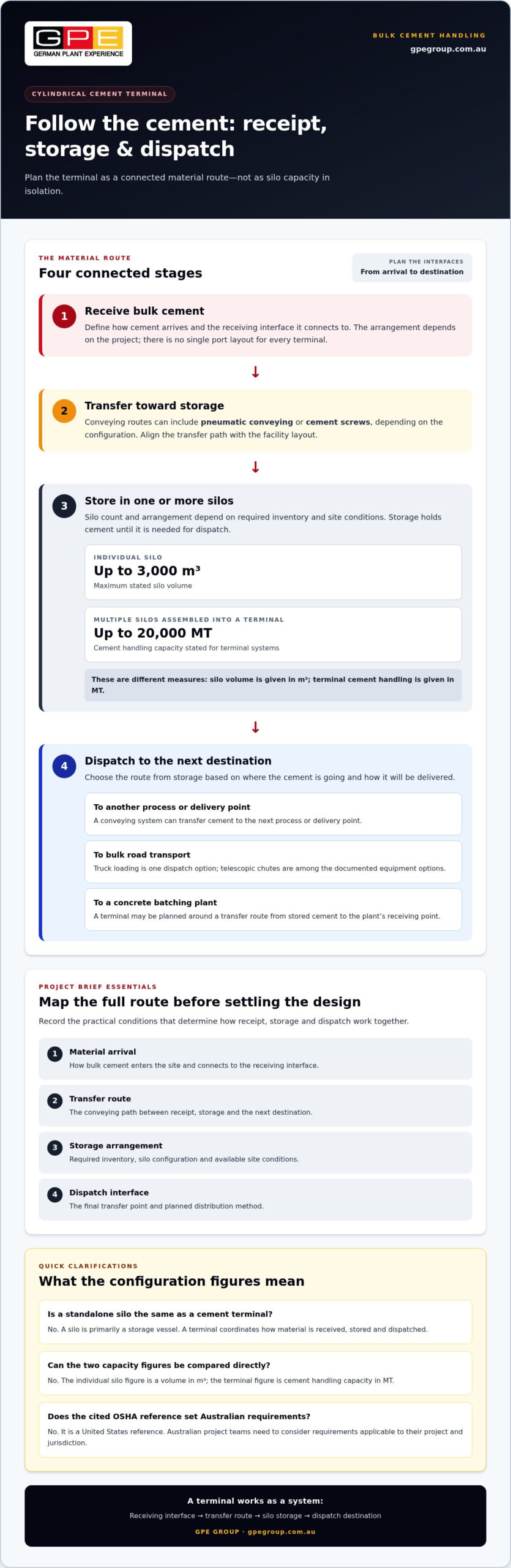
A terminal’s material route starts at bulk receipt, continues through transfer into storage and ends at the selected dispatch interface. Each connection needs to suit the material, site and operating model. Mapping the route before specifying equipment helps the project team identify how material will enter, where it will be held and how it will reach its next destination.
Receiving and Storing Bulk Cement
At receipt, bulk cement moves from its incoming transport arrangement into a conveying route that feeds the storage silos. Pneumatic conveying or cement screws may form part of this route, depending on the project configuration. The receiving interface and transfer path need to align with the facility layout; no single port arrangement applies to every terminal.
Once conveyed, cement is held in one or more silos until it is needed for dispatch. The number and arrangement of silos depend on the required inventory and available site conditions. Keep the capacity figures in their proper context: an individual silo can be up to 3,000 m³, while multiple silos can be assembled into a terminal handling up to 20,000 MT of cement. These are distinct measures, and neither determines the receiving or dispatch arrangement on its own.
Storage planning also intersects with operational safety. The linked OSHA standard for bulk cement storage is a United States reference addressing bins, containers, silos and employee entry. It is not an Australian regulation, so Australian project teams must consider the requirements applicable to their project and jurisdiction.
Dispatching Material to Its Next Destination
From storage, cement follows the route designed for its destination. A conveying system can transfer material to another process or delivery point. For bulk road transport, cement can be directed to truck loading, with telescopic chutes among the documented equipment options. The appropriate arrangement depends on the relative positions of the receiving facility, storage silos and dispatch point.
A terminal supplying a concrete batching plant, for example, may be planned around a transfer route from stored cement to the plant’s receiving point. A distribution facility may instead prioritise loading bulk trucks for onward delivery. These examples illustrate different operating needs, not fixed layouts. Define the destination and dispatch method early so the engineering design can account for the required interfaces. For further planning, GPE’s cement terminal systems provide a reference for considering the material route and project requirements.
Assess a cylindrical cement terminal as a connected sequence, not as storage capacity in isolation. A project brief that records the receipt method, transfer route, silo arrangement and dispatch destination gives the engineering team a clearer basis for designing around actual site and operating conditions.
Choosing a Terminal Configuration for the Operating Model
Choose a terminal configuration based on the work it must perform, not on a preferred silo count or a capacity figure considered alone. Import, production-site, satellite and distribution operations have different requirements for receipt, storage and onward movement. The table below is a decision aid: it summarises the main material route and a question that can help clarify each project’s priority.
| Operating context | Material route | Key planning question |
|---|---|---|
| Import terminal | Ship-received cement moves into storage, then onward to distribution or delivery. | How will incoming bulk material connect with storage and dispatch? |
| Production-site terminal | Material from the production operation moves into storage before dispatch or use. | Is the principal requirement to buffer production, support dispatch, or both? |
| Satellite terminal | Bulk material is received into a facility that forms part of a wider distribution model. | What role should this facility play between supply and the locations it serves? |
| Distribution terminal | Stored material is directed to the selected onward transport or user interface. | Which dispatch route must the storage arrangement support? |
Import, Production-Site, and Satellite Applications
An import terminal links ship-received cement with storage and subsequent distribution. At a production site, storage supports manufacturing, with the route shaped by how material moves from production to storage and then to dispatch or use. A satellite terminal sits within a wider distribution model; its role depends on how supply arrives and where material goes next, not on an assumed site layout.
These distinctions help identify the project’s main driver. Receipt may be the priority where bulk supply arrives in concentrated consignments. Storage may take precedence where continuity between supply and demand is central. Dispatch may lead where material must move to downstream users. Configure a cylindrical cement terminal around that operating priority and the interfaces it creates.
Matching Storage and Dispatch to Material Requirements
Cement is not the only bulk material that may shape terminal planning. Documented material applications include fly ash, ground slag, quick lime, minerals and ores. Their inclusion in a project does not mean that one storage arrangement or cement capacity figure automatically applies to each material. The materials and their intended routes need to inform the configuration.
For cement systems, individual silos can reach up to 3,000 m³, while multiple silos can be assembled into terminals handling up to 20,000 MT of cement. These figures measure different things: one describes an individual silo’s capacity, while the other describes the handling scale of a multi-silo terminal. Neither is a specification for other materials.
For practical planning, list the materials that need storage, the storage needs for each, the site conditions and the dispatch destinations. Then consider how the number and arrangement of silos can support those requirements as a coordinated system. This keeps the decision focused on operational fit rather than ranking terminal types by size.
Planning a Cylindrical Cement Terminal: Project Requirements to Define
A useful project brief connects the material-handling requirement with the operating purpose and site conditions. Define these points in sequence to give the engineering process a clear basis and avoid premature assumptions about silo numbers, dimensions or installation schedules. Use the following framework to organise the initial requirements.
Define Material, Capacity, and Operating Requirements
- Identify the material. List each material the terminal is intended to handle, distinguishing cement from other bulk materials. Material type informs the configuration assessment; cement capacity examples should not be applied automatically to other materials.
- State the operating purpose. Describe whether the facility supports import, production, satellite storage or distribution. Specify its role, such as receiving supply, holding material between operating stages or enabling onward dispatch.
- Set the storage requirement. Document the required storage volume and whether different materials or operating needs call for separate storage. Treat published capacity examples as reference points, not final design specifications. Consider the storage requirement alongside the complete material route.
- Describe receipt and dispatch. Record how bulk material is expected to arrive and identify its destination after storage. Include the intended dispatch interface and any downstream connections so transfer requirements are part of the system design, not an afterthought.
- Map site and installation constraints. Document the available site area, delivery and assembly access, and the intended locations of storage and transfer interfaces. Explain any constraints that may influence component positioning or assembly. These details help the engineering team develop a project-specific configuration.
Plan Site Assembly and Installation Supervision
Plan installation alongside the operating brief. GPE’s bolted steel panels are flat packed and transported in shipping containers, then bolted at site. Include the proposed assembly approach and site access conditions in early coordination, rather than treating erection as separate from terminal design. Local crews can erect silos, and factory-trained engineers are always available for supervision.
Every unit is supplied with a special waterproof gasket. Include this product detail in the brief to keep the supplied configuration clear, without assuming additional performance specifications.
Capacity examples are not a substitute for defining the material, required storage, operating purpose, site conditions and dispatch route for a specific installation. A well-structured brief records those decisions and identifies the issues that require engineering resolution.
To develop a project-specific terminal brief, review GPE’s cement terminal systems.
GPE Cylindrical Cement Terminals: Engineered Around the Project
A terminal design needs to respond to the complete project brief: the material to be handled, operating purpose, required storage arrangement, site conditions and planned dispatch route. GPE engineers and supplies cylindrical cement terminal systems around these connected requirements, treating storage capacity as one part of the design decision rather than the sole measure of suitability.
GPE’s terminal systems are designed around the project requirements, including material movement, site constraints and operating interfaces. In Australia, GPE also operates as a Concrete Batching Plant Manufacturer and Concrete Batching Plant Supplier. For a terminal project, the design discussion centres on the material route, site conditions and dispatch requirements rather than assuming every facility needs the same layout.
Bolted-Panel Construction and Project-Specific Configuration
The terminal uses bolted steel panels that are flat packed and transported in shipping containers, then bolted at site. This construction approach supports containerised transport and on-site assembly, with project requirements informing the configuration. Local crews can erect silos, and factory-trained engineers are always available to supervise erection.
Multiple silos can form part of a terminal configuration. Individual silos can reach up to 3,000 m³, while multiple-silo terminals can handle up to 20,000 MT of cement. These are documented cement-system capacities, not recommendations for a particular project or specifications for other materials. Every unit is supplied with a special waterproof gasket.
From Project Brief to Engineered Terminal
Before discussing a terminal system, prepare a concise record of the project inputs. Include:
- The material or materials the facility is intended to handle.
- The operating context, such as import, production, satellite storage or distribution.
- The storage requirement and the role of each silo in the overall operation.
- How material will be received, transferred and dispatched to its next destination.
- Site conditions, access constraints and the intended approach to assembly and erection.
This information gives GPE a practical basis for assessing how storage, material movement and site assembly fit together. The engineering discussion can focus on the interfaces and constraints that shape the configuration, rather than relying on silo capacity alone. Installation planning can also account for local crews and factory-trained engineer supervision as part of the erection approach.
With the operating purpose, material route and site requirements defined, discuss a project-specific cylindrical cement terminal with GPE. Review GPE’s cement terminal systems.
Move From Project Brief to Design Discussion
Turn operational priorities into a shared design basis. Bring project stakeholders together around the assumptions that will shape the terminal: the material route, the role of storage, the dispatch interface and the constraints that affect site assembly. Recording these decisions early gives the engineering discussion a defined scope and helps keep connected systems aligned as the project develops.
For an Australian project, a clear brief also supports coordination between terminal requirements and the wider site plan. It allows the design conversation to focus on the specific interfaces and conditions that matter to the operation, rather than relying on a generic configuration. With those inputs prepared, you can move from assessing the need to evaluating an engineered solution for a cylindrical cement terminal.
Prepare your project requirements and discuss a project-specific terminal design with GPE.
Frequently Asked Questions
What Is a Cylindrical Cement Terminal Used For?
A cylindrical cement terminal receives bulk cement, stores it and makes it available for onward movement or use. It can support importing cement for distribution or supplying a downstream concrete batching plant. For example, a project team may plan a terminal to connect incoming bulk supply with dispatch to operational destinations. The terminal’s role depends on its material route and the interfaces it must serve.
How Is a Cement Terminal Different From a Cement Silo?
A cement silo is a storage vessel. A cement terminal is a broader operating facility that coordinates storage with material receipt and dispatch. A silo may be one component within that facility. A standalone storage requirement may focus on holding material at a site, while a terminal brief also defines how bulk supply enters and how cement leaves for its next destination.
Can a Cylindrical Cement Terminal Handle Materials Other Than Cement?
Bulk-handling systems can be configured for materials including fly ash, ground slag, quick lime, minerals and ores, as well as cement. Specify each material in the project brief, because cement-system capacity figures do not establish specifications for other products. Listing each material and its intended route helps the engineering team assess the appropriate storage and handling arrangement.
How Many Silos Can Be Combined in a Cement Terminal?
There is no single silo count for every terminal; the number depends on the storage requirement and site conditions. Multiple silos can be assembled into a cement terminal handling up to 20,000 MT, and individual silos can reach up to 3,000 m³. These figures describe different measures. Project-specific planning determines the required silo count.
How Does Cement Move From a Terminal Into Bulk Trucks or Batching Plants?
Cement can be transferred from storage through pneumatic conveying or cement screws, with the route selected for the destination and operating arrangement. Documented dispatch options include direct truck loading and telescopic chutes; material can also be supplied to a batching plant. Defining the receiving point and intended dispatch interface helps establish which transfer arrangement the terminal design needs to accommodate.
Can Local Crews Erect a Bolted Steel-Panel Cement Silo?
Yes. Local crews can erect the silos, and factory-trained engineers are always available for supervision. The panels are flat packed and transported in shipping containers, then bolted at site. Include the planned erection approach and site access conditions in the project brief so assembly can be considered alongside the terminal layout and installation planning.
What Should a Project Team Define Before Planning a Cement Terminal?
Document the material, operating purpose, storage requirement, receipt method and dispatch destination. Add relevant site conditions and the intended assembly approach. For example, a distribution operation should state where cement arrives and whether its next destination is bulk trucks or a batching plant. These details give the engineering discussion a practical basis for assessing how storage and transfer requirements fit together.