 Main Number
 Find us on
 Reach us @
A German-engineered batching plant earns its value through a design that fits the project and support that continues beyond commissioning. For Australian operations, a german engineered batching plant manufacturer should explain how production requirements, raw materials and site conditions shape the plant configuration, rather than relying on broad claims about engineering heritage.
That distinction matters when a plant is a long-term capital investment. GPE Group engineers its concrete batching plants in Germany and provides turnkey project delivery, connecting design, manufacturing, testing and supply with transport, erection and commissioning. Its plants are designed in line with Australian Standards, and most parts are from internationally known brands and easily available in Australia. GPE has completed hundreds of batching plant installations worldwide, and its plants have been used to manufacture concrete for the Burj Khalifa project, where the highest quality of concrete was used.
This article explains what to assess when selecting a concrete batching plant supplier for an Australian project, from matching the design to production needs and available materials through to commissioning and lifecycle support. It also looks at how after-sales service and spare-parts provision contribute to ongoing operational planning.
Key Takeaways
- Define your concrete applications, required output, raw-material availability and site conditions before comparing plant configurations.
- Assess a german engineered batching plant manufacturer by its project-specific design process and how engineering connects with delivery and commissioning.
- Use design fit, delivery scope, Australian Standards alignment and lifecycle support as practical criteria when comparing batching plant suppliers.
- Organise supplier assessment around a clear production brief, then evaluate design, project execution and ongoing parts and service support.
- Understand the broad differences between wet and dry configurations, and assess each against your operation’s requirements.
What a German-Engineered Batching Plant Manufacturer Should Deliver
A concrete batching plant manufacturer should do more than supply equipment. It should connect project requirements to a considered design and a clearly defined delivery scope. For Australian buyers, assess how the proposed plant will serve the intended concrete applications, site conditions and operating needs, rather than starting with a catalogue model. A german engineered batching plant manufacturer should be able to explain how its engineering decisions respond to these project-specific inputs.
Plant configuration is shaped by practical constraints. Required production output informs the arrangement, while the availability and characteristics of raw materials affect how the design must accommodate the operation. Budget and applicable local standards are also project inputs. GPE designs its concrete batching plants in line with Australian Standards, aligning plant design with the Australian operating context.
Understanding the basic components and operation of a concrete plant can help frame a technical discussion, but the right configuration depends on the project brief. Compare models after documenting what the plant must produce, where it will operate and how it will be delivered, commissioned and supported. This shifts the assessment from equipment features alone to the complete operational requirement.
How German Engineering Connects to Project Requirements
German engineering is most useful to a buyer when it is applied through systematic, project-specific design. Required output, available materials, budget and relevant Australian requirements should inform engineering decisions before the plant configuration is settled. A clear design rationale helps the project team assess how the plant fits the intended operation without relying on general claims of superiority or unsupported performance promises.
Manufacturer, Supplier and Turnkey Delivery Roles
A manufacturer produces the equipment, while a supplier arranges its provision to the project. Turnkey delivery connects design, manufacturing, testing and supply with transport, erection and commissioning. GPE provides turnkey project delivery across these stages, linking plant engineering with delivery and site installation. Commissioning helps transition the installed plant into operation, while after-sales service and spare-parts support remain relevant beyond project handover.
When evaluating a manufacturer or concrete batch plant supplier, consider the full delivery and support pathway, not only the equipment quotation. A practical brief should identify:
- Production requirements: intended concrete applications and required output.
- Operating inputs: raw-material availability and site conditions.
- Project constraints: budget, applicable standards and delivery requirements.
- Lifecycle needs: commissioning arrangements, after-sales service and spare-parts support.
These criteria help establish whether a proposed plant is designed around the operation and whether the delivery scope covers the stages needed to bring it into service and support it over time.
How German Engineering Shapes a Concrete Batching Plant
German engineering is most meaningful when it provides a disciplined method for translating a production brief into a plant configuration. The design should respond to the work the operation needs to perform, the materials it can access, the characteristics of the site and the project budget. These inputs interact, so changing one may affect the practical choices available elsewhere. A project-specific approach makes those relationships clear before the plant design is settled.
From Production Brief to Plant Configuration
Start with the concrete applications and production requirements, then document the raw materials intended for use and their availability. Aggregate sources and material characteristics can influence how the plant is arranged to suit the project. Site conditions and budget also shape design decisions. A german engineered batching plant manufacturer should connect these inputs to a reasoned configuration, rather than presenting a standard model as suitable for every operation.
A useful design brief records:
- Applications: the concrete products and mixes the operation intends to produce.
- Production needs: required output and the operating pattern the plant must support.
- Materials: available cement, water and aggregates, including relevant supply constraints.
- Project conditions: site layout, access, applicable Australian requirements and budget parameters.
With this information established, engineering discussions can focus on a configuration that fits the project, rather than unsupported capacity comparisons or assumptions about performance.
Wet and Dry Plant Requirements
Wet and dry batching are broad configuration choices, not interchangeable labels for a project. The appropriate arrangement depends on the production brief and how the operation intends to manage batching and mixing. For a more detailed explanation of plant design and specification considerations, readers can refer to the Concrete Batching Plants: Engineering & Specification Guide. The key is to assess each configuration against the project’s actual requirements.
Once the design basis is established, turnkey delivery connects engineering decisions to execution. GPE’s turnkey project delivery covers design, manufacturing, testing, supply, transport, erection and commissioning. These stages bring plant preparation and site installation into a coordinated delivery pathway. Commissioning is part of bringing the installed plant into operation, with the project scope organised around its requirements.
GPE tailors concrete batching plant systems to project requirements, with engineering in Germany informing the design process. Explore project-tailored batching plant design to learn more.
Comparing Batching Plant Manufacturers for Australian Projects
A structured comparison helps Australian project teams assess plant suitability against a consistent brief. Buyers may encounter terms such as Concrete Batching Plant, Concrete Batch Plant, Cement Batching Plant, Cement Batch Plant and Readymix Plant when reviewing the market. Concrete Batching Plant Manufacturer, Concrete Batch Plant Manufacturer, Concrete Batching Plant Supplier and Concrete Batch Plant Supplier are also used in procurement discussions. Whatever the terminology, compare design fit, delivery scope, standards alignment and lifecycle support against the same operating requirements.
| Evaluation area | What to assess | GPE approach |
|---|---|---|
| Design fit | Whether the proposed configuration reflects intended concrete applications, output needs, raw materials and site conditions. | GPE tailors plant systems to project requirements. |
| Delivery scope | Which project stages are included, from engineering and equipment supply through installation and commissioning. | GPE’s turnkey delivery covers design, manufacturing, testing, supply, transport, erection and commissioning. |
| Standards alignment | How relevant Australian requirements inform the plant’s project-specific design. | GPE designs plants in line with Australian Standards. |
| After-sales support | How service and spare-parts provision support the plant over its operating life. | GPE provides after-sales service and spare parts around the world. |
Australian Standards and Project-Specific Design
Standards alignment should be considered as part of project design, rather than treated as a general assurance that every project obligation is automatically met. GPE designs plants in line with Australian Standards and tailors plant design to the project brief. For Australian buyers, assess how intended production, available raw materials and site requirements inform the proposed configuration. This keeps standards alignment connected to project needs without assuming one design suits every operation.
For a meaningful comparison, apply the same brief to each proposal. Record concrete applications, material sources and site constraints, then examine how each manufacturer has translated these inputs into its design. This enables procurement teams to evaluate the engineering rationale, rather than relying solely on a product label or feature list.
Parts Availability and After-Sales Support
Parts access is a practical lifecycle consideration. Most parts used in GPE plants are from internationally known brands and are easily available in Australia. GPE also provides after-sales service and spare parts around the world. These provisions matter when assessing a concrete batch plant supplier, alongside design and delivery scope, without implying a particular response time or stock arrangement.
Review support in relation to the equipment supplied and the operation’s ongoing needs. Consider after-sales service and spare-parts provision alongside commissioning and project delivery, so the assessment covers more than initial supply. Applying these criteria consistently helps Australian project teams compare manufacturers and suppliers on the factors that matter to the plant’s intended use.
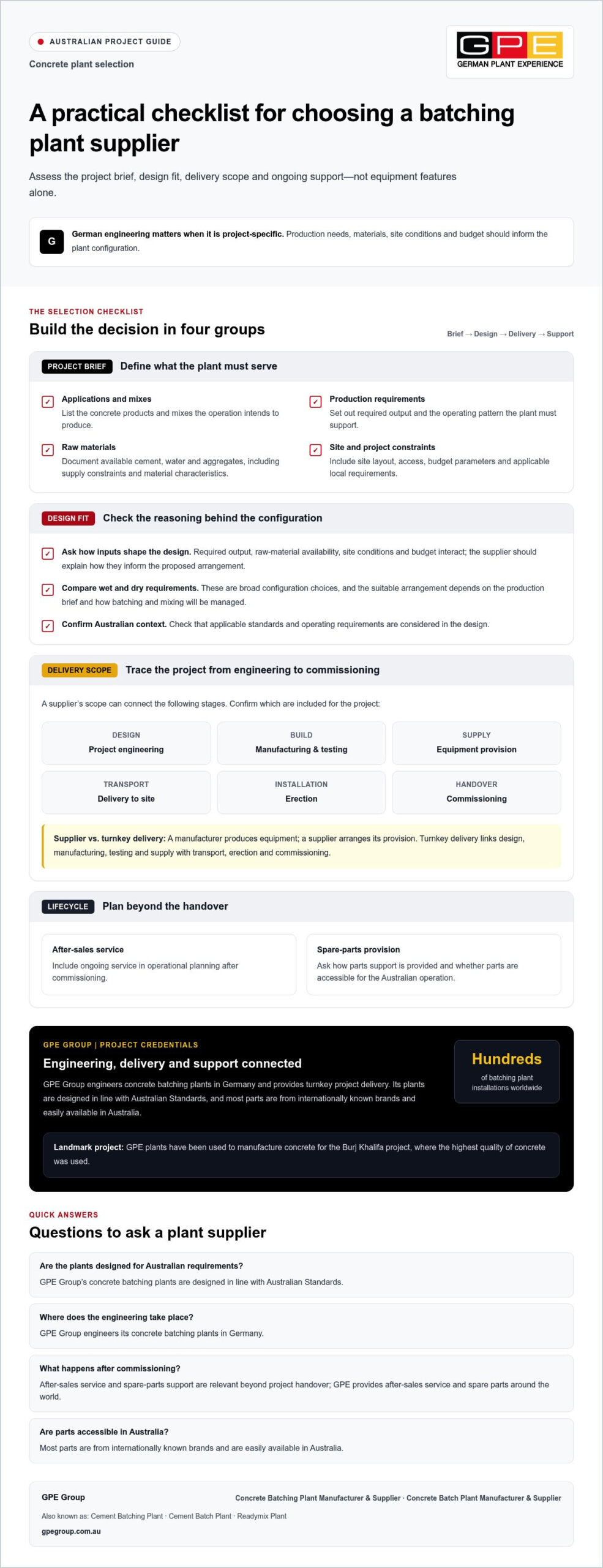
A Practical Framework for Assessing a Batching Plant Supplier
A disciplined assessment begins with the project, not a preferred plant model. Documenting production needs and constraints before reviewing proposals helps an Australian project team compare suppliers against a consistent brief and identify where engineering input is needed. This is especially useful when considering a german engineered batching plant manufacturer, because it connects design intent with delivery responsibilities and support over the plant’s operating life.
Build the Project Brief Before Comparing Proposals
Record the intended concrete applications, required output and raw materials available to the project. Include site constraints, budget parameters and applicable Australian Standards requirements so these inputs are visible during design discussions. Distinguish confirmed requirements from assumptions that need engineering review. This helps prevent preliminary estimates or untested material assumptions from becoming fixed design expectations.
- Define applications: Describe the concrete types and uses the plant is intended to serve.
- Document production needs: State required output and the production pattern the operation expects to support.
- Describe materials: List available cement, water and aggregates, noting known supply constraints or variability.
- Record site and budget inputs: Set out access, layout and other site considerations alongside the project’s budget parameters.
- Separate facts from assumptions: Identify which requirements are established and which need engineering assessment.
This brief gives the design process a clear basis. It also helps the project team evaluate how a proposed configuration responds to actual materials and site conditions, rather than making a decision from a model name or isolated specification.
Assess Delivery and Operational Support
Once the brief is established, compare each proposal’s scope and responsibilities. Review how design, manufacturing, testing and supply connect with transport, erection and commissioning. A complete delivery pathway should make clear which stages are included and how the handover into operation is addressed. Commissioning is a material part of project delivery, not an administrative detail to leave outside the comparison.
Assess lifecycle support with the same care. Consider the provision for after-sales service and spare parts, and how that support relates to the equipment supplied. GPE provides after-sales service and spare parts around the world, while most parts are from internationally known brands and easily available in Australia. These provisions inform an operational support assessment without implying a response time or uninterrupted availability.
For major infrastructure work, the framework in How to Select a Concrete Batching Plant for a Major Infrastructure Project can complement the project brief by focusing attention on procurement decisions at scale. Together, the brief and delivery review provide a consistent basis for evaluating design, execution and lifecycle needs.
Explore GPE’s tailored concrete batching plant solutions as part of your project planning.
GPE Group: German-Engineered Batching Plants and Global Support
Selecting a concrete batching plant is a long-term operational decision, so evaluation should extend beyond equipment configuration. Project fit, delivery responsibilities, commissioning and lifecycle support all inform the supplier’s role. GPE Group designs concrete batching plants engineered in Germany and tailors stationary and mobile solutions to project production requirements, connecting the plant design to the work it is intended to perform.
Project Experience and Engineering Context
GPE has completed hundreds of concrete batching plant installations all over the world. Its plants have been used to manufacture concrete for the Burj Khalifa project, where the highest quality of concrete was used. This reference provides project context without implying that GPE supplied all the concrete or attributing unsupported outcomes to its equipment.
GPE provides turnkey project delivery covering design, manufacturing, testing, supply, transport, erection and commissioning. After-sales service and spare parts are provided around the world. Most parts are from internationally known brands and are easily available in Australia, which is relevant when assessing support beyond initial supply.
Project Discussion and Next Steps
A productive project discussion begins with a clear brief. Set out intended concrete applications and required output, identify available raw materials, and document site conditions and budget parameters. These inputs provide a basis for discussing a plant configuration tailored to the project.
Use those requirements to frame the assessment: how the design fits the operation, how delivery connects with commissioning, and how after-sales service and spare-parts support factor into lifecycle planning. This keeps the discussion focused on the needs of your Australian project.
Discuss your batching plant project with GPE.
Move Your Plant Planning Forward
The next step is to turn your operational priorities into a clear design brief. Set out the intended applications, required output, available materials, site conditions and budget parameters to begin a focused discussion about a plant configuration suited to the project. This gives engineering decisions a practical foundation and helps keep procurement aligned with the operation’s actual needs.
Choosing a german engineered batching plant manufacturer is ultimately a decision about how project requirements become a designed, delivered and supported plant. An early discussion based on a clear brief can help define those requirements and establish a sound basis for the next stages of planning.
Discuss your batching plant project with GPE to define a solution for your Australian operation.
Frequently Asked Questions
How does German engineering benefit a concrete batching plant project?
German engineering supports a structured, project-specific approach to plant design. Required output, the availability of aggregates and other raw materials, budget parameters and applicable local standards can all inform the design brief. This helps the project team assess how a proposed configuration relates to its operating context before settling on a plant design. It describes an engineering approach, not a guarantee of performance or a claim that the equipment is manufactured in Germany.
Are GPE batching plants designed in line with Australian Standards?
Yes. GPE designs its batching plants in line with Australian Standards. This design alignment is considered alongside the requirements of each project, including its intended production and operating conditions. For an Australian project team, document relevant requirements in the design brief so they can inform plant planning. This describes design alignment; it is not a blanket guarantee that every plant automatically meets every project obligation.
How is a batching plant’s hourly capacity related to mixer size?
Hourly plant output and mixer size are related, but they describe different aspects of production and cannot be treated as interchangeable figures. For example, a 120 m³ per hour plant can be configured with a 3 m³ twin-shaft mixer. This is an example of a specific configuration, not a rule for every plant. Assess the proposed mixer and plant output together in the context of the project’s production brief.
Can a concrete batching plant produce different concrete slumps?
A batching plant’s suitability for a required slump depends on the specified concrete mix and production requirements, rather than one universal slump value for the equipment. The project’s mix design establishes the concrete requirements, while the plant configuration is considered in relation to producing those mixes. Include the intended mix specifications and slump requirements for the applications in the project brief. A specific slump range cannot be assumed without those project details.
Does GPE use internationally known parts, and are they available in Australia?
Yes. Most parts used in GPE batching plants are from internationally known brands and are easily available in Australia. GPE also provides after-sales service and spare parts around the world. For an Australian operator, these provisions are relevant to lifecycle planning because parts access and ongoing support matter beyond initial plant supply. This does not imply a particular brand, stock arrangement or availability timeframe.
Can a batching plant be configured around locally available raw materials?
Yes. GPE’s project-tailored batching plant designs consider raw-material availability alongside project requirements. Material sources and supply conditions can differ across Australia, so documenting the materials intended for use provides useful context for plant design. Include available cement, water and aggregates, together with known supply constraints, in the project brief. This allows engineering discussions to account for local material conditions without implying that GPE supplies those materials.