 Main Number
 Find us on
 Reach us @
The word “mobile” doesn’t tell you whether a silo will suit your project. A mobile cement silo for sale needs to fit the full transport-to-discharge workflow: getting the equipment to site, positioning it, storing cement and supplying it to the receiving system.
Storage capacity and relocation are important, but they are only part of the decision. Consider site access, delivery arrangements, the silo’s intended location and how cement will reach the batching process. Comparing these requirements together gives you a clearer purchasing brief.
This guide covers the questions to resolve before choosing a configuration, including how mobile horizontal silos differ from other storage options. GPE Group supplies mobile horizontal cement silos. Use your site, transport and operating requirements to assess how one could fit into your wider batching workflow.
Key Takeaways
- Define why the project needs mobility before comparing silo configurations. Identify the location changes or operating needs mobility must support.
- Map cement movement from delivery through storage to the receiving point. Treat transport, site positioning and discharge as separate requirements.
- Compare models using consistent criteria, and keep each published specification tied to its exact model and source.
- Prepare a procurement brief covering cement supply, storage role, site layout, access, receiving equipment and operating workflow.
- When assessing a mobile cement silo for sale, bring transport, site, storage and receiving requirements together to evaluate GPE’s mobile horizontal cement silo offering.
When Does a Mobile Cement Silo Make Sense for a Project?
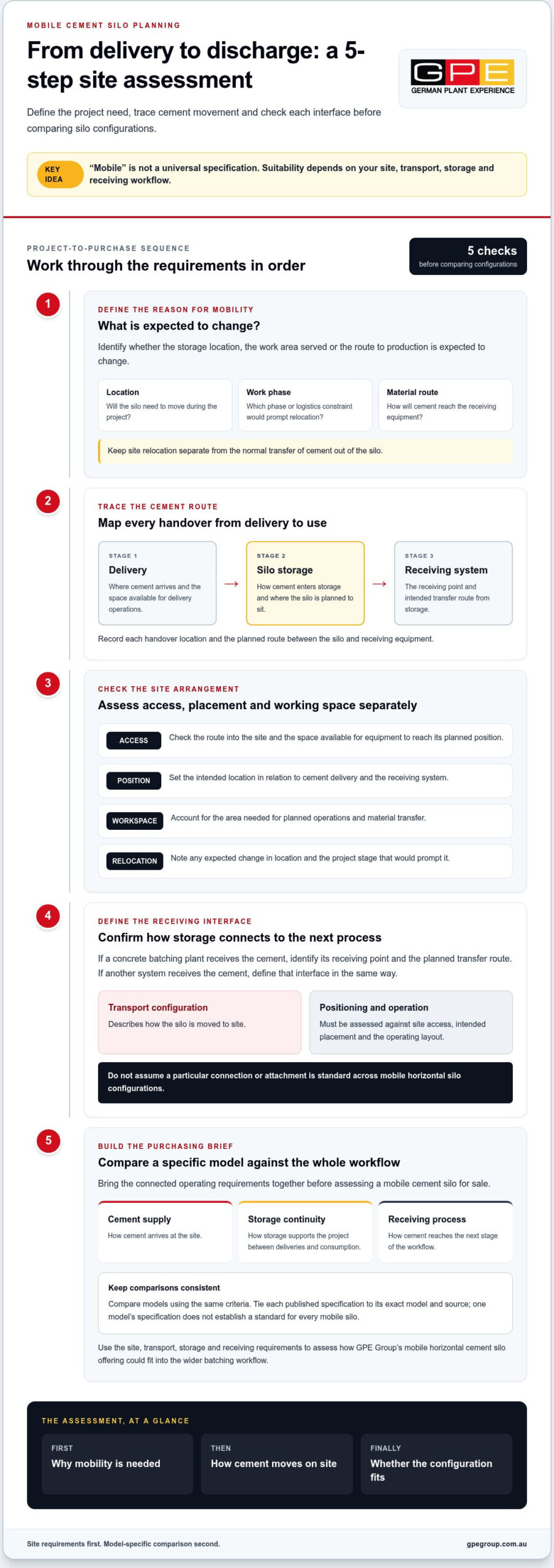
Mobility is useful when it addresses a defined project or logistics need. Before evaluating a mobile cement silo for sale, identify what is expected to change: the storage location, the work area served, or the route for transferring cement to production. Without a clear purpose, “mobile” is a label, not proof that a configuration suits your site.
Mobile cement silos can come in different configurations, so the term is not a universal specification. Consider transport, storage, site placement and the discharge interface for the specific equipment. A specification for one model does not establish a standard for every mobile silo.
What Project Conditions May Favour Mobile Cement Storage?
Mobile cement storage may be worth considering when the project’s operating footprint is expected to change. For example, a staged construction programme may move the active work area as one phase ends and another begins. If the storage location needs to follow that change, include relocation in the project plan. The purchasing case depends on the actual movement required, not an assumption that any silo can be moved in any condition.
Distinguish two kinds of movement when planning a temporary layout. Site relocation means moving storage equipment to another position or work area. Material transfer means moving cement from the silo to the receiving point during normal operations. These are separate requirements. A configuration suited to one is not automatically suited to the other.
Before comparing options, record:
- Whether the silo location is expected to change during the project.
- Which work phase or logistics constraint would prompt relocation.
- How cement will move from storage to the receiving equipment.
- Whether the site layout can accommodate the intended arrangement.
This project-led approach is more useful than treating individual listing details as features shared by all mobile cement silos. A general overview of types of cement silos can provide context, but your purchasing decision still depends on the worksite and material-handling plan.
Which Operations Should Define the Purchase Case?
Build the purchase case around three connected requirements: cement supply, storage continuity and the receiving process. Consider how cement arrives at the site, how the silo supports storage between deliveries and consumption, and how material reaches the next stage. Mapping this sequence can reveal constraints that a product label alone will not resolve.
If a concrete batching plant is the receiving system, consider the silo’s role within the plant’s material flow. The arrangement needs to work with the plant’s receiving point and site workflow. If another system receives the cement, define that interface in the same way. Keep the assessment focused on cement storage and transfer, rather than extending it to concrete supply.
A clear purchase case states why mobility is needed, which project movements it must support and how cement will reach the receiving equipment. GPE’s mobile horizontal cement silo offering can then be assessed against those requirements, rather than against an assumed one-size-fits-all specification.
How a Mobile Cement Silo Fits into Storage and Material Transfer
A silo is one part of a material-handling sequence. Map cement movement from delivery to the project site, through storage, and on to the receiving point. This shows where the silo sits in the process and which interfaces need to be defined for the selected configuration.
Map the Cement Route from Delivery to Use
Start with the delivery arrangement: where cement arrives, how it enters storage and how it moves from storage to the receiving system. For a concrete batching plant, identify the relevant receiving point and the planned route for cement. The transfer route depends on the project layout and silo configuration, so do not assume a particular connection or attachment is standard across mobile horizontal silos.
A project brief should identify every handover from cement delivery through silo storage to the receiving system, including the handover location and intended transfer route.
Record these project inputs:
- The cement delivery point and the space available for delivery operations.
- The silo’s planned position in relation to the receiving equipment.
- The receiving system and the intended transfer route between it and the silo.
- Layout constraints that could affect access to an interface or equipment movement.
These details help reveal whether the material route is workable or whether the layout leaves a handover point unresolved.
Keep Transport, Placement and Operation Distinct
The transport configuration describes how a silo is moved to site. It does not, by itself, establish how the unit is positioned or operated once there. Site access, the intended placement area and working space around the equipment are separate planning considerations. Do not treat a transport arrangement as proof that the silo can be repositioned in any condition or without preparation.
Assess each element separately:
- Access: the route into the site and the space available for equipment to reach its planned position.
- Positioning: the intended location relative to cement delivery and the receiving system.
- Working space: the area needed for planned operations and material transfer.
- Relocation: any expected change in location, including the project stage that would prompt it.
For a mobile cement silo for sale, separating these questions gives the project team a clearer basis for assessing fit. GPE’s mobile horizontal cement silo offering can be considered in relation to the defined transport, site and receiving arrangement through GPE’s mobile silo offering.
How to Compare Mobile Cement Silos Without Treating One Model as the Standard
Compare each option against the same project requirements instead of treating one listing as a template for the entire category. A capacity, transport arrangement or support feature published for a particular model applies to that model only. This distinction helps buyers assessing a mobile cement silo for sale avoid mistaking a model-specific specification for a general mobile-silo standard.
Use consistent comparison fields and record the source and exact model beside every published specification. Keep confirmed product information separate from questions that depend on project engineering or the site arrangement.
Transport: Record the stated transport configuration for the exact model, then list any project access requirements that still need assessment.
Storage: Capture published storage information with its units and source. Relate it to the project’s cement supply and storage role rather than assuming a figure from another model applies.
Site placement: Compare the stated placement arrangement and identify any layout or working-space requirements that need project assessment.
Discharge: Document the specified discharge arrangement, if published, separately from the receiving equipment and transfer route required by the project.
Project interfaces: Note how delivery, storage and the receiving system connect. Distinguish documented product information from design questions that still need to be resolved.
Which Specification Fields Belong in a Fair Comparison?
Include verified details that matter to the project, and label each with the model name and source. If comparing listings, treat each model’s stated capacity and features as specific to that product, not as typical specifications for all mobile cement silos.
Keep confirmed model specifications separate from questions that depend on the project, layout or engineering assessment. If a published page does not state a relevant detail, leave it blank rather than filling it with another model’s figure. This keeps the comparison traceable and the purchasing brief grounded in product-specific information.
How Does a Mobile Horizontal Silo Differ from a Bolted-Panel Silo?
Compare these as distinct storage approaches, not interchangeable versions of one product. GPE supplies mobile horizontal cement silos. Its bolted steel-panel silos are a separate product: they are flat packed and transported in shipping containers, then bolted at site, with a special waterproof gasket. Those construction and transport details apply to the bolted-panel silo, not to GPE’s mobile horizontal product.
The useful comparison is how each approach fits the project’s transport, storage, placement and receiving requirements. A mobile horizontal arrangement may suit a project with a defined need for mobile storage, while a bolted-panel silo has its own delivery and site-assembly process. Assess the stated requirements and documented specifications for each option, without relying on unsupported performance claims or financial comparisons.
What to Put in a Mobile Cement Silo Procurement Brief
A well-prepared brief turns an enquiry about a mobile cement silo for sale into a project-specific assessment. Assemble the information in sequence, separating confirmed site and operating requirements from assumptions that need engineering review. This gives the supplier a clear view of how cement arrives, where it will be stored and how the receiving system fits into the project.
- Define the storage role. State what the silo needs to support, how cement storage fits into the project and whether the requirement changes between work phases.
- Describe cement supply. Explain the expected delivery workflow and identify where cement enters the site storage process.
- Record transport and access constraints. Note the delivery route, access limitations and known restrictions that may affect getting equipment to its intended position.
- Document the site layout. Mark the proposed silo position, available working area and nearby plant or project interfaces. Identify conditions that need assessment rather than assuming an arrangement will suit.
- Name the receiving equipment. Identify the concrete batching plant or other system that will receive cement, and describe its position relative to storage.
- Set out the operating workflow. Describe the intended connection and discharge process, along with any planned relocation between phases. Treat these as project requirements, not assumed product features or a prescribed transport method.
Document Site and Transport Constraints
Provide a site plan or clear layout description showing the delivery route, access limitations, intended silo position and available working area. If the project expects to change the silo’s location between phases, state when and why. Record known site conditions for assessment, and keep observations separate from assumptions about foundations, preparation or transport arrangements.
Specify Storage and Receiving Requirements
State the cement material, supply workflow, storage role and receiving equipment. Describe the intended transfer route and discharge process as requirements to assess against the selected configuration, not as features every silo provides. Where plant selection informs the brief, align the storage interface with the considerations in How to Select a Concrete Batching Plant for a Major Infrastructure Project.
Keep confirmed information, such as the proposed receiving equipment and site layout, separate from items still requiring engineering review. This prevents a preliminary assumption from being treated as an agreed specification and gives the project team a more disciplined basis for assessing fit.
With the project inputs assembled, discuss the defined requirement with GPE, including transport, site, storage and receiving needs for a mobile horizontal cement silo. Discuss your mobile silo requirements with GPE.
Discuss a Mobile Cement Silo for Sale with GPE
GPE supplies mobile horizontal cement silos for project-specific cement storage requirements. Start with the application rather than an assumed model specification. Bringing transport, site, storage and receiving requirements into one conversation helps explain how the silo needs to fit into the wider material-handling arrangement, and which configuration details matter to the project.
GPE operates in Germany, Italy, Dubai and Australia, and installs all over the world. For an Australian project, a clear scope helps connect the proposed silo arrangement with the site conditions and operating workflow, without treating specifications for another product or model as universal.
Bring a Defined Project Scope to the Supplier Discussion
Summarise the intended application, cement supply approach, site constraints and expected location changes during the project. Include the receiving equipment and describe the intended material route between storage and that system. This gives the discussion a practical basis and avoids assumptions about transport methods, discharge arrangements or other features not established for the selected configuration.
Separate mandatory requirements from preferences. A defined receiving interface might be essential, while the preferred placement arrangement may allow flexibility. Marking the distinction keeps the discussion focused on what the project must achieve and what can be considered as the configuration is developed.
Connect Silo Planning with the Wider Plant System
Cement storage is one part of the project’s plant arrangement. If a concrete batching plant is the receiving system, its configuration can influence the silo interface and material workflow. The guide How to Select a Concrete Batching Plant for a Major Infrastructure Project addresses plant selection. Mixer choice matters to the silo discussion where it changes the receiving workflow. For that specific consideration, see Twin-Shaft vs Planetary vs Pan Mixers: Which Concrete Mixer Is Best?
For a separate discussion of engineering and deployment at relocatable sites, consult Mobile Cement Silos: Engineering for Relocatable Sites. Keeping these topics distinct lets the purchasing conversation stay centred on your project scope while related plant and deployment decisions receive their own consideration.
GPE’s mobile horizontal cement silo offering can be assessed against a defined project application, including its transport context, proposed site arrangement, storage role and receiving workflow. Identify fixed requirements and details still requiring assessment to frame a focused project discussion.
Discuss your mobile cement silo requirements with GPE.
Turn the Project Brief into a Confident Decision
As procurement advances, use the project brief as a decision record, not just an enquiry document. It should explain why mobility matters, which requirements are essential and which still need engineering assessment. This gives internal stakeholders a consistent basis for reviewing proposals and helps distinguish a preferred configuration from a non-negotiable project need.
Before selecting a mobile cement silo for sale, align the technical and project teams on the criteria that determine suitability. Recording those criteria early supports a more disciplined evaluation, particularly if site arrangements or operating plans change.
With the requirements documented, assess how a proposed configuration addresses the project’s priorities and interfaces. Discuss your mobile cement silo requirements with GPE and take the next step with a clear project basis.
Frequently Asked Questions
Can a mobile cement silo be used with a concrete batching plant?
Yes. A mobile cement silo can be used with a concrete batching plant when the project defines a suitable cement transfer route and receiving interface. Mark the plant’s cement intake location and the proposed silo position on a site layout, then identify where material transfers between them. “Mobile” alone does not establish a particular connection, attachment or discharge arrangement, so assess those details for the selected configuration.
How do I decide what capacity a mobile cement silo needs?
Base the capacity assessment on project cement demand, delivery pattern, storage role and operating plan. Expected usage and supply arrangements help clarify the storage requirement. Include those details in the brief rather than relying on a generic figure. This gives the proposed configuration for a mobile cement silo for sale a project-specific basis without borrowing capacity information from another silo product.
Can a mobile cement silo be moved while it contains cement?
Do not assume that a silo can be transported while it contains cement. Whether movement is appropriate depends on the specific equipment, its transport configuration and its operating condition. Define the expected movement scenario before procurement, including whether relocation between project stages is planned and the condition of the equipment at that time. The product documentation and project plan should address the scenario rather than relying on a general assumption about mobile silos.
Does a mobile cement silo need a prepared foundation?
Support and placement requirements depend on the selected equipment and site conditions. Do not specify foundation dimensions, ground-bearing limits or construction methods without verified engineering information for that arrangement. Include the intended location and available site information, such as the layout and known ground conditions, in the project brief so the support and placement requirements can be assessed for the actual equipment and site.
What information should I send when requesting a mobile cement silo proposal?
Provide the intended application, cement supply and usage pattern, site access, available space, transport expectations and receiving equipment. A site plan can show the proposed position and surrounding interfaces, while a process description can explain how cement is expected to move through the operation. Label confirmed requirements and assumptions clearly. This context helps frame the project discussion and identify details that need engineering input.
Are capacity figures shown for one mobile silo applicable to every model?
No. Capacity and equipment features apply to the specific model identified in its product documentation, not to every mobile cement silo. Compare options using model-specific source information and your project requirements. Do not carry a value from one listing into another product’s assessment.