 Main Number
 Find us on
 Reach us @
A sound selection begins with project fit, not catalogue breadth. Choose an asphalt plant manufacturer by assessing production capacity, plant configuration, site requirements, installation capability and after-sales support against the demands of your Australian operation. The best fit is the manufacturer whose equipment and delivery approach align with your production needs, location and long-term operating plans.
For a major plant investment, look beyond the equipment specification. Engineering support, customisation, delivery planning and maintenance capability all affect how well a plant serves its intended role over time.
This article offers a practical framework for comparing manufacturers and identifying the questions to ask before purchasing. It explains how capacity and installation considerations shape plant selection, outlines asphalt production principles and examines factors that influence ongoing costs, without quoting product prices.
You will also find an overview of future directions in asphalt equipment and profiles of global suppliers, providing context for evaluating the market. Together, these points help you assess manufacturer capability, plant suitability and the next steps in planning an asphalt production project in Australia.
Key Takeaways
- Compare plant configurations against your production requirements, site conditions and project duration to narrow the most suitable options.
- Assess capacity alongside installation planning, since layout, logistics and operating needs all shape a plant’s fit for an Australian project.
- Understand how aggregate, filler and bitumen move through the production process, and consider the operator training and technical support required for reliable operation.
- Evaluate future equipment developments in terms of their practical relevance to your production priorities and long-term operating plans.
- Use global supplier profiles to compare engineering approaches and support capabilities, then identify which align with your project requirements.
What Factors Should I Consider When Choosing an Asphalt Plant Manufacturer?
Compare plant configuration, production requirements and project conditions before assessing a manufacturer’s engineering, delivery, installation and after-sales capabilities. For Australian projects, the right choice depends on what the plant must produce and where it will operate.
Batch and Continuous-Mix Plants
A batch plant produces asphalt in separate batches, combining aggregate, filler and bitumen for each mix. This supports controlled production of different mix designs, so consider changeovers and recipe management. A continuous-mix plant produces material through an ongoing process, which can suit projects with consistent mix requirements. Compare expected demand, mix changes and production planning before choosing a system. Drum plants are commonly associated with continuous production, so assess their process alongside batch equipment rather than treating all plants as interchangeable.
Mobile, Modular, and Stationary Configurations
Mobile plants are designed to move between projects, while stationary plants are intended for a fixed production site. Modular configurations arrange equipment in sections, which can support transport and staged assembly. Compare options against site access, available space, project duration and relocation logistics. For example, a remote road project may place greater emphasis on relocation planning, while a permanent production site may prioritise a fixed layout. Installation and dismantling requirements also affect whether a configuration is practical.
Plants for Small and Medium-Sized Projects
For small and medium-sized projects, a batch plant may offer useful control where work requires distinct asphalt mixes or planned production runs. Match the plant’s production capacity to the project schedule and material demand, rather than selecting capacity on nameplate output alone. Consider how frequently the mix design changes and whether the plant can meet delivery timing. Up to 20% recycled asphalt can produce asphalt of the same quality as 100% virgin material; quality starts decreasing when the recycled proportion rises beyond 20%.
Assess manufacturers on more than plant type. Review experience with comparable installations, equipment range, customisation, installation coordination and technical support. A capable asphalt plant manufacturer should explain how its proposed configuration addresses your production process, site layout and maintenance needs. Compare the full project scope, not just the equipment specification.
Before shortlisting suppliers, document expected mix types, production patterns, site constraints and relocation needs. Then compare batch, continuous, drum, mobile, modular and stationary options against those requirements. This step-by-step assessment helps identify a suitable plant and avoid configurations that create operational compromises.
Plant installation and production capacity
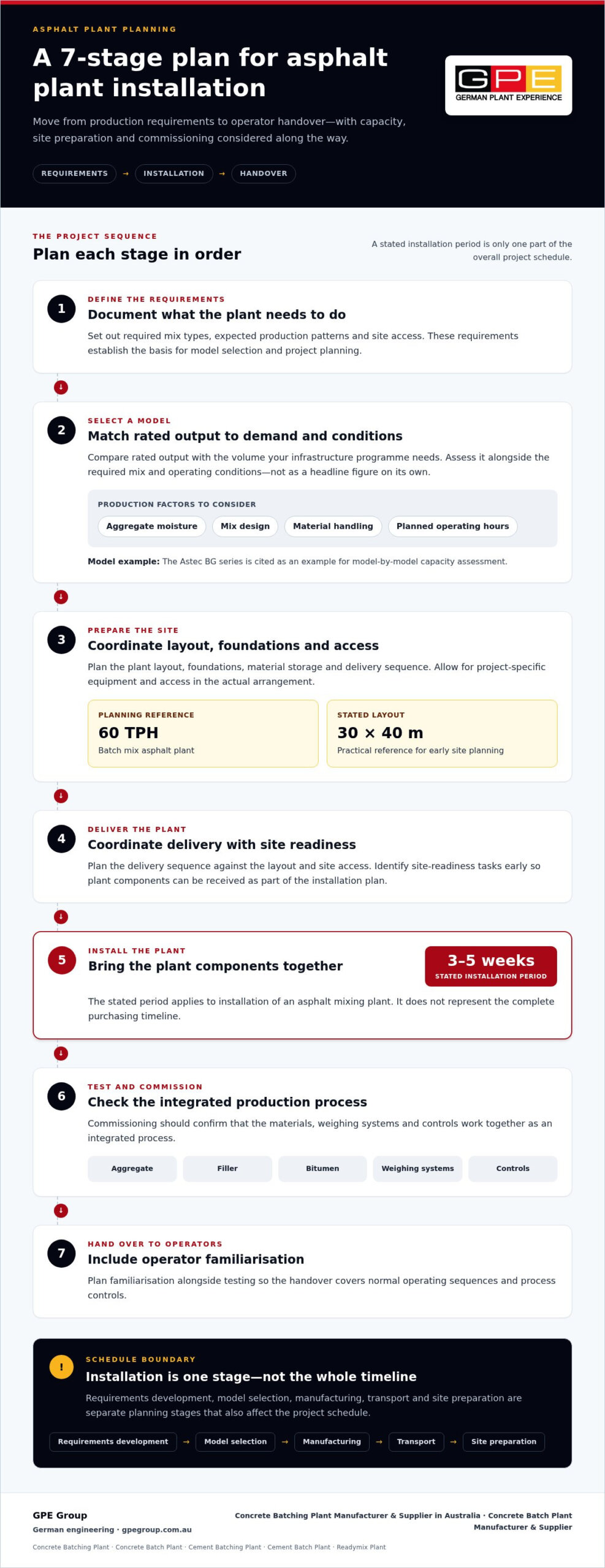
The sequence is requirements definition, model selection, site preparation, delivery, installation, testing and operator handover. A stated installation period for an asphalt mixing plant is 3 to 5 weeks.
Plant Models and Output Capacities
Compare each model’s rated output with the volume your infrastructure programme needs to produce. The Astec BG series provides a named example for model-by-model capacity assessment: match the selected model’s stated production rate to the required mix and operating conditions. A stated layout for a 60 TPH batch mix asphalt plant is 30 by 40 metres, giving a practical reference for early site planning.
Do not treat a series name or rated output as a complete capacity assessment. Aggregate moisture, mix design, material handling and planned operating hours all affect production. Record expected demand by project phase, then compare it with the plant’s rated output and site logistics. This makes model comparisons more meaningful than a headline capacity alone.
Installation and Commissioning Steps
Begin by documenting required mix types, expected production patterns and site access. Use these requirements to select a model, then coordinate the plant layout, foundations, material storage and delivery sequence. For a 60 TPH batch plant, the stated 30 by 40 metre layout can inform preliminary site planning, while the actual arrangement must accommodate project-specific equipment and access.
After delivery, installation brings plant components together for testing and operational handover. Commissioning should confirm that aggregate, filler, bitumen, weighing systems and controls work as an integrated process. Plan operator familiarisation alongside testing, so the handover covers normal operating sequences and process controls.
Typical Commissioning Lead Times
The stated installation period for an asphalt mixing plant is 3 to 5 weeks. This refers to installation, not the complete purchasing timeline. Requirements development, model selection, manufacturing, transport and site preparation are separate planning stages that affect the project schedule.
For an Australian project, map these stages against the intended production start and infrastructure delivery sequence. Identify site-readiness tasks early, including layout coordination and access for plant components. Poor site preparation can disrupt installation even when equipment delivery is planned. Set out each milestone in the programme rather than treating commissioning as a single date.
Before finalising a capacity choice, compare rated output with the mix schedule, material supply and installation footprint. This provides a disciplined basis for assessing asphalt plant configurations against the project’s production and commissioning requirements.
How dose an asphalt mixing plant works?
An asphalt mixing plant coordinates material handling, heating, weighing and mixing through connected components. Understanding this sequence helps operators identify where training, maintenance and technical support matter most.
Core Components and Production Sequence
Aggregate enters the plant’s material-handling system before moving into a drying drum. Heat removes moisture and prepares the aggregate for mixing. Weighing systems measure aggregate, filler and bitumen, while an automated control system coordinates quantities and timing. In a batch plant, the mixer combines measured materials for each batch; continuous systems feed materials through an ongoing process.
Bitumen tanks store and supply the binder, while conveyors and elevators move materials between production stages. To maintain high throughput and reduce mechanical downtime, engineering teams often rely on industrial distributors such as Jealco International, Inc. for essential power transmission components and material handling equipment. Operators monitor controls and process readings to keep the sequence coordinated. Maintaining the temperature of finished asphalt during transport and construction is important for pavement durability. The required temperature depends on production and delivery conditions, so transport planning forms part of process control.
Operator Training and Technical Support
Training should follow the plant’s operating sequence, from start-up and control-system use to routine shutdown. Operators need to understand material feed, weighing, drum operation and mixer control, and recognise when readings indicate an interruption. Practical instruction should cover normal production procedures and the response to faults.
Technical support is most useful when it helps diagnose a specific component or control issue. Before production begins, establish how operators will access operating documentation, identify replacement parts and report faults. For plants operating across different countries, clear technical communication and parts coordination can support consistent maintenance planning.
Environmental and Operational Features
Environmental performance depends on how the plant manages dust, fuel use and material movement. When assessing equipment, examine the dust-collection system, burner controls, enclosed transfer points and control interface. These features influence plant operation and how emissions and materials are managed on site.
Operational performance also depends on maintaining hot mix asphalt temperature during transport and construction. The production plan should therefore coordinate output with haulage and paving schedules. For example, producing material faster than trucks can transport it can create a mismatch between plant output and site demand.
Operating Costs and Routine Checks
Operating costs include raw materials, labour, energy, maintenance and transportation. Different decisions affect each cost: material sourcing influences input costs, production planning affects labour and energy use, and maintenance practices shape equipment upkeep. Transport distance also affects delivered material condition and the production schedule.
Use regular operating reviews to track material use, production interruptions, energy consumption and maintenance tasks. Comparing these records across operating periods can reveal recurring inefficiencies. Trained operators, coordinated control systems and planned technical support all contribute to dependable plant operation.
Future trends in asphalt equipment manufacturing
For Australian road construction projects, assess future equipment decisions against measurable operating needs. Examine how automation, energy management, material handling and plant configuration affect production planning. These are practical evaluation areas, not reasons to adopt technology without a defined operational purpose.
Automation and Production Control
Automated controls can coordinate weighing, material feed and mixing while operators supervise the process. When comparing equipment, examine what the control system monitors and how it presents operating information. For projects with changing production requirements, clear controls can help operators manage adjustments systematically. The key question is whether each feature supports the intended production process.
Continuous production also depends on coordination between the plant, material supply and transport. Assess how controls support steady feeding and identify interruptions. For projects with varied operating schedules, consider how the plant can be managed during start-up, production changes and shutdown. These factors connect equipment design with real road construction workflows.
Optional Equipment and Project Scope
Optional equipment should address a defined requirement, not simply expand the specification. List the functions the project needs, then assess each option against production, site layout, maintenance and material handling. An additional component may help resolve a specific process constraint, but may be unnecessary if the existing arrangement already meets demand.
For an Australian project, price depends on the case and is provided after a quote request; capacity, configuration, optional equipment, installation scope and transport affect cost. Compare quotations by separating core plant equipment from selected options and delivery or installation items. This makes the technical and commercial scope easier to assess without relying on a headline figure.
Equipment Across Road Construction Projects
WIRTGEN is a named supplier of road construction equipment and offers a reference point for considering how plant production connects with roadbuilding operations. Evaluate the complete project workflow: asphalt production, transport and construction scheduling. A plant should fit the project’s operating sequence, rather than being assessed separately from the equipment and teams using its output.
Future-focused procurement also requires lifecycle thinking. Compare how plant configuration affects maintenance access, component replacement and operator procedures. Ask how proposed technology will be supported throughout its operating life and whether it addresses a documented production need. This helps distinguish useful developments from features that add complexity without improving the defined workflow.
Before selecting optional equipment, define the production constraint it must address and its effect on the project sequence. Then compare plant controls, material-handling arrangements and support requirements against that need. For Australian infrastructure programmes, this disciplined assessment connects equipment choices with operational priorities and long-term production planning.
Global asphalt plant manufacturer profiles
Astec and WIRTGEN offer useful reference points when comparing global equipment portfolios. Manufacturers differ in model range, capacity, fuel use, emissions controls and automation, so compare technical information for each proposed configuration.
Manufacturer Profiles
Astec’s BG series is one model family to examine when comparing asphalt plant configurations. Assess each proposed model against the required production process, site arrangement and operating plan. A series name alone does not show whether a configuration suits an Australian project, so compare model-specific technical information and installation requirements.
WIRTGEN is associated with road construction equipment, making it a relevant name when considering how plant production connects with roadbuilding operations. Evaluate the complete project workflow, including the plant, material transport and construction schedule. These profiles provide comparison points, not a substitute for assessing the configuration proposed for your site.
Capacity, Fuel Use, Emissions, and Automation
Compare manufacturers using the same four criteria: production capacity, fuel requirements, emissions management and automation. For each model, examine how its stated capacity relates to your mix and operating conditions. Assess fuel use in the context of the production process, and review the emissions-control features included in the proposed equipment.
Assess automation in operational terms. Compare how each system coordinates material feed, weighing and mixing, and what information it provides to operators. A control system is useful when its functions support the plant’s production sequence and operator workflows.
For Australian buyers, request a like-for-like comparison of proposed plant configurations. Include the model, rated output, fuel and emissions information, controls, installation scope and support arrangements. Consistent criteria make supplier differences easier to interpret and help ensure a broad brand profile does not replace project-specific analysis.
Interpret capacity with care. Stated output is meaningful only alongside the conditions under which it can be achieved, including material characteristics, mix requirements and operating setup. Likewise, compare fuel and emissions information using equivalent operating assumptions. Without a shared basis, technical summaries may describe different conditions rather than comparable performance.
For automation, connect each stated function to an operating task. For example, identify how the system manages weighing, monitors production and supports adjustments between mix requirements. Then consider the training and technical support needed to use those functions effectively. This creates a practical evaluation instead of treating automation as a standalone feature.
The clearest takeaway is to assess Astec and WIRTGEN, and any other shortlisted manufacturer, against a consistent project-specific matrix. Compare documented model details and operating conditions, then weigh those against site requirements and production plans. Discuss your project requirements as you refine the comparison.
GPE Group: Concrete Batching Plants
GPE Group is a Concrete Batching Plant Manufacturer and Concrete Batching Plant Supplier in Australia, supporting infrastructure projects that require concrete production equipment. Its German-engineered plants are available in stationary and mobile configurations, with custom production capacities from 30 m³/h to 400 m³/h. Hundreds of GPE Group Concrete Batching Plants have been installed around the world.
For projects requiring mobile production or cement storage, GPE Group also offers mobile concrete batching plants, cement silos and mobile horizontal cement silos. These solutions are relevant when a project needs batching or bulk cement storage equipment.
To discuss concrete production or storage requirements for your project, contact GPE Group or visit gpegroup.com.au.
Turn Your Assessment Into a Project Specification
Before progressing procurement, turn your comparison into a written project specification. Set out production requirements, site constraints, preferred configuration and commissioning sequence, then use these criteria to assess proposals consistently. This gives your project team a clear basis for discussing scope, responsibilities and operational priorities with a prospective asphalt plant manufacturer.
If a broader infrastructure programme also involves concrete production or cement storage, identify those interfaces early. Coordinated planning can help align equipment requirements, site arrangements and delivery schedules across related work packages, while keeping the asphalt plant’s distinct operating needs in focus.
GPE Group’s concrete batching and cement storage solutions may also be relevant to projects with these connected requirements. To discuss the equipment scope for your project, contact GPE Group about your plant needs. A clearly defined brief is a sound foundation for the next procurement decision.
Frequently Asked Questions
Who are the leading asphalt plant manufacturers serving Australia?
Astec and WIRTGEN are global equipment names relevant to asphalt and road construction, but this article does not rank manufacturers serving Australia. Compare specific plant models and their documented capacities, configuration, installation scope and technical support arrangements. Australian project suitability also depends on freight, site access, commissioning and parts logistics. A global profile is a useful starting point, not a substitute for assessing a proposed plant against your operating requirements.
What types of asphalt plants are available: batch mix, drum mix, mobile, and stationary?
Available configurations include batch mix, drum or continuous mix, mobile, modular and stationary plants. Batch systems produce separate lots, while continuous drum systems feed materials through an ongoing process. Mobile equipment is intended for relocation; stationary plants suit fixed production sites. For example, projects with frequent mix changes may prioritise batch production, while a stable, ongoing production schedule may favour continuous operation. Consider the mix programme, site and relocation needs together.
What is the price of a new asphalt plant in Australia, including delivery and installation?
Price depends on the case and is provided after a quote request. Major cost factors include plant capacity, configuration, optional equipment, transport, installation scope and commissioning requirements. Treat delivery and installation as explicit parts of the project estimate, not as items assumed to be included in the equipment price. For an Australian project, site access and distance from the delivery point can also affect logistics planning and the overall procurement scope.
What Australian standards and environmental approvals apply to asphalt plant installation and operation?
Applicable standards and approvals depend on the site, plant design and relevant jurisdiction. An approvals review should map planning requirements and environmental considerations, including emissions, dust, noise, stormwater, and fuel or bitumen storage. Identify the responsible approval pathways early, then align plant layout and operating controls with those requirements. This project-specific review should inform site selection and design before installation planning is finalised.
What site, power, water, and transport requirements are needed to install an asphalt plant?
Requirements depend on the selected plant model and its supporting equipment. Site planning should account for layout, ground preparation, delivery-vehicle access, aggregate and bitumen storage, and space for safe operation. Establish power demand and water needs from the equipment configuration and intended process. For transport planning, map the delivery route, site entry and assembly area so plant components can reach their designated positions.
What warranties, spare parts, maintenance, and technical support do Australian suppliers provide?
Warranty terms, spare-parts arrangements and technical support vary by supplier and plant specification. Compare what each proposal says about covered components, exclusions, maintenance guidance, parts ordering and technical assistance. For example, a remote operation may place particular importance on parts logistics and clear troubleshooting procedures. Review these terms alongside maintenance requirements, so ongoing support is part of the procurement decision rather than an afterthought.
What are the main safety, emissions, and operational risks of asphalt plants?
Key areas to manage include hot materials and bitumen, moving machinery, dust, fuel combustion and interruptions to material flow. Operational planning should establish safe access, clear operator procedures, routine inspections and appropriate emissions controls. Transport delays can also affect asphalt temperature and coordination with construction work. A practical risk review should consider plant layout, operator responsibilities, maintenance practices and the controls required for site operating conditions.