 Main Number
 Find us on
 Reach us @
A mobile batching plant earns its value through productive use and repeat deployment, not mobility alone. For Australian project teams facing uncertain demand, that makes the business case for purchasing a mobile batching plant a question of project pipeline, site logistics and lifecycle costs, rather than equipment cost alone.
When production volumes, mobilisation requirements and future project locations are uncertain, an ownership assessment should make those risks visible. Test realistic utilisation assumptions against the costs and operational demands of setup, relocation, production and ongoing support.
This article provides a project-specific framework for weighing those factors, assessing where mobility can create commercial value and identifying the information needed to evaluate a purchase. GPE Group designs and manufactures concrete batching plants in Germany, including mobile solutions tailored to project and site requirements. Its plants have been installed around the world, including on projects producing concrete for the Burj Khalifa.
Key Takeaways
- Assess repeatable demand, production control and deployment requirements before deciding whether ownership fits your operation.
- Build the business case for purchasing a mobile batching plant from project-specific assumptions, separating plant investment from operating and deployment costs.
- Compare ownership with external concrete supply and, where relevant, hired capacity to understand the trade-offs in control, flexibility and commitment.
- Model downside, expected and stronger-demand scenarios using documented assumptions to see how underutilisation could affect the decision.
- Evaluate the full delivery scope, from engineering and manufacturing through transport, erection and commissioning, when considering a mobile plant investment.
When Does Purchasing a Mobile Batching Plant Make Commercial Sense?
Assess repeatable demand, the need for production control and the practical requirements of deployment before selecting equipment. A mobile plant is a capital asset, so its commercial case depends on how consistently it can serve planned work, not just whether a project would benefit from on-site production.
For a contractor, ownership may support self-production on defined projects where supply reliability, pour scheduling or specific mix requirements matter to delivery. For a producer, the key question is whether customer demand and operating commitments support a continuing concrete production operation. These are different cases: project-specific production may have a clear end point, while commercial supply depends on a credible basis for ongoing operation.
Project Production or Ongoing Commercial Supply?
Contractors should map concrete demand across secured work and credible follow-on projects, noting when and where production is required. Separate contracted quantities and established schedules from prospective work that remains at an early pipeline stage. This prevents speculative demand from carrying more weight than the available evidence supports.
Producers should assess customer demand, delivery obligations and the continuity of planned operations. Consider whether expected orders align with the plant’s intended production role and whether operating periods are likely to be sustained or intermittent. In either case, base the business case for purchasing a mobile batching plant on documented requirements and defensible assumptions, not a universal volume or project-duration threshold.
What Mobility Changes in the Ownership Case
Mobility can strengthen an ownership case when a plant can serve a sequence of planned project sites. GPE’s mobile units are designed for rapid erection and dismantling, a relevant consideration when assessing deployment order and the work involved in moving between sites. That capability alone does not establish that relocation will reduce costs or remove site constraints.
Test the deployment plan against actual project conditions. Account for site order and timing, readiness, access, available space and the work required to establish production at each location. A Mobile concrete plant brings batching functions to a project location, but its commercial value depends on how well that arrangement fits the operational requirements. A plant that can move between suitable sites on a credible schedule may serve a wider pipeline than one assigned to a single isolated project.
- Identify which demand is committed and which remains prospective.
- Compare planned operating periods with gaps between projects.
- Assess whether each proposed site can support the intended deployment and production role.
Where supply reliability, scheduling control or mix requirements are central, self-production may fit the operation better. Where demand is intermittent or future sites remain uncertain, those advantages may not offset the complexity of ownership and deployment. Treat mobility as a practical capability to evaluate, not as a guaranteed source of savings.
Build a Mobile Batching Plant Business Case from Operating Inputs
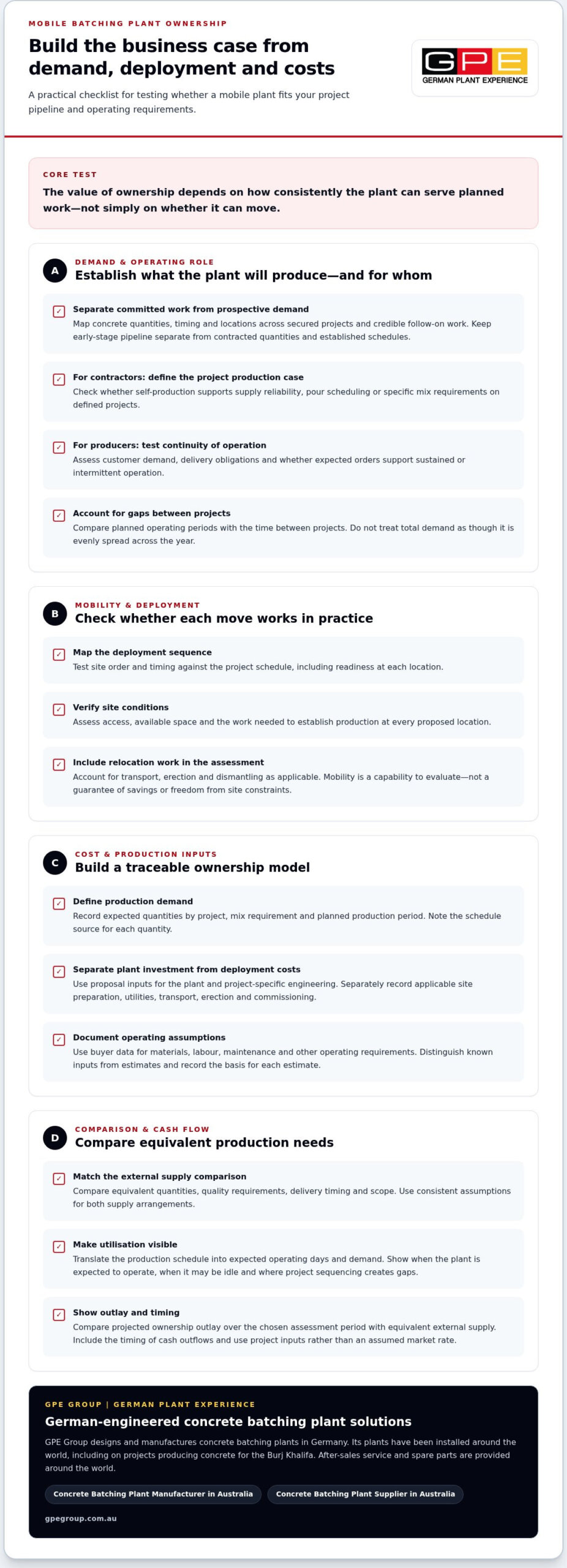
Build a defensible ownership model from the project’s quantities, schedule and proposal inputs, rather than a generic utilisation target. Keep the plant investment separate from the costs of preparing and operating each deployment. This makes the business case traceable: decision-makers can see which figures are supported by documents and which are estimates.
Assemble the Cost and Production Assumptions
Start with the plant proposal and project plan. Record plant investment and project-specific engineering separately from site and operating requirements. Then assemble the model in a consistent sequence:
- Define production demand. Enter expected concrete quantities by project, mix requirement and planned production period. Record the schedule source for each quantity.
- Record plant investment. Use proposal inputs for the plant and project-specific engineering. Separate these from site preparation, utilities, transport, erection and commissioning, including only the items that apply to the project.
- Build operating assumptions. Use the buyer’s data for materials, labour, maintenance and other plant operating requirements. Distinguish known inputs from estimates and document the basis for each estimate.
- Set the comparison case. Model external concrete supply against equivalent quantities, quality requirements, delivery timing and scope. Use consistent assumptions so the comparison reflects the same production need, not unlike service arrangements.
Test Utilisation, Cash Flow and Break-Even Logic
Translate the production schedule into expected operating days and concrete demand, then compare that demand with the plant’s planned operating periods. This shows when production is expected, when the plant may be idle and whether project sequencing creates gaps that affect the ownership case. Avoid treating total annual demand as though it were evenly distributed across the year.
Compare projected ownership outlay over the chosen assessment period with the equivalent external supply scenario. Show the timing of cash outflows as well as total amounts, using project inputs rather than an assumed market rate. Break-even logic should identify the production level or operating pattern at which the two cases become comparable under those inputs. That is a model result, not a universal industry threshold.
Run three cases: confirmed work only, confirmed work plus plausible follow-on demand, and lower utilisation. Label the evidence behind each case. If the result changes materially when a single follow-on project is removed, the investment depends on that pipeline assumption and should be assessed accordingly.
Use Capacity as a Project Fit, Not a Return Guarantee
Match required output to the production schedule, mix requirements and operating pattern. GPE designs mobile batching plants to suit project and site production needs. Use the proposed configuration to assess production fit, but do not treat a plant’s stated capacity as proof of utilisation or financial return. A proposal for a custom mobile batching plant can inform the model, while the buyer’s demand and deployment assumptions determine the commercial result.
Test Mobility Against Deployment Risk and Alternative Scenarios
Mobility has commercial value only when the deployment plan is workable and repeat use is supported by credible project evidence. Compare ownership with external concrete supply and, where relevant to the assessment, project-specific hired capacity. Keep assumptions consistent across the scenarios so the result reflects operational differences rather than mismatched scope.
Compare Project Scenarios on a Like-for-Like Basis
Use equivalent concrete volumes, mix requirements, production timing and delivery scope in each case. Distinguish project costs from items included in an external supply arrangement, then record the source of each input. This framework helps show where responsibilities and risks sit:
| Scenario | Assess | Key sensitivity |
|---|---|---|
| Plant ownership | Plant investment, site and deployment requirements, operating inputs, and production control. | Utilisation, project timing, and whether planned sites can reuse the plant. |
| External concrete supply | Equivalent volumes, mix requirements, delivery schedule and the scope covered by the supply arrangement. | Changes to delivery timing, required quantities or mix specifications. |
| Project-specific hired capacity | Applicable arrangement terms, production scope, mobilisation responsibilities and operating period. | Availability for the project schedule and the responsibilities retained by the project. |
Recalculate the comparison if project timing shifts or expected demand falls. For example, a delayed follow-on project may leave an owned plant idle for longer, while a change in pour sequence may affect the timing or volume of external supply. Record these effects rather than smoothing them into an average that hides operational gaps.
Include Relocation and Site Readiness
Model each proposed deployment as a sequence of distinct requirements. Separate transport, site preparation, erection, dismantling and commissioning, using project-specific inputs rather than generic Australian cost figures. For every site, assess transport access, utility readiness and the logistics of obtaining required raw materials. A planned move has limited value if the receiving site cannot support the intended production arrangement.
- Transport: document the route, access conditions and project-specific transport assumptions.
- Site preparation and utilities: identify the work and connections required before installation and operation.
- Erection, commissioning and dismantling: record the expected sequence, responsibilities and schedule assumptions for each site.
- Materials: assess supply sources, delivery timing and handling requirements against the production plan.
Assign value to mobility only when later projects are sufficiently credible and the plant can realistically be redeployed between them. GPE mobile units are designed for rapid erection and dismantling, but deployment effort and site readiness remain project-specific inputs. This comparison helps establish whether mobility strengthens the ownership case or whether external supply better fits the assessed project conditions.
Address the Main Objection: What If the Plant Is Underused?
Low utilisation can weaken an ownership case, even when a mobile plant appears well suited to the work. Mobility does not create demand. If projects are delayed, cancelled or smaller than forecast, the plant may operate fewer days than the initial model assumes. Test this exposure directly instead of relying on a single expected-demand forecast.
Stress-Test the Project Pipeline
Separate awarded work from tender opportunities and uncommitted forecasts. For each project, record the expected start, production schedule and concrete demand, then model the effect of schedule gaps, delays and reduced quantities. Label tender work as an assumption unless it is supported by a firm commitment.
Build three scenarios from verified buyer inputs:
- Downside: include confirmed work only, with delayed starts or reduced operating days where project evidence supports that possibility.
- Expected: combine awarded work with follow-on projects assessed as plausible, while identifying the evidence behind each forecast.
- Stronger demand: include credible additional work, but keep uncommitted opportunities visible as assumptions rather than secured production.
Compare how each scenario changes plant use and the ownership result. Do not apply a universal “safe” utilisation level. Instead, identify the demand level at which your own model changes materially, then set a decision trigger. For example, pause the purchase assessment if a key award or start date moves beyond the planning basis.
Check Capacity and Operational Fit
Underuse can result from a mismatch between plant capacity and the project’s production sequence, not only from insufficient total demand. Compare required hourly output with planned pours, operating periods and mix requirements. The relevant capacity is the one that fits the actual production plan, not simply the highest expected output.
Include project-specific engineering inputs for concrete recipes, raw-material characteristics and required slump. If those requirements change between projects, assess whether the proposed configuration remains suited to the pipeline. A plant sized for peak demand may see limited use during lower-output periods, while a configuration that cannot meet scheduled production requirements may constrain delivery.
Frame Risks as Decisions, Not Assurances
List uncertain assumptions and their effect on the result, including award timing, operating days, material supply and site readiness. If the downside case makes ownership difficult to justify, consider delaying the decision until demand evidence improves or revisiting the capacity and deployment plan. This is a decision point, not a prediction of future savings, resale value or payback.
GPE provides after-sales service and spare parts around the world, which can be included in lifecycle planning. Support should not be treated as a guarantee of uptime. Purchasing a plant does not remove project, supply or operating risks. To assess a configuration against your demand scenarios, discuss your mobile batching plant requirements.
Connect the Investment Case to GPE’s Mobile Plant Delivery
Once you have assessed the project assumptions, translate them into a defined equipment and delivery brief. GPE designs and manufactures concrete batching plants in Germany and supplies mobile and stationary solutions for project-specific production needs. The brief should connect required output, operating pattern, raw-material conditions and site requirements to the proposed scope, so the plant can be assessed against the actual work rather than a generic configuration.
Match GPE’s Documented Scope to the Project
Set out the intended production role, required mix characteristics, site conditions and applicable local standards. GPE’s custom-tailored plant designs take account of required output, raw-material availability, budget and local standards. These inputs help define a project-specific scope and show which business-case assumptions need to be addressed in engineering.
GPE’s turnkey project delivery covers engineering, manufacturing, testing, supply, transport, erection and commissioning. Include the relevant stages in the project brief and schedule. A defined scope helps align procurement and deployment planning while keeping project-specific requirements visible during assessment.
For mobile units, consider planned erection and dismantling alongside the intended deployment sequence. Set out the expected sites and readiness requirements, then assess how the mobile configuration fits that plan. This links equipment selection to practical deployment without assuming mobility eliminates site preparation or relocation work.
Evaluate Lifecycle Support and Project Evidence
Lifecycle planning should account for the support arrangements relevant to the plant’s intended use. GPE provides after-sales service and spare parts around the world. Include these in maintenance and parts planning, while distinguishing support provision from any assumption of uninterrupted operation or a specified response time.
GPE operates across Germany, Italy, Dubai and Australia, and installs plants all over the world. Its experience includes plants used in producing concrete for the Burj Khalifa. Keep your own engineering requirements and site conditions central when assessing the proposed scope.
Move from Analysis to a Project Discussion
Prepare a concise project brief with the sequence of work, required output, site conditions, raw-material information, production assumptions and intended deployment plan. If a particular mix or operating pattern drives the specification, include it explicitly. This gives the engineering discussion a clear basis and connects the commercial assessment with the practical requirements of the proposed plant.
Bring your project assumptions into a focused discussion with GPE. Discuss a mobile batching plant for your project.
Turn Your Assessment into a Project Brief
A sound investment decision does not require certainty about every future project. It requires a clear record of what is known, which assumptions remain conditional, and how changes in demand or timing affect the preferred option. Use that record as the basis for the next engineering discussion, keeping the project sequence and production requirements central as the assessment develops.
The business case for purchasing a mobile batching plant is more useful when its operating assumptions can be translated into a defined scope. Bring together expected output, site conditions, mix requirements and the deployment plan so the proposed plant can be assessed against the work it is intended to serve.
For a project-specific discussion, discuss a mobile batching plant for your project. A carefully prepared brief gives the conversation a practical foundation and helps move your assessment towards a considered next step.
Frequently Asked Questions
How do I calculate the business case for purchasing a mobile batching plant?
Compare project-specific ownership inputs with an equivalent external supply option. Create a register that records each assumption, its source and who is responsible for validating it. Include production quantities, schedule changes and operating inputs, then show which variables change the comparison. This makes the assessment easier to review and update as tender outcomes or project requirements develop.
When does owning a mobile batching plant make more sense than buying ready-mix concrete?
Ownership may fit better when a project needs production scheduled around its work sequence or requires control over mix production. Assess delivery timing against planned pours, including whether supply must serve changing work fronts or production periods. Compare this with external supply for equivalent mix specifications, delivery scope and quantities. Base the decision on the project’s actual logistics and demand profile, not a general assumption that either option is always preferable.
How does a mobile batching plant’s capacity relate to mixer size?
Mixer size describes the output of a batch, while hourly capacity depends on how many batches can be produced within the operating cycle. A useful planning relationship is batch output multiplied by completed cycles per hour, with actual production affected by operating conditions and process requirements. Use the proposed configuration and production schedule to assess fit. Mixer size alone does not establish the output a site will achieve consistently.
Can a mobile batching plant produce concrete mixes with different slumps?
Different slump requirements relate to the concrete mix design and its constituent proportions, not to plant mobility. For each application, document the specified slump, recipe, aggregate grading and other relevant material characteristics. This gives the engineering assessment a clear basis for considering the batching arrangement. Evaluate suitability against the specific mixes and project quality requirements rather than assuming one configuration will meet every recipe without adjustment.
Are GPE concrete batching plants designed in line with Australian Standards?
GPE custom-tailors plant designs to account for local standards. In your project planning, identify the standards relevant to the plant design and intended application, then include those requirements in the engineering brief and project documentation. This keeps the applicable design requirements visible during assessment and distinguishes equipment design considerations from project-specific approvals, site obligations and operating procedures.
How does German engineering inform GPE’s concrete batching plant design?
GPE’s concrete batching plants are engineered in Germany. For a project team, the practical evaluation is how the proposed design responds to the defined production duty and site brief. Set out the intended operating role and production requirements so the engineering discussion can be assessed against documented criteria. This keeps the review focused on the proposed plant’s fit for purpose.
Are parts for GPE batching plants available in Australia?
GPE provides spare parts for European-made batching plants as part of its support offering around the world. For maintenance planning, identify the components in the proposed plant and create a parts register with relevant descriptions or references. This helps the operating team plan stockholding and procurement according to the project’s maintenance strategy.