 Main Number
 Find us on
 Reach us @
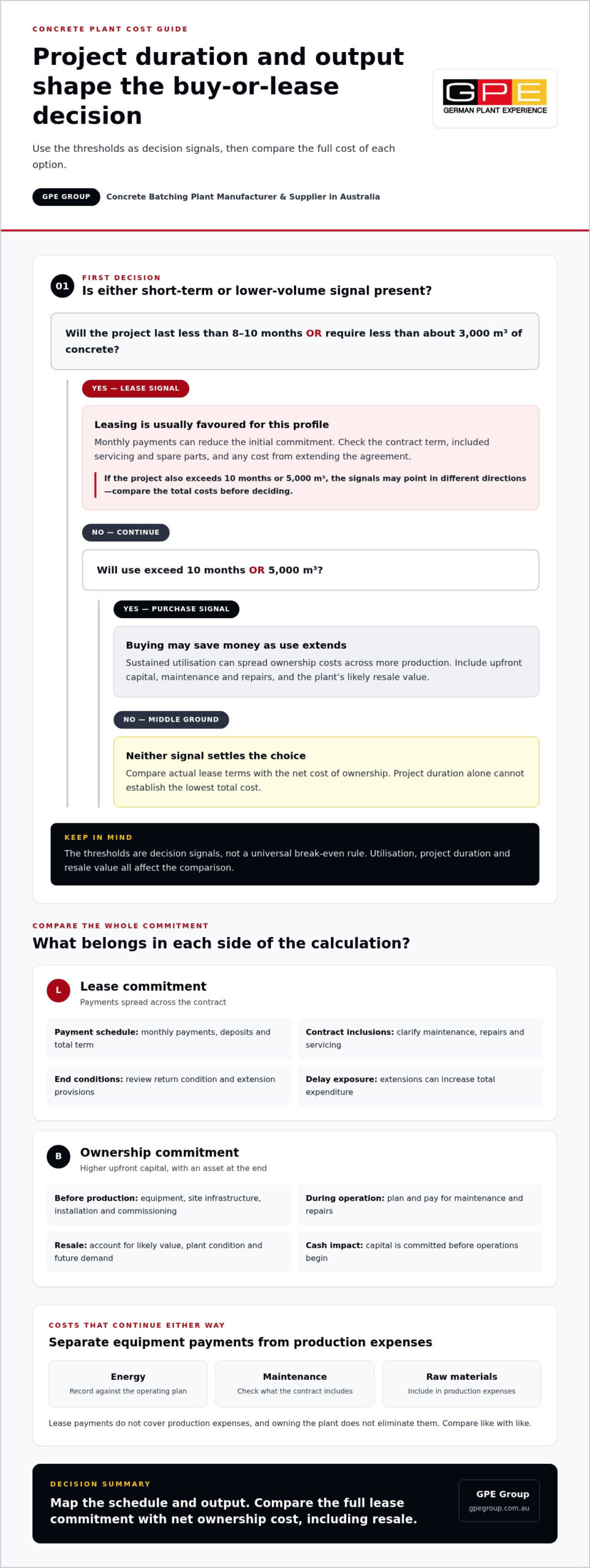
The counterintuitive answer is that leasing can be the more economical choice, even when owning a plant appears to offer greater control. In Australia, renting is usually favoured for projects lasting less than 8-10 months or requiring less than about 3,000 cubic metres of concrete; buying usually saves money when a project exceeds 5,000 m³ or lasts longer than 10 months. An owning-versus-leasing concrete plant cost analysis therefore turns on duration and output, as well as the plant’s eventual resale value.
The drawbacks of ownership deserve careful attention: the upfront capital commitment, responsibility for maintenance and the risk that a project ends before the plant’s value has been recovered. Leasing can reduce initial expenditure and spread payments, but a long term or contract extension can change the overall economics. Neither option is automatically less expensive for every project.
This article explains how to compare total ownership and leasing costs, factor in plant capacity and resale value, and estimate the break-even volume. It also explores how project duration, production needs and the choice between mobile and stationary equipment affect the decision, helping you assess which arrangement suits your Australian operation.
Key Takeaways
- Use project duration and concrete volume as initial guides: renting is usually favoured for shorter or lower-volume work, while purchasing may become more economical as use extends.
- Compare the full cost of ownership with lease payments, including operating responsibilities and the effect of resale value.
- Match plant capacity to expected production so the investment reflects the project’s actual output requirements.
- Assess whether mobile or stationary equipment better suits the project’s location, duration and operating needs.
- Understand how GPE Group’s stationary and mobile plant options, engineered in Germany, can align with production requirements ranging from 30 m³/h to 400 m³/h.
Buying and leasing for short-term work needs
For Australian work lasting less than 8-10 months or requiring less than about 3,000 cubic metres, renting is usually the financial choice. Buying becomes more attractive when use is sustained, although project duration alone cannot establish the lowest total cost. A separate guide says purchase may save money above 5,000 m³ or beyond 10 months, so treat these thresholds as decision signals, not a universal break-even rule.
Utilisation, project duration and resale value are closely linked. Steady, high utilisation spreads ownership costs across more production, while a short project leaves less time to recover the upfront investment. Resale value can reduce the net cost of buying, but depends on the plant’s condition and future demand. A shorter commitment may favour leasing; sustained use and recoverable asset value can strengthen the case for buying.
Lease costs are commonly assessed as monthly payments, with the total depending on capacity, term and contract inclusions. Because plant configurations vary, compare actual lease terms with purchase costs rather than relying on a generic figure. Rental is not a service offered by the manufacturer.
Before deciding, map the likely project schedule and output, then compare the full cash commitments. Monthly lease payments spread equipment expenditure over time and can help with budgeting. Some lease contracts include maintenance or repairs, while rental arrangements may cover servicing and spare parts. These inclusions can reduce operational responsibilities, but extensions after delays may add cost. With ownership, you plan for maintenance and pay for repairs.
Buying directly from a manufacturer can avoid intermediary markups and provide direct access to technical support and spare parts. Compare this route with leasing by listing the capital required, contract duration, included services, expected utilisation and likely resale value. The Australian Government’s business website advises businesses considering plant or equipment purchases and leases to assess their needs and finances.
| Option | Project fit | Cash profile | Key consideration |
|---|---|---|---|
| Short-term lease | Brief construction work | Monthly payments | Review servicing and extension terms |
| Longer lease | Ongoing work without purchase | Payments continue through the term | Compare cumulative cost and renewal exposure |
| Outright purchase | Consistent plant utilisation | High upfront capital | Account for maintenance and resale |
| Direct manufacturer purchase | Long-term operational requirement | Purchase commitment | Direct technical support and spare-parts access |
| Lease with maintenance | Projects prioritising service inclusion | Monthly contract commitment | Check precisely which support is included |
Match the expected project schedule and production volume against total lease commitments or net ownership cost, including resale.
Capital expenditure and operating expenditure
Buying commits capital before production begins; leasing spreads equipment payments across the contract. Compare setup costs, operating expenses and contractual obligations, not just the initial outlay.
Buying Plant and Upfront Capital
Buying adds the equipment investment to the business’s balance sheet and requires capital before operations begin. Plan for site infrastructure, installation and commissioning as well as the plant itself. These costs differ from a lease, where payments are spread over time and the initial financial commitment may be lower. Purchasing can suit sustained operations, but ties up funds that could support other project needs.
Leasing Terms and End Conditions
Lease agreements set out payment schedules, deposits and end-of-term conditions. Review payment frequency, maintenance responsibilities, return condition and extension provisions. Contracts may include repairs and maintenance, but inclusions vary. Scheduled payments can make budgeting more predictable, while extending an agreement after project delays may increase total expenditure. Unlike buying, leasing does not leave the business owning the plant at contract end.
Separate capital expenditure from operating expenses before comparing options. The Australian Government’s business website advises businesses deciding whether to buy or lease plant or equipment to consider their needs and finances. For a concrete operation, recurring expenses can include energy, maintenance and raw materials. Lease payments do not cover production expenses, and owning the plant does not eliminate them. Record each cost category against the expected operating plan.
Setting up a batching plant involves more than buying machinery. Site infrastructure, aggregate storage, control facilities, installation and commissioning all affect the capital required. For example, a project that needs aggregate storage and a control room must include those site requirements alongside equipment procurement. Compare the total installed investment with the lease commitment, including any services in the agreement. This avoids treating the equipment payment as the full cost of either option.
- Capital: Record the initial equipment and site expenditure required before production.
- Operations: Estimate energy use, maintenance, materials and staffing against the project schedule.
- Lease conditions: Identify payment timing, included repairs, return obligations and extension costs.
- Cash allocation: Consider whether retaining funds for materials or other project demands outweighs owning the plant.
Storage and accessories also shape the investment. Match storage capacity to material requirements, and leave out features the production plan does not need. For example, omitting an unnecessary admixture dosing system can reduce plant costs, while inadequate storage may complicate materials handling. The right configuration depends on the project’s concrete recipes and workflow.
For a structured comparison, put purchasing, setup and operational expenses beside the lease schedule and end conditions. Reviewing batch plant configuration options can help connect production requirements with the capital and site decisions being assessed.
Asset depreciation and resale value
Ownership creates a capital asset that can retain resale value, while depreciation reduces its recorded value over time. A well-maintained concrete batch plant often resells for 40-60% of its purchase price. That range makes condition central to an ownership comparison, but it is not a guaranteed return. Mixers, conveyors and silos influence a used plant’s appeal, alongside maintenance history and spare-parts availability.
In Australia, plant depreciation is usually spread over 10 to 15 years unless the purchaser qualifies for the instant asset write-off. Owning equipment allows the business to claim depreciation; leasing does not create the same owned asset. Rental payments are described as 100% tax-deductible in the year spent. Tax timing therefore differs between arrangements, while financing costs can add to the total amount paid to acquire equipment.
Compare cash and tax effects over the plant’s operating period. For a purchase, consider upfront capital, financing expense, depreciation period and eventual sale proceeds. For a lease, consider payments over the contract and when those expenses affect tax. These are different measures: a deduction affects taxable income, while resale proceeds reduce the net cash cost of ownership.
Resale demand depends on whether a future buyer can use the plant productively. Construction and mining projects may create demand, but that alone does not establish a resale price. A mobile plant may suit a buyer working at another site; condition, configuration and maintenance records matter for both mobile and stationary equipment.
Before estimating resale value, document the plant’s condition and operating history. Assess the mixer, conveyors and silos, and record maintenance needs and spare-parts availability. Compare these findings with the planned sale date and likely buyer requirements. A plant needing substantial repairs may attract less interest than a maintained unit, even if both had the same purchase price.
- Ownership: Include acquisition financing, depreciation and estimated sale proceeds in the cost model.
- Leasing: Total the contract payments and account for the timing of deductible expenses.
- Condition: Record the state of mixers, conveyors and silos, plus maintenance and parts needs.
- Demand: Consider whether the plant’s configuration suits future construction or mining work.
Use the 40-60% resale range as a planning reference, then test how the result changes with different sale values. If the plant’s condition weakens or buyer demand falls, the ownership calculation changes. If it remains serviceable and suitable for later projects, resale can reduce the net capital cost. A sound comparison keeps operating use, financing, tax timing and asset condition visible rather than treating depreciation as the plant’s only lifecycle cost.
Production capacity and project scale
Match the machine’s rated capacity to the project’s required production, not its peak demand alone. Capacity examples include 25, 50, 90 and 180 m³/h, while customised plant solutions can range from 30 m³/h to 400 m³/h. A plant sized for actual output avoids committing capital to capacity the project may not use.
Consider a project requiring 50 m³/h: a 30 m³/h plant may be too small to meet that production requirement. A larger machine may meet the hourly demand, but its upfront cost and operating requirements must also suit the work schedule. Compare expected output with the plant’s practical production rate, allowing for working hours, interruptions and the sequence of construction activities.
Project duration changes the capacity decision. Stationary plants are suited to large-scale projects lasting 18 months or longer, while mobile plants suit flexible or temporary construction sites. A stationary installation can be appropriate where production remains concentrated at one location. A mobile configuration may better match work that shifts between sites, where moving production equipment supports the project plan.
Use a step-by-step assessment before selecting plant size:
- Define output: Estimate the concrete volume and hourly production required by the construction schedule.
- Check capacity: Compare required output with rated plant capacity and the expected production pattern.
- Match the site: Select stationary equipment for sustained fixed-site work, or mobile equipment for changing locations.
- Review utilisation: Identify periods of peak demand and likely idle time across the project duration.
- Compare investment: Weigh the required capacity against upfront cost, operating needs and future project use.
Capacity also depends on the mixer and production configuration, not just the plant’s headline rating. For instance, a 3 m³ twin-shaft mixer is associated with 120 m³/h in the stated example. Such a figure is a capacity reference, not a guarantee of continuous delivered output. Material flow, recipe changes and site scheduling shape how effectively the machine serves actual demand.
Right-sizing helps avoid paying for more capacity than the project needs. But insufficient capacity can constrain the construction schedule if required output exceeds the plant’s rated capability. Compare projected hourly demand with the plant’s production rating, then determine whether that demand is sustained or limited to particular stages of the work.
Plant pricing depends on required capacity, mixer configuration, mobility, storage and site requirements. A quote provides the exact figure for your project. Assessing these factors alongside expected production helps align the investment with the project’s scale.
Project savings and break-even volume
Buying may save money on projects exceeding 5,000 m³ or lasting longer than 10 months. Treat these thresholds as screening points, not universal break-even rules. A thorough owning vs leasing concrete plant cost analysis compares total costs over the same period and production volume. Break-even volume is where the total cost of owning matches the total cost of leasing.
For ownership, add the purchase price, financing, setup and operating expenses, then subtract expected resale value. Divide the net cost by the volume of concrete produced. For leasing, add lease payments and operating expenses across the project, then divide by its output. Comparing cost per cubic metre gives you a consistent basis for evaluating both options.
Apply the calculation to your forecast, then test different volumes around the likely crossover point. If the project falls below 5,000 m³, compare its lease commitments with the ownership costs at that output. Repeat the exercise at volumes above the threshold. Utilisation, operating expenses, contract duration and resale assumptions determine where the actual break-even falls.
Efficiency and site infrastructure can also affect the decision. A plant with more capacity than the project requires may tie up capital without improving the operating plan. An undersized machine, by contrast, can constrain scheduled work. If production needs to move between sites, flexibility may matter as much as cost per cubic metre. Include the practical cost and operational impact of relocating in your comparison.
Test schedule changes as well as production volumes. A construction delay can extend lease commitments or leave an owned plant underused. Model the planned completion schedule alongside a delayed scenario, then compare each option’s total cost and break-even output. This gives you a more useful basis for planning than relying on a single volume estimate.
Project break-even differs from the longer-term investment recovery period. Under normal operation, a properly invested plant may recoup its costs and begin making profits within 3 to 5 years. That longer horizon may include future production beyond the current contract. A second owning vs leasing concrete plant cost analysis can therefore assess whether follow-on work justifies retaining the plant after the project ends.
- Use equal assumptions: Compare the same operating period, output and project schedule.
- Include full costs: Account for financing, setup, operations, lease payments and resale.
- Test scenarios: Recalculate for lower output, schedule delays and changing site needs.
- Separate horizons: Distinguish the current project’s break-even from longer-term asset recovery.
To align plant configuration with your project’s output and duration, discuss your concrete plant requirements.
GPE Group: Concrete Batching Plants
GPE Group serves Australian projects as a Concrete Batching Plant Manufacturer and Concrete Batching Plant Supplier, with stationary and mobile plant solutions engineered in Germany. Its custom production capacities range from 30 m³/h to 400 m³/h, supporting assessment against project output, site conditions and operating requirements.
Hundreds of installations worldwide reflect GPE Group’s international project experience. Its Concrete Batching Plants have been used to manufacture concrete for landmarks including the Burj Khalifa, where high-quality concrete was required. Cement Silos and Mobile Horizontal Cement Silos can support projects requiring material storage, while after-sales service and spare parts are provided around the world.
For a project-specific discussion of plant configuration and production requirements, contact GPE Group.
Turn the Cost Model Into a Project Plan
The next step is to turn the financial comparison into a procurement plan that reflects your operating priorities. An owning-versus-leasing concrete plant cost analysis is most useful when its assumptions lead to clear decisions about site readiness, production scheduling, maintenance responsibilities and future equipment use. Assign responsibility for each assumption so your team can identify unresolved operational dependencies before they affect delivery.
Bring together the people responsible for construction scheduling, finance and plant operations. Their combined assessment can match equipment selection to the project’s actual workflow, rather than treating acquisition as an isolated purchasing decision. It also gives decision-makers a practical way to assess how changes in schedule or production demand could affect the plan.
For a project-specific discussion of equipment configuration, discuss your plant requirements with GPE Group. A considered plan gives your team a stronger foundation for moving forward with clarity.
Frequently Asked Questions
But what about the cons of plant ownership?
Ownership ties capital to equipment and puts maintenance planning, repair coordination and asset condition under your control. If a project is delayed or future work needs a different configuration, the plant may be underused. Before buying, assess whether your operations team can manage maintenance and whether the plant can serve the projects you expect to pursue after the current contract.
How do you calculate concrete batch plant costs?
List one-time and recurring costs separately, then compare both options over the same operating period and expected output. Include equipment acquisition or lease commitments, site preparation, installation, energy, materials, maintenance and financing where applicable. For example, keep site infrastructure as a separate cost rather than folding it into the equipment figure, so decision-makers can see what drives the total.
Should you lease or own your plant?
Choose leasing when preserving capital and avoiding long-term asset responsibilities matter most; consider ownership when the plant will support sustained operations and future projects. Also assess how predictable the project schedule is and whether the configuration will remain useful. If you are planning several contracts, evaluate the plant across those expected uses rather than against one project alone.
What are the upfront costs of owning versus leasing a concrete plant?
Buying requires funding for the equipment and the work needed to prepare an operational site, including infrastructure and commissioning. Leasing generally spreads equipment payments across the agreement, reducing the initial cash commitment. Compare the funds required before production begins, including site-specific preparation. For example, include dedicated aggregate storage in the setup estimate if the project requires it.
How do operating and maintenance costs compare for owned and leased concrete plants?
Both arrangements involve production expenses, including energy, materials and ongoing operational needs. With ownership, the business arranges and pays for maintenance and repairs. A lease may include servicing or repairs, depending on its terms. Separate routine maintenance from the risk of unplanned repairs, then identify who arranges each task. This helps reveal whether a lower equipment payment shifts responsibilities elsewhere.
What are the main risks of owning or leasing a concrete plant, including downtime and repair responsibility?
Ownership can leave the operator responsible for repair costs and lost production during downtime, while a lease makes maintenance and extension terms central to the agreement. Identify who coordinates repairs, supplies parts and authorises work under either arrangement, then map that process against the production schedule. Clear responsibilities reduce uncertainty when a breakdown interrupts planned output.
How can you calculate the break-even point for buying versus leasing a concrete batching plant?
Compare total ownership and lease costs over the same operating period, then test the figures at different production volumes. For ownership, include financing, setup and operating costs, less expected resale proceeds. For leasing, include lease payments and operating expenses. Break-even occurs when the totals match. Testing lower output or schedule delays shows how sensitive the result is to project conditions.
Are GPE Group batching plants designed in line with Australian Standards?
Yes. GPE Group designs concrete batching plants in line with Australian Standards. For an Australian project, assess this alongside the required production configuration, site conditions and intended operating profile. Standards alignment is one design consideration; capacity and system configuration must also suit the production task. Considering these factors together supports a more complete technical evaluation of the proposed installation.