 Main Number
 Find us on
 Reach us @
A batch plant’s uptime directly affects project profitability by determining how much scheduled production becomes consistent, saleable concrete. Process plants average 67% machine uptime as a share of scheduled uptime, but a project’s return depends on how downtime, batch consistency and actual production capacity interact. A plant’s rated output alone cannot show how much concrete it will reliably produce across a project schedule.
Project teams know that equipment interruptions can disrupt delivery sequences and put pressure on labour, materials and downstream work. The impact of batch plant uptime on project profitability becomes clearer when downtime is assessed alongside batch cycle times, consistency and equipment reliability.
This article explains how these factors affect usable output and investment decisions on Australian projects. It also covers how to distinguish lost production from planned maintenance, assess capacity against demand and determine when a more reliable plant configuration could support commercial performance.
Key Takeaways
- Measure usable production against scheduled operating time to understand where interruptions are affecting project output.
- Track batch cycle times and consistency alongside uptime, since reliable operation alone does not ensure dependable production.
- Assess practical capacity against project demand rather than relying solely on a plant’s rated output.
- Separate planned maintenance from unplanned breakdowns when evaluating lost production and scheduling work.
- Use utilisation and reliability evidence to guide decisions about maintaining, improving or expanding plant capacity.
1. How downtime, variable batch cycle times, and out-of-specification batches affect production
Uptime is the share of scheduled production time when equipment is operational and available. At a batching plant, an unplanned stop interrupts weighing, mixing or discharge. Slow or variable cycles can also reduce output, even when the plant is running. Record both stoppage duration and cycle time to identify where production is being lost.
Batch consistency also affects whether output can be used as scheduled. A batch outside its required specification may need adjustment, testing or rejection, using materials and production time. Where deliveries are sequenced, rework can affect subsequent loads and site coordination. Review batch records alongside cycle times to distinguish equipment stoppages from quality-related losses.
Backup capacity, a mobile plant or outsourced production can help maintain supply during an outage, but each option has different costs. Backup equipment may involve mobilisation and setup, while outsourcing adds purchase, transport and scheduling costs. Compare the cost of maintaining supply with the project impact of interrupted production.
Typical downtime causes include equipment failure, planned maintenance, repairs and production transitions. Failures can stop the plant without warning; maintenance and changeovers can reduce available production time even when scheduled. Unplanned downtime is estimated to cost Australian businesses almost A$349,000 per hour, but that broad estimate is not a batch-plant-specific rate. Plant costs depend on lost output, repair work and resulting project disruption.
The financial effect reaches beyond the stopped asset. Crews, transport and downstream work may be left waiting, while recovery can require extra labour or rescheduling. Out-of-specification batches also create material and handling losses. For each event, record its duration, affected production, recovery tasks and any quality rework.
Reduce transition delays by documenting changeover steps and assigning responsibilities before production changes. Training can improve the consistency and pace of these tasks, while time studies can pinpoint setup or cleaning delays. Compare planned cycle times with actual records to identify recurring hold-ups instead of treating every shortfall as a mechanical failure.
Preventive maintenance supports uptime by scheduling inspection and servicing before avoidable failures interrupt production. Predictive maintenance uses equipment condition data to identify developing issues and guide the timing of interventions. To assess the value of either approach, connect maintenance records with outage duration, repair effort and production losses. Schedule planned work around operating requirements.
Extra capacity can absorb interruptions, but unused capacity is an investment that needs to be justified against project demand. Compare expected production requirements with dependable output, allowing for servicing, variable cycles and recovery after failures. This helps determine whether existing assets can meet the schedule, contingency capacity is commercially sensible, or reliability improvements could protect project margins.
2. Asset utilisation and production capacity
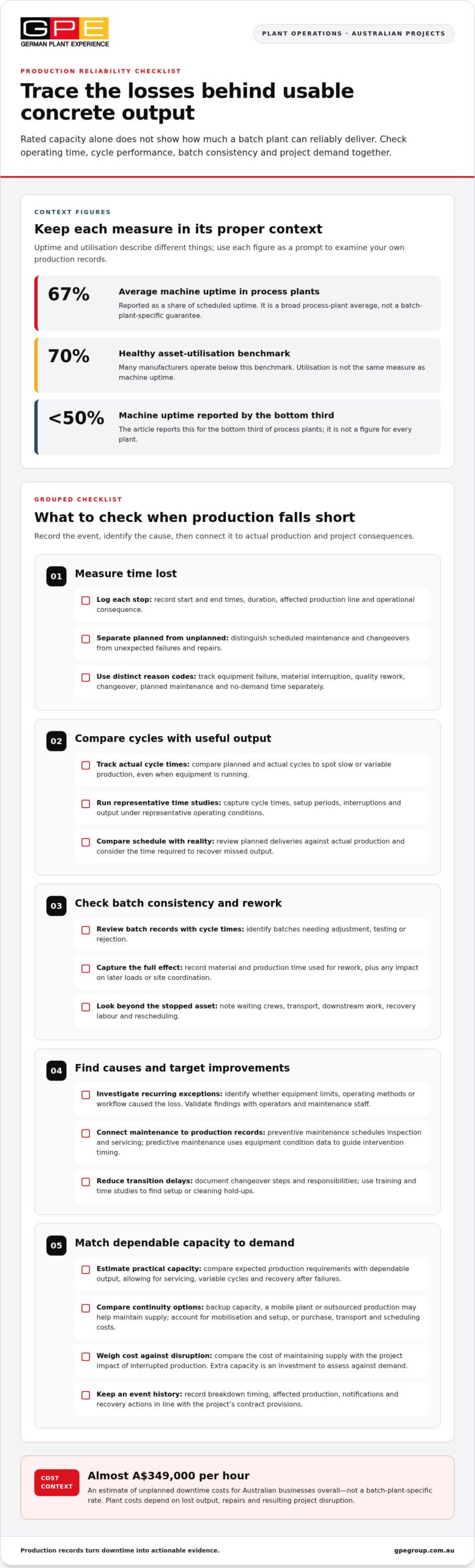
Asset utilisation shows how effectively available plant time becomes useful production. A plant can be running yet deliver less than its rated capacity if processes are slow or demand is absent. Many manufacturers operate below the 70% healthy benchmark for asset utilisation, while the bottom third of process plants report machine uptime below 50%. These figures illustrate why scheduled availability and actual production should be assessed separately.
When uptime falls, less concrete is available for dispatch during scheduled production periods. This can compress delivery windows, delay subsequent site activities and leave labour waiting for supply. The effect depends on the plant’s production rhythm, the work sequence and the time needed to recover missed output. Compare planned deliveries with actual production records to identify capacity pressure.
Australian project contracts address breakdown-related delays through their notice, delay, extension-of-time and responsibility provisions. The contract wording and documented cause determine how the parties manage schedule consequences. Record when the breakdown occurred, the production affected, notifications and recovery actions to maintain a clear event history for project decisions.
Use consistent reason codes to separate production exceptions. Record equipment failure, planned maintenance, material interruption, quality rework, changeover and no-demand time as distinct causes. Each entry should include start and end times, the affected production line and the operational consequence. This helps supervisors distinguish a mechanical constraint from scheduling or process issues instead of grouping all lost time under one downtime label.
Root-cause analysis turns event records into improvement priorities. Review recurring exceptions, identify the critical constraint and determine whether equipment limits, operating methods or workflow caused the loss. Production reports should compare scheduled and actual output and explain the largest variances. Review findings with operators and maintenance staff to validate causes before assigning corrective work.
Time studies help estimate achievable production capacity. Record cycle times, setup periods, interruptions and output while the line operates under representative conditions. Then account for equipment breakdowns, changes in demand and staff absence, which can all reduce production. This estimate is more useful for scheduling than multiplying rated output by planned operating hours.
Reliability also affects utilisation through wasted batches. If equipment stops during production, material already in process may need assessment or rework, and the line may take time to resume stable operation. Track affected batches alongside exception codes to link output losses to specific events. Reviewing these records over time can show whether changes improve efficiency or simply shift the constraint.
3. Asset utilization and investment decisions
Asset utilisation and production-process effectiveness measure different aspects of performance. A process may run effectively while available plant time is underused because demand is limited. Conversely, high utilisation can hide slow cycles or quality losses. An investment decision should assess both measures rather than treating uptime as a complete indicator of commercial performance.
Consider the contrast between a plant operating at 60% utilisation and a 90% world-class example. The difference does not automatically justify purchasing additional equipment. First, identify whether lost time comes from demand gaps, operating constraints, maintenance or breakdowns. If the constraint is a scheduling problem, new capacity may increase idle assets rather than useful output.
Start with actual production records, scheduled operating time and maintenance history. Compare these with project demand across relevant operating periods, then identify the stages limiting throughput. Include cycle variability and planned servicing in the capacity estimate. This helps show whether an investment case is driven by unmet demand, unreliable equipment or avoidable process losses.
Asset condition should also shape the decision. Repeated repair interruptions may justify evaluating reliability improvements before expansion. If equipment remains serviceable and demand consistently exceeds dependable output, additional capacity may address a genuine constraint. Compare each option by its expected effect on usable output, maintenance requirements and project scheduling.
Continuous monitoring strengthens that comparison. Track operating time, output, maintenance events and demand together, using consistent reporting periods. A 68% asset-performance case study illustrates how measured performance can expose a gap, but the cause must still be established locally. The same utilisation figure can reflect different operating conditions and therefore support different investment choices.
Before approving capital expenditure, test different operating scenarios. Assess changes in demand, the effect of planned maintenance on available production, and how breakdowns affect dependable capacity. Compare the results with the investment’s purpose. If the main objective is to protect delivery commitments, reliability measures may matter more than peak rated output.
Investment plans should define what results would prompt a different decision. For example, management can review whether utilisation improves after a maintenance programme or workflow change. If output remains constrained, expansion may be better supported by the evidence. This staged approach links spending to observed results rather than assumptions about maximum capacity.
Establish a review process that combines operating data with project forecasts. Assess utilisation, production effectiveness, equipment condition and demand separately, then document the constraint each proposed investment addresses. This helps distinguish capacity shortages from performance losses and directs capital towards the operational issue most likely to affect delivery and profitability.
4. Lean manufacturing and reliable equipment
Lean methods can improve reliability by making interruptions visible and clarifying responses. In concrete production, a recurring stoppage at one stage can constrain the entire operation, even when other equipment is available. Map each production step, record delays and identify the constraint. Prioritise changes that prevent repeat interruptions without compromising quality or safe work.
Planning and scheduling maintenance can improve equipment availability compared with a reactive approach. In one comparison of manufacturing plants, the plant using planning and scheduling practices reported 96% availability, while the mostly reactive plant reported 88%. These figures illustrate the value of disciplined maintenance, but each operation should assess its own failure patterns, condition data and production requirements.
Lean practices such as 5S, Just-in-Time and Total Productive Maintenance can help remove bottlenecks. For a batching operation, apply them by organising tools and service materials, coordinating maintenance with production schedules, and involving operators in routine equipment observations. A clear handover also helps ensure that a reported fault reaches the person responsible for assessment and action.
Maintenance planning matters because unplanned work can consume time intended for useful repairs. Maintenance teams in organisations without planning or scheduling reportedly achieve roughly 2 to 3 hours of useful wrench time in an eight-hour workday. A defined work order, parts preparation and task sequence can reduce avoidable waiting. Schedule planned work during appropriate production windows to limit disruption.
Predictive maintenance uses equipment data to identify developing faults before failures interrupt operations. Operators can monitor relevant condition indicators, record abnormal changes and connect observations to maintenance histories. This supports earlier intervention, while the maintenance team can target inspections according to asset criticality. Reactive maintenance can cost 30-40% more than predictive approaches, making the choice of strategy relevant to lifecycle performance.
Preventive work also requires prioritisation. In a 21-site manufacturing portfolio, 40% of preventive maintenance work was reportedly performed on equipment that did not need it. This highlights the importance of matching tasks to actual asset condition and operational risk. Review maintenance records alongside breakdown history, then adjust the schedule to focus resources on equipment whose failure would constrain production.
Treat lean improvement as an ongoing operating discipline, not a one-off initiative. Record a baseline for failures, equipment availability and production interruptions, implement a focused change, then compare results using the same measures. For example, standardise inspection handovers and track whether recurring faults decline. Regular review keeps maintenance decisions aligned with production needs and schedules.
5. Machine uptime and plant profitability
Machine uptime contributes to profit only when available time produces usable output that meets project requirements. Connect operating records with production volumes, batch quality and delivery performance. For example, compare each shift’s planned production window with actual output, recording the reason for every gap. This shows whether equipment availability, process rate or demand is constraining profitability.
Downtime can affect several cost lines at once. A stoppage may reduce concrete output, disrupt dispatch and leave scheduled labour or transport waiting. Recovery may require rescheduling production or coordinating delayed work with site teams. Record each event, its duration, affected production and recovery tasks, then relate these effects to the project schedule.
Replacement parts are another recurring operational expense. In the reported process-plant data, 58% of plants incur machine replacement-parts costs weekly, daily or constantly. For project assessment, review parts consumption alongside failure records and maintenance activity. A repeated replacement pattern may indicate that a critical asset is generating both direct repair demands and interruptions to planned production.
Planned downtime is necessary for servicing assets and helping prolong their life. Treating every maintenance hour as a lost opportunity can defer essential work and expose production to avoidable failures. Schedule servicing around operating requirements, then assess whether availability supports expected output. Compare controlled maintenance time with the operational consequences of degraded equipment.
Use a consistent performance review to connect uptime with return. Track machine availability, actual output, batch quality, maintenance work and delivery performance together. Separate planned servicing from unplanned stoppages and identify which events affect the production constraint. This keeps a single uptime figure from obscuring losses caused by slow cycles, rework or lack of demand.
Condition monitoring can support better decisions when its data leads to clear action. Set a baseline for relevant machine indicators, document abnormal readings and link interventions to subsequent operating results. Review the records with production and maintenance teams to determine whether interventions reduced interruptions or shifted the work elsewhere.
The impact of batch plant uptime on project profitability is therefore best judged through dependable output, quality and schedule performance, not availability in isolation. Use project records to identify the losses with the greatest operational effect, then prioritise corrective action against those causes. For a considered review of plant performance and project requirements, discuss your plant uptime requirements.
GPE Group: Concrete Batching Plants
GPE Group is a German-engineered Concrete Batching Plant Manufacturer and Concrete Batching Plant Supplier serving projects in Australia. Its stationary and mobile plants are configured for project production requirements, while Cement Silos and Mobile Horizontal Cement Silos support bulk material storage.
GPE Group has hundreds of Concrete Batching Plant installations worldwide. Its plants have been used to manufacture concrete for landmarks including the Burj Khalifa, where high-quality concrete was required. After-sales service and spare parts are provided around the world.
Contact GPE Group to discuss a concrete batching plant configuration for your project.
Turn Operational Evidence Into a Confident Investment Decision
Before committing to a plant investment or operational change, define the performance outcome the project needs. This might mean protecting delivery sequences, improving dependable production or reducing disruption across connected site activities. A clear objective gives engineering and project teams a shared basis for assessing options and measuring results.
Understanding the impact of batch plant uptime on project profitability means turning operational priorities into a fit-for-purpose plant decision. Consider the production profile, site requirements and continuity needs together, rather than treating equipment selection as an isolated purchase. This creates a more disciplined path from project demands to a practical plant configuration.
GPE Group can discuss how its concrete batching plants, mobile concrete batching plant and cement silos relate to your operational requirements. For a considered conversation about your project, contact GPE Group. A clear brief is a sound starting point for planning dependable production.
Frequently Asked Questions
What is Uptime and Downtime in Industrial Operations?
Uptime is the period an asset is operational and available for production; downtime is the period it cannot perform its intended role. For useful reporting, measure both against scheduled production time and classify interruptions as planned or unplanned. For example, record planned servicing separately from an unexpected mixer fault to distinguish maintenance allowances from avoidable interruptions.
What is the Cost of Downtime?
Downtime cost combines direct expenses with the financial effect of production that cannot be completed as planned. A useful estimate includes repair labour and parts, lost contribution margin, idle crews or transport, recovery work and batch rework. Keep these categories separate to avoid counting the same production loss twice and identify the cost drivers that need attention.
What real and tangible benefits should I expect?
Improved uptime can make production planning more dependable, reduce interruptions to dispatch and limit idle time for crews waiting on concrete. It can also help teams use existing plant capacity more effectively before considering expansion. Track completed production against schedule, missed dispatch windows, recovery shifts and repeat faults to see whether operational changes are delivering project value.
How does batch plant downtime affect project costs and profitability?
A plant stoppage can reduce concrete available for a scheduled placement and disrupt subsequent work. A delayed supply, for instance, may require the site team to revise labour allocation or coordinate a changed delivery sequence. The commercial effect can include recovery costs and lost contribution from delayed work. Link plant events to actual schedule and resource consequences in project records.
How much does one hour of concrete batch plant downtime cost in Australia?
There is no single hourly figure that accurately represents every Australian concrete batching operation. Unplanned downtime is estimated to cost Australian businesses almost A$349,000 per hour overall, but that broad estimate is not a plant-specific rate. For a project estimate, calculate the concrete output affected, its contribution margin, idle resources, recovery effort and any quality-related losses during the outage.
How can contractors calculate the profitability impact of batch plant uptime?
Calculate uptime by dividing operating hours by scheduled production hours, then assess how much conforming output those hours produced. To estimate the financial impact, total the contribution margin from lost usable production and add documented idle-resource, repair and recovery costs. Separate planned maintenance from unplanned stoppages and exclude overlapping costs. Comparing results across reporting periods helps assess operational changes and investment decisions.