 Main Number
 Find us on
 Reach us @
When choosing a Concrete Batch Plant, the wet or dry batching method is only one part of the production plan. Cement storage also affects how materials fit into the site layout and how the production system is supplied. Planning the silo alongside the plant helps connect storage capacity, bulk handling, transport and on-site assembly from the outset.
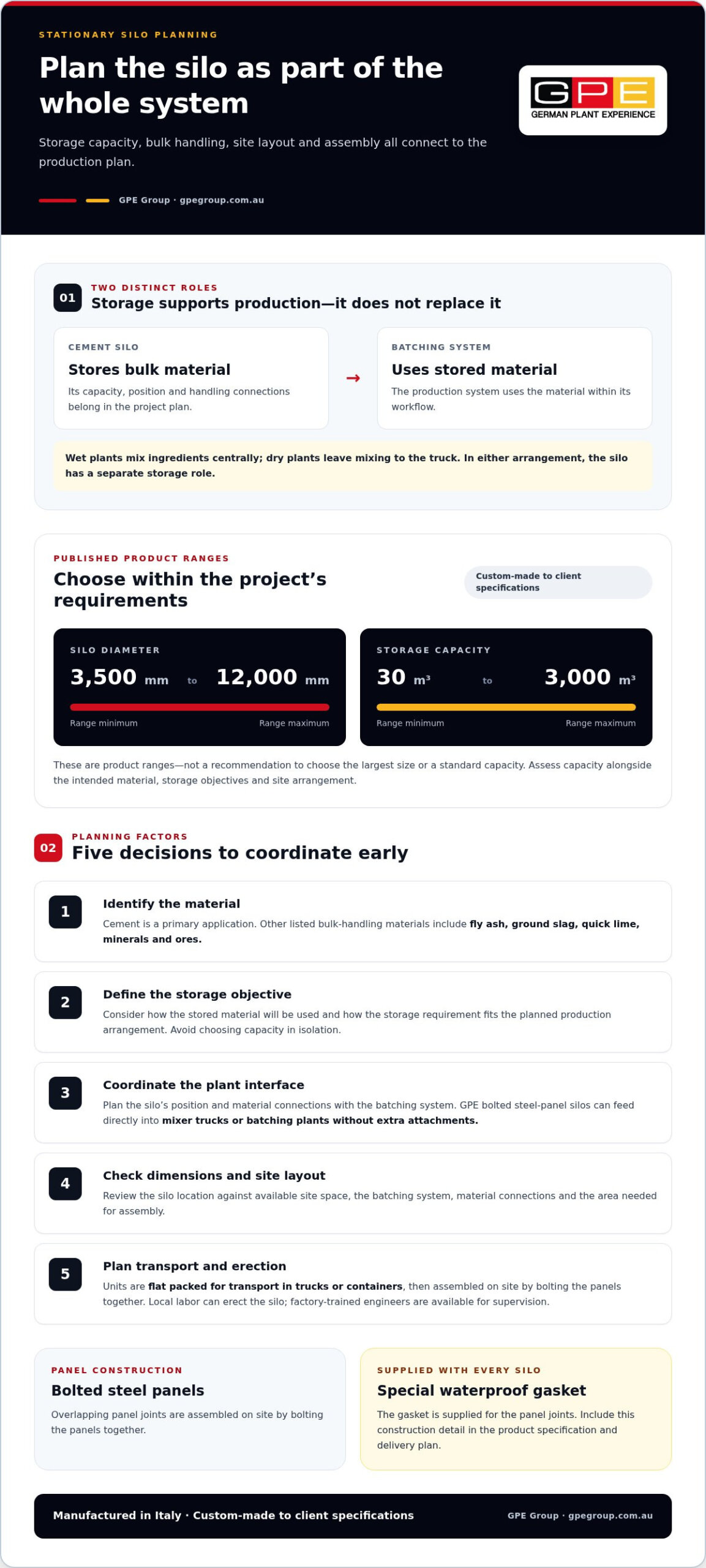
Wet plants mix ingredients centrally, while dry plants leave mixing to the truck. Whichever process is planned, the cement silo has a separate role: it stores bulk material and forms part of the wider handling arrangement. To assess the right setup, consider what material the silo will hold, the project’s storage objectives, the site’s access and assembly conditions, and the planned interface with the batching system.
GPE Group’s bolted steel-panel cement silos are manufactured in Italy and custom-made to client specifications. Units are flat packed for transport in trucks or containers, then assembled on site. Capacities range from 30 m³ to 3,000 m³, and every silo is supplied with a special waterproof gasket. Local labor can erect the silo, with factory-trained engineers available for supervision.
Key Takeaways
- A stationary silo provides bulk storage as part of a Concrete Batch Plant’s material-handling arrangement.
- Assess the intended material and storage objectives alongside the planned production arrangement instead of choosing capacity in isolation.
- Plan transport and assembly early. GPE silos are flat packed for transport in trucks or containers and bolted together on site.
- Consider the silo’s position and interface with the batching system when planning site layout and bulk handling.
- Local labor can erect GPE silos, with factory-trained engineers available for supervision.
What a Stationary Cement Silo Contributes to a Concrete Batch Plant
A stationary cement silo stores bulk material for use in concrete production. It is a separate part of the system from the batching plant, but its capacity, position and bulk-handling connections should be considered as part of the overall project plan. GPE’s bolted steel-panel silos are custom-made to client specifications and manufactured in Italy.
The silo’s function is storage. The batching system uses stored material within its production workflow. Keeping these roles clear helps project teams define what the storage system needs to do without treating a silo as a substitute for batching equipment or assuming that every project requires the same arrangement.
In practical terms, start by identifying the bulk material to be stored and how the storage point will relate to the plant. Cement is a primary application; GPE also lists fly ash, ground slag, quick lime, minerals and ores among its bulk-handling applications. The planned material and production arrangement inform the required silo configuration and its interface with the site’s handling system. An overview of plant components and batching configurations is available in this Concrete Plant Overview.
Storage and production decisions are linked, but neither determines the other on its own. Production objectives help frame the storage requirement, while the silo’s location and handling connections affect the site layout. Considering both early can prevent the silo from becoming an afterthought during procurement. For wider project factors involved in plant selection, see GPE’s guide to selecting a concrete batching plant for a major infrastructure project.
Where the Silo Fits in the Batch Plant System
The silo holds bulk material before it is used in production. Its role is distinct from the batching process, so planning should cover both the storage requirement and how material will be handled between storage and the plant. GPE’s bolted steel-panel silos can feed directly into mixer trucks or batching plants without extra attachments. Include the intended connection in the project layout rather than assuming a transfer arrangement that may not suit the site.
This functional distinction helps clarify procurement decisions. The plant’s production requirements inform the overall system, while the silo provides bulk storage within that system. Define the intended material, storage objective and interface together to make the role of each part clear.
What Stationary Means in This Context
Here, stationary refers to a silo arranged as part of a site-based bulk-storage system. It is not a comparison of mobile batching plant configurations. The silo’s position and connection to the rest of the handling arrangement depend on project requirements and the available site layout.
For project teams, the practical distinction is straightforward: the silo stores bulk material, and the production system uses that material in its process. Evaluating these functions together gives a clearer basis for planning site layout, storage and procurement.
How Bolted Steel-Panel Cement Silos Store and Protect Bulk Material
A cement silo is an engineered storage structure, not simply a container added after the plant layout is settled. Its dimensions, capacity and position all affect how bulk material is accommodated on site. GPE’s silos are custom-made to client specifications, with defined diameter and capacity ranges to support project planning.
GPE’s bolted steel-panel cement silos are manufactured in Italy, with diameters from 3,500 mm to 12,000 mm and capacities from 30 m³ to 3,000 m³. The panel construction shapes how the silo is transported and assembled, while the selected dimensions and capacity determine its storage configuration.
Custom-Made Dimensions and Storage Capacity
The listed diameter range is 3,500 mm to 12,000 mm, and the capacity range is 30 m³ to 3,000 m³. These are product ranges, not a recommendation that every project should select the largest silo or a particular standard size. GPE makes silos to client specifications, so the selection should reflect the intended material, storage objectives and site arrangement.
Assess capacity in the context of the production plan. First define what the silo will store and how that material will be used. Then consider the project’s storage objectives and how they fit the planned bulk-handling arrangement. Avoid choosing a capacity based only on the plant’s headline output or assuming a generic formula applies to every project.
Site dimensions matter too. Review the intended silo position in relation to the batching system, the available assembly area and the planned material connections. A silo can fit within its published product range and still require careful layout coordination. Treat capacity, dimensions and placement as connected decisions.
Panel Joints and Moisture Protection
GPE’s silos use bolted steel panels with overlapping joints. Every silo is supplied with a special waterproof gasket for the panel joints. Include this construction detail in the product specification and delivery plan. It describes the supplied gasket, rather than promising a particular sealing level or service life.
The panel design also affects transport and assembly. Units are flat packed for transport in trucks or containers and assembled by bolting the panels together on site. Factor the delivery format into access and assembly planning instead of considering only the silo’s final dimensions. The EPA Information on Concrete Manufacturing provides a broader overview of the sector.
For project teams, the main considerations are connected: dimensions define the storage envelope, capacity informs the storage plan, and bolted panels with a supplied gasket form part of the construction specification. GPE’s stationary cement silo solutions are made to client specifications, linking the storage configuration to the project’s requirements.
How to Assess Stationary Cement Silo Requirements for a Project
A silo specification should reflect the material to be stored, the project’s production plan and the physical site conditions. Assessing these together gives the storage system a defined role in the wider arrangement rather than making capacity an isolated purchase decision. GPE makes stationary cement silos to client specifications.
Material requirements
Identify the bulk material the silo will hold, such as cement, fly ash, ground slag, quick lime, minerals or ores. Confirm how that material relates to the planned production or bulk-handling operation.
Storage objectives
Set out the project’s storage requirements in the context of its operating plan. GPE’s silo capacities range from 30 m³ to 3,000 m³, with diameters from 3,500 mm to 12,000 mm. These are product ranges, not a prescribed capacity for a particular application.
Site access and assembly
Review the delivery route and the space available for assembly. GPE silos are flat packed for transport in trucks or containers and assembled on site, so consider how the delivery format fits the site’s access and layout.
Bulk-handling interface
Plan where the silo will sit in relation to the batching system and how material will move into the intended operation. GPE silos can feed directly into mixer trucks or batching plants without extra attachments.
This framework helps define the project requirements, but it does not replace detailed configuration. A production plan helps establish storage objectives, while site conditions influence where the silo can be positioned and assembled. Neither consideration alone determines a universal capacity. GPE’s made-to-specification approach uses the client’s requirements to shape a silo configuration within the published diameter and capacity ranges.
Material, Storage, and Plant Interface
Start by defining the silo’s intended material and its role in the operation. GPE lists cement, fly ash, ground slag, quick lime, minerals and ores among the materials its silos can handle. The storage objective and the material-handling arrangement should inform the configuration, rather than relying on an assumed one-size-fits-all solution.
Next, consider how the silo will connect with the production system. GPE silos can feed directly into mixer trucks or batching plants without extra attachments. Include that interface in the layout discussion so the storage location and material flow are planned together. This does not mean that every project uses the same connection or arrangement.
Transport and Site Assembly Considerations
Plan transport and assembly as related steps. GPE silo units are flat packed for transport in trucks or containers, then assembled on site by bolting the panels together. The project layout should account for delivery access and the intended assembly area, as well as the silo’s final position.
Local labor can erect the silos, with factory-trained engineers available for supervision. Include the erection approach and any supervision in delivery coordination, alongside the intended silo position and bulk-handling interface. This helps keep storage and site planning aligned without assuming a particular crew size or assembly schedule.
How Silo Erection and Bulk Handling Fit Into Delivery Planning
Silo delivery involves more than transporting equipment to a site. Requirements, delivery format, assembly coordination and the connection to the wider bulk-handling arrangement should be considered as one sequence. Planning these elements together helps define responsibilities and the silo’s role in the production system.
A practical planning sequence is:
- Define the requirement. Identify the intended material, storage objectives and relationship to the site layout.
- Plan transport access. Account for flat-packed units travelling in trucks or containers and how they will reach the assembly area.
- Coordinate assembly. Align site preparation and the bolted on-site assembly with the wider project plan.
- Plan supervision. Set out how local erection and supervision by factory-trained engineers will be coordinated.
- Confirm the material-handling interface. Include the intended connection to a batching plant or mixer truck in the layout and bulk-handling plan.
Bulk discharge belongs in the same discussion. GPE’s bulk discharge system is designed to prevent blockages and is suitable for continuous service. When planning the silo, consider how its discharge arrangement fits the intended operation and how material will move to the next stage. This keeps the discharge system connected to the project’s handling requirements instead of treating storage as a standalone item.
Flat-Packed Delivery and On-Site Assembly
GPE cement silos are flat packed for transport in trucks or containers. At the site, the steel panels are bolted together during assembly. Delivery planning should therefore connect the transport route and arrival arrangements with the designated assembly area and final silo position.
Discuss these steps early enough to coordinate the silo with related project activities. Consider the route for the flat-packed units, where assembly will take place and how the completed silo will fit into the planned handling arrangement. These are planning considerations, not statements about freight cost, delivery timing or a required crew size.
Local Erection and Engineering Supervision
Local labor can erect GPE silos, and factory-trained engineers are available for supervision. Local erection and engineering supervision are distinct parts of the plan: project teams can coordinate the assembly work and include the available supervision in their delivery arrangements.
Before delivery, document the intended silo position, access and assembly sequence, erection responsibilities and material-handling interface. Clear coordination connects the silo’s transport and assembly with the broader project plan, while keeping the configuration specific to the site and client requirements.
Explore GPE’s stationary cement silo solutions to plan bulk storage as part of your concrete production system.
GPE Stationary Cement Silos: Custom Storage for Concrete Production
Stationary silo planning brings several decisions into one specification: the material to be stored, the project’s storage objectives, the site arrangement and the connection to the wider bulk-handling system. GPE’s cement silos are manufactured in Italy from bolted steel panels and made to client specifications. The published dimensions provide a basis for assessment, while the configuration is shaped by the individual project requirements.
These silos provide stationary bulk storage as part of a concrete production arrangement. Their role is distinct from mobile batching equipment. For project teams, the key question is how the storage specification and handling interface fit the site and intended operation. Considering these elements together provides a clearer basis for procurement and delivery planning.
Confirmed Silo Design and Delivery Facts
GPE stationary cement silos have diameters from 3,500 mm to 12,000 mm and capacities from 30 m³ to 3,000 m³. These are the published product ranges, not a capacity prescription for any particular project. Specifications may change without notice, so use the stated ranges as a planning reference and confirm the required configuration within the project specification.
The bolted steel panels are flat packed for transport in trucks or containers, then assembled on site. Every silo is supplied with a special waterproof gasket for the panel joints. These details help project teams account for the construction, transport and assembly requirements when bringing the storage system into the site plan.
GPE’s silos can be divided into compartments for multiple products. This can be relevant when a project needs to store more than one material, but the required compartment arrangement should follow the project’s handling and storage needs. GPE also lists direct feed into mixer trucks or batching plants without extra attachments, and a bulk discharge system designed to prevent blockages for continuous service.
Project Discussion and Next Steps
Before settling the storage arrangement, define the material requirement and how stored material will relate to the operation. This gives the project team a clear basis for considering capacity within the stated range, silo dimensions, delivery access, assembly coordination and the handling interface. Avoid assuming that one configuration or capacity suits every site.
GPE makes stationary silo solutions to client specifications. A useful project brief brings together the key inputs:
- Material and storage: Identify the bulk material and the project’s storage objectives.
- Handling interface: Describe how the silo is intended to connect with the batching plant, mixer truck or other operation.
- Site and delivery: Account for truck or container access, the assembly area and bolted on-site construction.
- Coordination: Include local erection and the availability of factory-trained engineering supervision in delivery planning.
- Configuration: Set out whether compartments are needed for multiple products and how the discharge arrangement fits the intended operation.
With these requirements documented, teams can assess a custom silo arrangement as part of the wider bulk-handling system. Explore GPE cement silo solutions and discuss your project requirements with GPE.
Carry Plant Planning Into the Next Decision
A wet or dry production choice determines where mixing takes place, but planning also involves material storage and site logistics. Once process priorities are clear, map the storage requirement, silo position, handling connections and assembly needs against the project plan. This turns an equipment comparison into a coordinated brief rather than a standalone plant decision.
For teams assessing a Concrete Batch Plant and its bulk storage, record the intended production approach, material requirements, site access and the interfaces that need to align before equipment is ordered. A shared brief gives project and procurement teams a common basis for resolving layout dependencies and keeping silo planning connected to plant selection.
Set out the project requirements, then review GPE cement silo options for your project. GPE makes bolted steel-panel cement silos to client specifications, with local labor able to erect the units and factory-trained engineers available for supervision.
Frequently Asked Questions
What is a stationary cement silo used for?
A stationary cement silo stores bulk material for use in concrete production or another bulk-handling operation. GPE lists cement, fly ash, ground slag, quick lime, minerals and ores among the materials its silos can handle. The silo’s intended material and its connection to the wider operation help define the required configuration.
Can local crews erect a stationary cement silo?
Yes. Local labor can erect GPE silos, and factory-trained engineers are available for supervision. Include the erection approach, assembly sequence and supervision arrangements in project delivery planning. These details should reflect the site and project requirements.
How are stationary cement silos transported and assembled?
GPE silo units are flat packed for transport in trucks or containers, then assembled on site by bolting the steel panels together. Plan for delivery access, the assembly area and the silo’s final position within the bulk-handling layout.
What materials can GPE cement silos store?
GPE lists cement, fly ash, ground slag, quick lime, minerals and ores among the bulk materials its silos can handle. The required configuration should reflect the intended material and project needs. Silos can also be divided into compartments for multiple products.
What capacity and diameter ranges are available?
GPE’s cement silos have capacities from 30 m³ to 3,000 m³ and diameters from 3,500 mm to 12,000 mm. These are published product ranges, not a recommendation for a particular project. Specifications may change without notice, so define the required configuration around the site and storage objectives.
Can a silo feed directly into a batching plant or mixer truck?
Yes. GPE’s silo information specifies direct feed into mixer trucks or batching plants without extra attachments. Include the intended connection in the project layout so that the silo’s position and handling arrangement suit the operation.
How does GPE’s bulk discharge system support material handling?
GPE’s bulk discharge system is designed to prevent blockages and is suitable for continuous service. Consider how the discharge arrangement fits the intended material-handling workflow when defining the silo specification.