 Main Number
 Find us on
 Reach us @
The most suitable cement storage solution for an Australian readymix plant may not be the tallest structure on site. Height limits, ground conditions, vehicle access and material transfer all influence how storage should fit with production. That makes choosing Concrete Batching Plant suppliers in Australia an important project decision.
Assessing a horizontal cement terminal means looking beyond silo capacity to how cement arrives, is stored and moves to its destination. This guide explains how storage can work with pneumatic conveying, cement screws, telescopic chutes and direct truck loading, and how to compare configurations against site and operating requirements. It also covers the practical steps involved in coordinating engineering, transport, erection and commissioning. GPE Group applies German engineering to concrete and cement infrastructure, with hundreds of Concrete Batching Plants installed all over the world. Its plants have been used to manufacture concrete for landmarks including the Burj Khalifa. The guidance below can help turn project requirements into a clear engineering brief.
Key Takeaways
- Distinguish a complete horizontal cement terminal from an individual silo by mapping how bulk cement is received, stored and transferred.
- Compare horizontal and cylindrical terminal configurations against the site footprint, material route, access and operating arrangement rather than assuming one form suits every project.
- Define cement flow, storage requirements, transfer destination and truck access before selecting equipment or setting project interfaces.
- When evaluating Concrete Batching Plant suppliers in Australia, consider how the cement terminal will integrate with the wider readymix plant and its material-handling requirements.
- Include modular construction and project supervision in the delivery plan. Terminals can be flat packed and transported in shipping containers and bolted at site. Cement silos are waterproofed by a special gasket supplied with every unit, and factory-trained engineers are always available for supervision.
What a Horizontal Cement Terminal Does in a Bulk Cement Operation
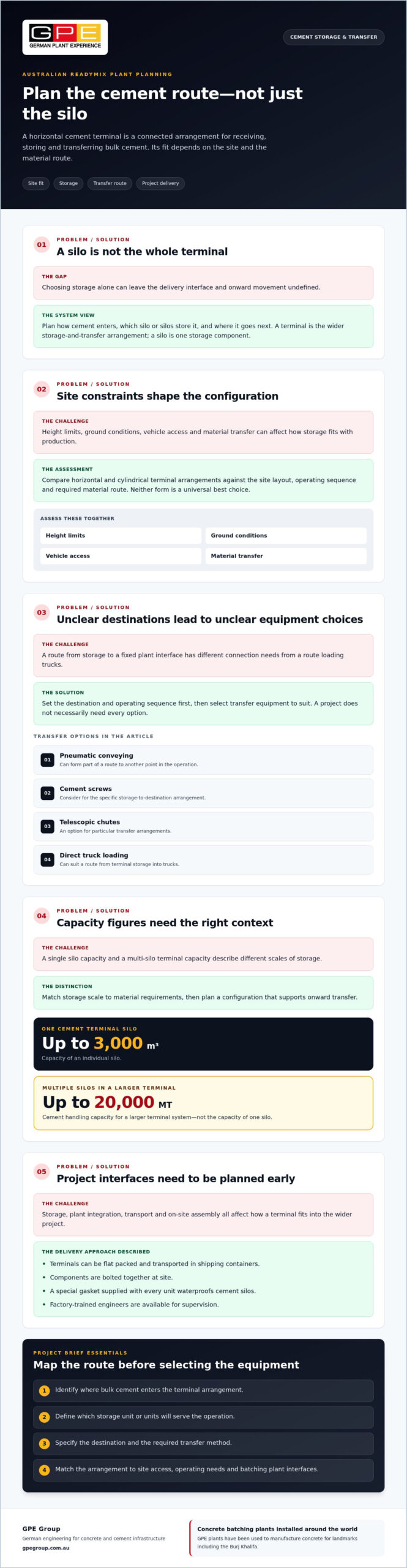
A horizontal cement terminal is a bulk-handling arrangement that receives cement, stores it in one or more silos and transfers it to its intended destination. A silo is a storage component; a terminal is the wider system planned around storage, material movement and operating interfaces. This distinction helps project teams establish whether they need additional storage alone or a coordinated terminal system.
In a readymix operation, the terminal connects bulk cement deliveries with the plant’s production process. Its configuration depends on where deliveries are received, where cement is stored and how it moves onward. Transfer equipment and connections should therefore be considered as part of the terminal design, not added as an afterthought once storage has been selected. For an overview of batching plant components and production systems, see Concrete plant.
Horizontal Terminal Versus a Standalone Cement Silo
A standalone cement silo provides storage. A terminal is assessed as a broader storage-and-transfer arrangement, which may include multiple storage units and equipment connecting delivery, storage and onward movement. A silo alone does not define how cement arrives or where it goes next.
Horizontal and cylindrical describe different terminal arrangements, not a universal hierarchy of performance. A horizontal configuration uses a lengthwise storage form, while a cylindrical arrangement uses cylindrical terminal silos. The right scope depends on the site layout, operating sequence and required material route. Cement silos are waterproofed by a special gasket supplied with every unit.
Where Cement Terminals Fit in Australian Projects
Cement producers, concrete manufacturers and other bulk-material operators may need infrastructure that connects cement receipt with storage and onward handling. A readymix plant must coordinate its cement supply interface with batching; a bulk-handling site may need a terminal serving a specific transfer destination. In both cases, start with the material-handling task, not simply the vessel shape.
This distinction matters when evaluating Concrete Batching Plant suppliers in Australia. A batching plant and a cement terminal are related parts of a project, but they perform different roles. GPE designs concrete batching plants as well as horizontal and cylindrical cement terminal systems tailored to bulk-material requirements. The terminal handles the storage and transfer infrastructure, not the cement itself. Defining its purpose early helps align storage scope with the plant layout and operating interfaces.
How Horizontal Cement Terminal Storage and Transfer Work Together
A cement terminal connects bulk delivery, storage capacity and transfer equipment to move cement along the route required by the operation. The material path may run from a delivery interface into one or more silos, then to a batching plant, another destination or a truck-loading point. Planning these stages together helps ensure the storage arrangement supports how cement is received and used.
Define the transfer route around the project’s operating needs and site interfaces. A readymix plant may need cement to move from terminal storage to production, while a bulk operation may need to load trucks for onward transport. Identify where material enters, where it must go and how the operation is organised. Storage capacity is only one part of the design decision.
Choosing a Transfer Route for the Project
GPE’s terminal options include pneumatic conveying, telescopic chutes, cement screws and direct truck loading. These serve different material routes, and a project does not necessarily require every option. Direct loading can suit a route from terminal storage into trucks, while pneumatic conveying can form part of a route to another point in the operation.
Telescopic chutes and cement screws are further options for specific transfer arrangements. Their role depends on the destination, layout and operating sequence. For example, a route between storage and a fixed plant interface has different connection requirements from a truck-loading arrangement. Evaluate Concrete Batching Plant suppliers in Australia in the context of how their proposed storage and transfer systems will integrate with the batching operation.
Before selecting equipment, map the route and record the key interfaces:
- Identify where bulk cement enters the terminal arrangement.
- Define which storage unit or units will serve the operation.
- Specify the destination and whether the route involves conveying, screws, chutes or truck loading.
- Match the transfer arrangement to site access and operating requirements.
Storage Scale and Terminal Configuration
Storage capacity should reflect the project’s material requirements, while the terminal configuration must provide a suitable path for onward transfer. An individual cement terminal silo can have a capacity of up to 3,000 m³. This is the capacity of a single silo, not the total handling capacity of a multi-silo terminal.
For a larger terminal, multiple silos can form a system handling up to 20,000 MT of cement. This figure describes a multi-silo terminal and should not be confused with the capacity of an individual silo. The appropriate scale and transfer configuration depend on the project’s bulk-material requirements and operating interfaces.
GPE applies German engineering to terminal systems designed around project requirements, connecting storage scope with the intended material route. Reviewing horizontal cement terminal solutions in this context can help define a system that brings delivery, storage and transfer needs together.
Comparing Horizontal and Cylindrical Cement Terminal Solutions
Horizontal and cylindrical cement terminals are alternative arrangements for bulk storage and handling. Neither is right for every project. The choice depends on how storage fits the site and how cement must move between delivery, storage and its destination. Comparing these interfaces early gives the project team a practical basis for defining the terminal scope.
Compare horizontal and cylindrical terminals against available space, the material route, access and the required operating arrangement. Use the factors below as a starting point. The final design should reflect the project’s specific bulk-material requirements.
| Comparison factor | Horizontal arrangement | Cylindrical arrangement |
|---|---|---|
| Site footprint | Assess the lengthwise space available and how storage aligns with site boundaries and plant interfaces. | Assess the space available for the selected cylindrical terminal arrangement and its connections. |
| Material route | Map delivery, storage and onward transfer around the proposed terminal position. | Define the same route, including how transfer equipment connects storage to its destination. |
| Access | Consider delivery vehicle access, loading interfaces and access around the installation. | Consider vehicle access and how operators reach the relevant delivery and transfer interfaces. |
| Operating arrangement | Set out how the terminal will support the site’s storage and transfer sequence. | Define how the cylindrical system will integrate with the operation and its material-handling sequence. |
When a Horizontal Arrangement May Suit the Site
Assess the usable area alongside the route between cement delivery, terminal storage and the transfer destination. A horizontal arrangement may be worth considering where site conditions make its configuration relevant, including some space-constrained or remote projects. Check vehicle access, connections and the operating sequence as well. Avoid basing the decision on assumed dimensions or a layout outcome before the site requirements have been assessed.
When to Compare a Cylindrical Terminal Arrangement
Compare a cylindrical terminal when the project’s layout and material route indicate that this form should be considered alongside a horizontal system. Review how each arrangement can connect delivery, storage and onward movement, then assess access and operating interfaces. GPE engineers both horizontal and cylindrical terminal systems for specific bulk-material requirements, applying German engineering to project-specific designs.
For readymix projects, terminal selection belongs within the wider plant plan, not in isolation. When comparing Concrete Batching Plant suppliers in Australia, consider how the proposed terminal integrates with the batching operation, delivery interface and site material route. For more on plant selection, see “How to Select a Concrete Batching Plant for a Major Infrastructure Project.”
Before choosing a configuration, document the available site area, delivery and transfer points, vehicle movements and operating sequence. This creates a consistent basis for comparing options without assuming that either terminal form is inherently cheaper, faster or more efficient. The engineering decision can then reflect the project’s actual interfaces and bulk-material requirements.
How to Assess a Horizontal Cement Terminal for an Australian Project
A structured assessment turns operational priorities and site information into a clear engineering brief. Before comparing configurations, document what the terminal must handle, where it will sit and how it will connect with the wider operation. Separate confirmed requirements from assumptions so the design process can address open decisions directly.
Define Material, Storage, and Transfer Requirements
Start with the cement flow required by the operation, the storage need and the intended transfer destination. Map the route from delivery access to the terminal and onward to the batching plant, truck-loading point or another project interface. Record vehicle access and site constraints alongside these requirements so the design team has a joined-up view of the proposed operation.
- Specify material needs. Describe the material to be handled, how it will be delivered and how it should move through the terminal.
- Establish storage needs. Define the storage scope in relation to the operation. Note which requirements are fixed and which remain estimates.
- Identify the destination. State where cement must go after storage and describe the connection required with the batching plant or other interface.
- Document the site. Record available space, delivery access, vehicle movements and the location of connected equipment.
- Separate requirements from assumptions. Mark confirmed project information and list unresolved design questions for engineering development.
Assess Site Constraints and Project Delivery
For a remote or space-constrained project, include access to the installation area and the relationship between the terminal and connected equipment in the initial assessment. This gives engineering a practical basis for adapting the arrangement to site conditions instead of relying on a generic layout.
Include transport, erection and commissioning in the delivery-scope discussion, and clarify project interfaces and responsibilities. GPE terminal systems can be flat packed and transported in shipping containers and bolted at site. Factory-trained engineers are always available for supervision. GPE can also source locally available components to support cost-effectiveness, with component selection based on project requirements.
For Australian readymix developments, assess the terminal alongside the wider batching project. GPE is a Concrete Batch Plant Manufacturer and Concrete Batch Plant Supplier, as well as a provider of concrete and cement infrastructure. Considering these systems together helps align the terminal brief with the batching operation. When evaluating Concrete Batching Plant suppliers in Australia, assess how the proposed equipment and project interfaces meet the requirements you have documented.
Once the brief covers material needs, site conditions and delivery responsibilities, the project team has a practical basis for design development. Review GPE’s horizontal cement terminal solutions to see how terminal requirements can be developed into a project-specific design scope.
GPE Horizontal Cement Terminal Engineering and Project Delivery
After establishing material flow, storage requirements, site interfaces and delivery scope, the next step is to develop a terminal configuration suited to the project. GPE Group designs horizontal and cylindrical cement terminal systems for bulk-material requirements, applying German engineering to storage and transfer. For a readymix development, the terminal is considered within the wider plant project, with interfaces defined according to how cement will be received and handled.
GPE has offices in Germany, Italy, Dubai and Australia, and installs all over the world. Its international project presence supports work across locations while keeping terminal design focused on each project’s documented requirements.
Engineering the Terminal Around Project Requirements
Terminal engineering begins with the required storage arrangement and the route cement must follow through the operation. Depending on the project, options include direct truck loading, pneumatic conveying, telescopic chutes and cement screws. These are configuration choices, not a fixed package. The selection is tailored to the material route, destination and operating interfaces.
Defining those interfaces early helps align the terminal with the wider readymix plant design. As a Concrete Batching Plant manufacturer and supplier serving Australian projects, GPE connects cement infrastructure considerations to the broader batching context while keeping the terminal scope focused on bulk handling. The delivery point, storage location and transfer destination inform the engineered arrangement.
Erection, Supervision, and Ongoing Support
Modular terminal systems are flat packed and transported in shipping containers, then bolted at site. This approach is part of the delivery plan, alongside transport, erection and commissioning interfaces. Cement silos are waterproofed by a special gasket supplied with every unit. Factory-trained engineers are always available for supervision during site erection.
GPE provides after-sales service and spare parts around the world. Define delivery scope and site responsibilities alongside the engineering brief so equipment interfaces and supervision needs are included in project planning. This gives the installation team a clearer understanding of how the terminal fits into the project and who is responsible for each interface.
Australian project teams can develop terminal requirements with GPE around material flow, storage needs and transfer destinations. Bringing these details together provides a practical basis for coordinating design and delivery stages.
Discuss your cement terminal requirements with GPE to turn your Australian project assessment into an engineered terminal solution.
Move From Project Brief to Defined Scope
A clear project brief gives design work a practical starting point. Bring together operating priorities, site information and stakeholder requirements, then identify which decisions are settled and which remain open. Assign responsibility for resolving open points so engineering discussions stay focused and the next planning stage can proceed with a clearer scope.
For companies assessing Concrete Batching Plant suppliers in Australia, consider how the cement terminal fits the wider readymix project and its planned operating model. Documenting the assumptions behind key decisions also helps the team evaluate design proposals consistently as requirements develop.
With the project priorities established, turn them into a concise engineering brief to guide design development and coordination. This provides a sound basis for advancing the terminal concept in line with the project’s needs.
Discuss a horizontal cement terminal for your project with GPE to take the next step towards a clearly scoped solution.
Frequently Asked Questions
What is a horizontal cement terminal, and how does it differ from a cement silo?
A silo is a storage component. A terminal is the wider installation planned around storage and material transfer, including the interfaces needed to receive cement and move it to its destination. When preparing a project brief, state whether the requirement is for additional silo storage or for a coordinated terminal arrangement, then describe the delivery and transfer points.
How does a horizontal cement terminal transfer cement to trucks or a batching plant?
The transfer arrangement depends on the destination and route. GPE’s terminal options include direct truck loading, pneumatic conveying, telescopic chutes and cement screws. To guide the design, identify where cement enters the system, where it must go and how the terminal will connect with the truck-loading point or batching plant.
Can a horizontal cement terminal be designed for a remote or space-constrained site?
Yes. GPE tailors terminal systems to specific bulk-material requirements, including projects with remote or space-constrained sites. Provide available site information, delivery access, installation-area constraints and the location of connected equipment. Include planned transport and site-installation arrangements so these can be considered during project coordination.
How much cement can a GPE terminal handle?
An individual cement terminal silo can have a capacity of up to 3,000 m³. Multiple silos can form a terminal system handling up to 20,000 MT of cement. When setting the design requirement, specify whether the figure refers to one silo or the terminal as a whole, and describe the project’s intended storage and transfer needs.
What should Australian buyers assess before selecting a cement terminal supplier?
Start with the supplier’s ability to develop a project-specific design from clear operating requirements. Document the material route, storage scope, site constraints and interfaces with the readymix operation. Then establish how engineering, transport, erection and commissioning will be coordinated, including responsibilities for site work and supervision.
Can local crews erect a cement terminal, and what supervision is available?
Yes. Cement silos can be erected by local crews, and factory-trained engineers are always available for supervision. Include crew responsibilities, the supervision scope and the sequence of site activities in the delivery plan so each party understands its role in the installation.
Does GPE provide after-sales service and spare parts for cement terminals in Australia?
Yes. GPE provides after-sales service and spare parts around the world, including for Australian projects. Keep equipment identification and installation records accessible so the relevant system and component requirements can be described clearly when arranging support.